Tsingy de Namoroka: Madagascar’s Forgotten Labyrinth of Stone
Nestled in the remote northwestern reaches of Madagascar, far from the well-trodden paths of its famous sibling, the Tsingy de Bemaraha, lies a hidden geological masterpiece: Tsingy de Namoroka National Park. Often overshadowed and less visited, this protected area offers an experience of raw, untamed wilderness, where limestone cathedrals pierce the sky and ancient forests harbor biological secrets found nowhere else on Earth. Known in Malagasy as Tsingy, meaning “where one cannot walk barefoot,” Namoroka’s razor-sharp karst formations form a labyrinthine world that challenges and rewards the intrepid explorer. This article delves into the park’s turbulent geological history, its unique and specialized flora and fauna, and the demanding circuits that unveil its stark beauty.
Part 1: A Land Forged in Stone and Water – The Geological History
The story of Tsingy de Namoroka begins not with a whisper, but with a cataclysm. Its landscape is the result of hundreds of millions of years of geological drama, a narrative written in limestone and sculpted by water.
The Jurassic Foundation: During the Middle Jurassic period, approximately 160-170 million years ago, this part of western Madagascar was submerged under a shallow, warm sea. Over millennia, the skeletons of countless marine organisms—shellfish, corals, and microorganisms—accumulated on the seabed, compressing under their own weight to form a massive, thick bed of limestone.
Uplift and Exposure: The colossal forces of plate tectonics began to lift this ancient seabed skyward during the Cretaceous period. This uplift exposed the limestone plateau to the atmosphere, initiating its transformation. This period of emergence was pivotal, setting the stage for the primary artist to begin its work: erosion.
The Sculptor: Water: The primary architect of the tsingy is water. Madagascar’s tropical climate, with its intense seasonal rainfall, provided the perfect conditions for karstification. Rainwater, slightly acidic from absorbing carbon dioxide in the atmosphere, percolated down into the limestone. It chemically dissolved the rock along natural fractures and fissures, gradually widening them into deep, vertical canyons known as grikes.
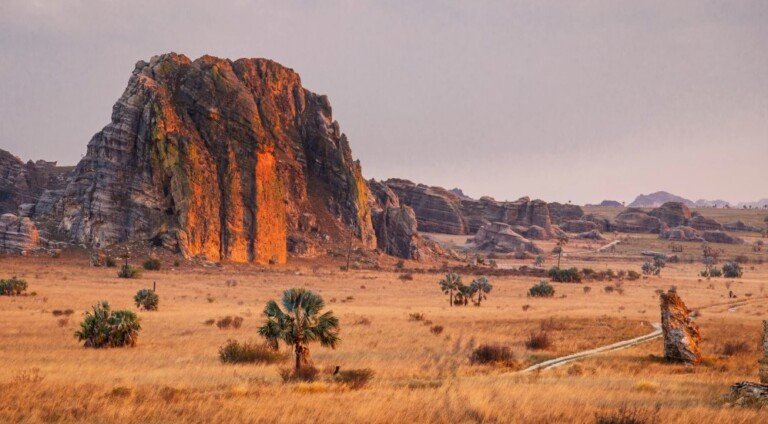
Simultaneously, the physical force of flowing water during the rainy season carved and scoured the surface, leaving behind the narrow, impossibly sharp pinnacles called lapiés or tsingy. This process, repeated over millions of years, created the park’s iconic and impenetrable forest of stone—a breathtaking, almost alien landscape of jagged grey spires that can tower over 100 meters high.
A Living Landscape: The geological evolution of Namoroka is not a relic of the past; it is an ongoing process. Erosion continues to shape the tsingy, subtly altering its form with every rainy season. This dynamic, ever-changing nature makes the park a living laboratory for the study of karst geomorphology.
Part 2: A Fortress of Life – The Unique Flora of Namoroka
The Tsingy is far more than a mineral world. Its harsh and isolated environment has functioned as a biological fortress, creating unique microclimates and driving the evolution of a flora that is both highly specialized and remarkably resilient. The park protects a mosaic of ecosystems, including dry deciduous forest, savannah, and the unique “tsingy” itself.
Life on the Razor’s Edge: The true marvel of Namoroka’s flora is its ability to thrive in the most inhospitable niches. Plants have adapted ingenious strategies to survive on the tsingy:
Lithophytes: Many species are lithophytes, meaning they grow directly on the bare rock. They possess incredibly deep or widespread root systems to seek out the scant pockets of soil and moisture trapped within the grikes.
Xerophytic Adaptations: To combat the arid conditions on the exposed pinnacles, many plants have evolved xerophytic traits, such as succulent leaves (for water storage), thick waxy cuticles (to reduce evaporation), and small or spiny leaves (to minimize surface area).
Notable and Endemic Plant Species:
The Madagascar Banana (Musa perrieri): This wild relative of the commercial banana is a rare and endemic species found in the sheltered grikes of the tsingy. It is considered a crucial genetic resource due to its resistance to certain Panama disease strains that threaten global banana crops.
Tapia Forest (Uapaca bojeri): On the plateaus surrounding the limestone massif, patches of Tapia forest thrive. This ecosystem is characterized by the Tapia tree, whose leaves are the sole food source for the wild silkworm (Landibe), supporting a traditional silk-harvesting industry for local communities.
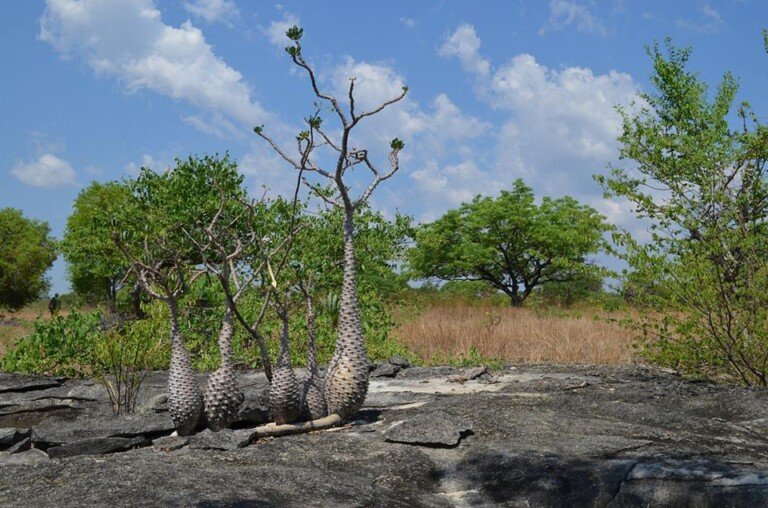
Pachypodiums and Aloes: The rocky outcrops are adorned with drought-resistant succulents like the fiery-flowered Madagascar aloe (Aloe capitata) and the bizarre, bottle-shaped Pachypodium species.
Orchids and Carnivorous Plants: The humid, shaded grikes create a perfect “reverse greenhouse” effect, fostering a lush undergrowth of ferns, mosses, and delicate orchids. In the nutrient-poor soil pockets, carnivorous plants like pitcher plants may also be found, supplementing their diet by trapping insects.
This specialized vegetation not only clings to life but creates a dense, green canopy that blankets the stone forest, hiding its sharp teeth from above and creating a world of contrasting beauty below.
Part 3: Evolution in Isolation – The Fauna of the Stone Forest
The Tsingy’s jagged terrain has acted as a spectacular natural sanctuary, isolating populations and fueling the engine of speciation. The animals here are not just residents; they are agile specialists, perfectly evolved to navigate this vertical, razor-sharp world.
Lemurs of the Limestone: The park is a stronghold for several lemur species, all of which have become master climbers.
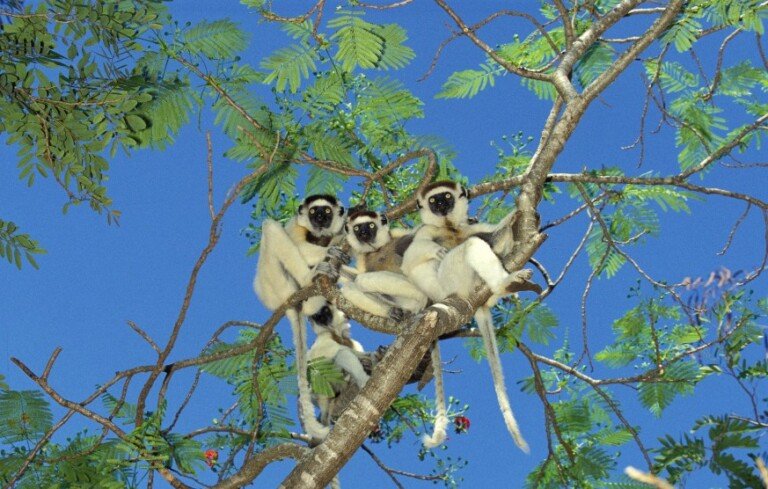
Decken’s Sifaka (Propithecus deckenii): This magnificent lemur, with its creamy-white fur and black face, is a star of Namoroka. It is breathtakingly agile, capable of making leaps of over 10 meters between the needle-sharp tsingy spires—a behavior that seems to defy both gravity and logic.
Grey Mouse Lemur (Microcebus murinus): These tiny, nocturnal primates find refuge in the deep grikes and tree hollows during the day, emerging at night to forage for insects and fruit.
Fat-tailed Dwarf Lemur (Cheirogaleus medius): Known for hibernating during the dry season, this lemur survives by storing fat in its tail.
Sanford’s Brown Lemur (Eulemur sanfordi): Often seen in larger groups, these lemurs traverse the forest canopy and the edges of the tsingy formations.
Reptiles and Amphibians: The tsingy is a haven for herpetofauna, boasting a high number of endemics.
*Namoroka Leaf Chameleon (Brookesia sp.):* This region is likely home to a dwarf chameleon of the Brookesia genus, perfectly camouflaged to look like a dead leaf on the forest floor.
Various Geckos (Paroedura, Phelsuma): The rocky surfaces are patrolled by numerous gecko species, including day geckos (Phelsuma) that bask on sun-warmed rocks and nocturnal species that hunt insects in the grikes.
Snakes: The park is home to harmless and endemic snake species like the Madagascar tree boa (Sanzinia madagascariensis).
Birds: Over 80 species of birds have been recorded, including many endemics.
Madagascar Fish Eagle (Haliaeetus vociferoides): This critically endangered raptor can sometimes be seen soaring over the park’s waterways.
Coquerel’s Coua (Coua coquereli) and Crested Coua (Coua cristata): These charismatic, terrestrial birds are common sights on the forest floor.
Vangas and Ground-Rollers: The forests echo with the calls of endemic bird families like the hook-billed vangas and the short-legged ground-rollers.
Invertebrates: The tsingy is also a world of miniature wonders, with a vast array of endemic insects, spiders, and the iconic Madagascar hissing cockroach.
Part 4: Conquering the Labyrinth – Trekking Circuits in Namoroka
Exploring Tsingy de Namoroka is a physical challenge that requires good fitness, sturdy gear, and the guidance of a local park guide. The circuits are not paved trails but adventurous routes that involve climbing, squeezing, and scrambling.
The Essential Guide: Hiring an official guide from Madagascar National Parks (MNP) is non-negotiable. Their expertise is crucial for navigation, safety, and unlocking the secrets of the ecosystem. Porters can also be hired to carry gear, which is highly recommended.
Classic 2-3 Day Circuit: This is the standard way to experience the core of the park, typically starting and ending at the park entrance near the village of Soalala.
Day 1: Enter the park and trek to the base of the Great Tsingy. The hike involves traversing dry deciduous forest, offering your first glimpses of the limestone massif. Set up camp at a designated site and take an afternoon walk to a viewpoint for a stunning sunset over the stone forest.
Day 2: The Tsingy Ascent. This is the main event. With the help of ladders and fixed ropes (via ferrata style), you will ascend into the heart of the pinnacles. The trek involves navigating narrow ledges, crossing natural rock bridges, and descending into deep, cool grikes. The reward is a panoramic view from the top—an endless sea of jagged grey stone. The afternoon may involve exploring the Antsingy Cave or the dramatic Canyon des Rats.
Day 3: Trek out of the park via a different route, perhaps passing by sacred caves or waterfalls, returning to the park entrance by midday.
Specialized Circuits and Activities:
The Canyon des Rats: This is a spectacular, water-carved canyon that slices through the tsingy, creating a cool, shaded oasis. Hiking through it is a highlight of any visit.
Caving: The park contains several caves, some of which hold archaeological significance with evidence of past human habitation.
Birdwatching Treks: Specific circuits can be tailored for avid birdwatchers seeking the park’s endemic species.
Preparation and Practicalities:
Best Time to Visit: The dry season (April to November) is essential. The park is completely inaccessible during the rainy season.
Fitness Level: A good level of fitness and agility is required. There are no easy walks.
What to Pack: Sturdy, ankle-supporting hiking boots are non-negotiable. Also pack: tough work gloves, a headlamp, long pants and long-sleeved shirts for protection against the sharp rock, a wide-brimmed hat, all your own water and purification tablets, and a high-quality sleeping bag for cool nights.
Access: Reaching Namoroka is an expedition in itself. It requires a long, arduous 4×4 journey from Mahajanga or **Morondava**, often taking two full days of driving on very rough tracks. This isolation is what has preserved its pristine nature.
Conclusion: The Ultimate Reward for the Intrepid
Tsingy de Namoroka National Park is not for the casual tourist. It is a destination for the dedicated adventurer, the passionate naturalist, and the curious geologist. It demands physical effort, logistical planning, and a spirit of exploration.
The rewards, however, are immeasurable. It offers a profound sense of discovery and solitude that is increasingly rare in the world. To stand atop a limestone pinnacle and see an untouched wilderness of stone and forest stretching to the horizon is a humbling and unforgettable experience. It is a journey to the heart of Madagascar’s wild, ancient soul—a chance to walk through a geological timeline and witness evolution unfolding in a fortress of rock.