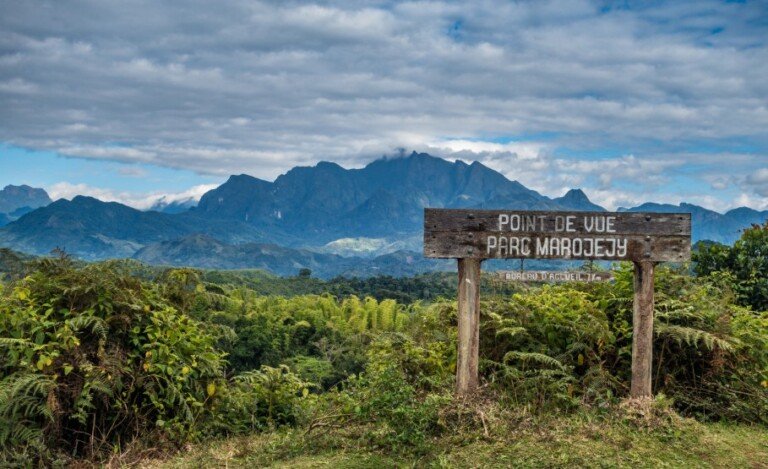
Ankarana National Park, located in the Diana region in the extreme north of Madagascar, is one of the island’s most spectacular and enigmatic natural sites. Renowned for its immense tsingy massifs, mythical caves, underground rivers, and exceptional biodiversity, Ankarana offers a unique experience blending adventure, mystery, and raw beauty. It is one of the few places in the world where such a vast karst massif is still perfectly preserved, unveiling a landscape that seems straight out of another era.
Halfway between the port city of Antsiranana (Diego Suarez) and the cocoa plantations of Ambanja, the park covers over 18,000 hectares—a true mineral labyrinth where every step reveals a new surprise. Between its dry forests, steep cliffs, natural bridges, lemurs, bats, and still-unexplored depths, Ankarana is one of Madagascar’s most fascinating natural sanctuaries.
1. General Presentation and Geological Importance
The Ankarana massif is an ancient limestone plateau dating back to the Jurassic period. Over millions of years, erosion caused by water, wind, and earth movements has sculpted a spectacular karst formation: the famous tsingy, sharp rock needles characteristic of certain Malagasy regions. Unlike the Tsingy de Bemaraha, which forms a massive and uniform plateau, the Ankarana tsingy are more fragmented, alternating with wooded valleys, underground rivers, and canyons.
The park also contains one of the most important underground networks in Africa. The caves of Ankarana extend for over a hundred kilometers, including rivers, gigantic chambers, stalactites and stalagmites, as well as passages that served as refuges for the Antankarana people during historical conflicts.
This geological diversity is one of the main reasons why Ankarana is considered a scientific jewel. The karst relief, combined with a resilient dry forest, creates multiple microclimates allowing for the coexistence of extremely specialized endemic species.
2. Remarkable Biodiversity
Despite the seemingly austere environment presented by the tsingy, Ankarana harbors astonishing biodiversity.
Lemurs
The park is home to more than ten species of lemurs, including:
- The Crowned Lemur (Eulemur coronatus), emblematic of the region.
- Perrier’s Sifaka (Propithecus perrieri), one of the most threatened lemurs in the world.
- The Brown Lemur (Eulemur fulvus).
- The Northern Rufus Mouse Lemur, a small nocturnal primate.
Lemurs are relatively easy to observe, especially at sunrise or sunset, or in the wooded areas bordering the tsingy.
Reptiles and Amphibians
The park is home to several endemic species, including:
- Miniature chameleons in the forest zones.
- Brightly colored day geckos.
- Non-venomous snakes, often encountered in wetland areas.
- Several species of frogs adapted to rock cavities.
Bats
The caves of Ankarana are famous for hosting impressive colonies of fruit-eating and insect-eating bats. Among the most remarkable are the giant fruit bats, whose wingspan can reach one meter.
Birds
The park is an excellent spot for birdwatching: drongos, couas, flycatchers, falcons, endemic parrots, and kingfishers frequent the wetlands and open forests.
Aquatic Fauna
The underground rivers harbor blind fish, a biological rarity due to their evolution in total darkness. This adaptation gives the park particular scientific importance.
3. How to get to Ankarana National Park
Ankarana is relatively accessible despite its location in a fairly isolated zone of northern Madagascar.
Main Departure Point: Antsiranana (Diego Suarez)
The city of Antsiranana is located about 100 kilometers from the park. You can get there:
- by domestic flight from Antananarivo,
- by road from Ambanja,
- via organized tours.
Route Antsiranana – Ankarana
National Road 6 (RN6) connects Antsiranana to the park. The road is paved but sometimes shows deterioration, especially during the rainy season.
Travel time: between 2 and 3 hours.
Access from Ambanja or Ankify
Travelers coming from Nosy Be or the Ambanja region can reach Ankarana by also taking the RN6. The journey takes between 3 and 4 hours depending on road conditions.
Recommended Transport
Access is easy by car or 4×4. Bush taxis (taxi-brousse) run on this route, but they are slower and less comfortable. To visit the park itself, having an official guide is mandatory.
4. Best Time to Visit Ankarana
The climate in the north is tropical, with a dry season and a wet season.
Dry Season (April to November)
This is the best time to visit the park. The trails are passable, the caves are accessible, the climate is pleasant, and conditions are ideal for hiking.
Wet Season (December to March)
During this period:
- many tracks become impassable,
- some caves are flooded,
- humidity makes the tsingy slippery and dangerous.
Although the park remains open, visiting is much less recommended.
5. Main Sites to Discover in the Park
Ankarana National Park is full of spectacular natural sites. Here are the most famous ones.
The Tsingy Rary
The most emblematic sector, consisting of sharp limestone needles stretching as far as the eye can see. An impressive natural bridge allows visitors to cross part of the massif, offering spectacular views of the surrounding canyons.
The Sacred Caves
Several caves have strong cultural value for the Antankarana people. They formerly served as shelters during wars and sometimes contain royal tombs.
Among the best known:
- the Bat Cave,
- the Cave of the Great King,
- the Underground River Cave.
The Underground River of Ankarana
One of a kind, it snakes for several kilometers under the rock before resurfacing in the open air. It is accessible in certain areas on foot or by following specialized guides. Blind fish can be observed in these dark waters.
The Canyons
The park possesses several impressive canyons, including the Yellow Canyon and the Red Canyon, where ochre colors contrast beautifully with the surrounding forests.
The Dry Forest
On the outskirts of the tsingy, the dry forest is home to numerous lemurs and birds. The trails crossing this area are easier and suitable for all levels.
The Green Lake and the Blue Lake
Two small isolated bodies of water in the heart of the park, often considered sacred, take on astonishing colors depending on the light.
6. Activities and Itineraries in the Park
Ankarana offers a variety of circuits adapted to different levels of physical fitness.
Hiking
Hiking is the main activity. Trails vary from easy to very technical.
Wildlife Observation
Lemurs, birds, and bats are the easiest to observe.
Cave Exploration
Accompanied by a guide, it is possible to visit several caves, often on secured routes. Some require a headlamp and good physical condition.
Cultural Discovery
Certain caves and areas of the park are linked to the history of the Antankarana kingdom. Locals willingly tell local legends surrounding these sacred places.
Photography
The play of light on the tsingy, canyons, rocky slopes, and caves offers spectacular scenes for photographers.
7. Accommodation and Services
The park has a well-equipped main entrance, with a reception, a guide office, and itinerary maps.
Nearby Accommodation
Several options are available to visitors:
- small lodges in the immediate vicinity of the park entrance,
- hotels in Ambilobe or Ambanja,
- more comfortable accommodations in Diego Suarez.
These lodges are often simple but well-suited for travelers.
Guides
The presence of an official guide is mandatory for safety reasons. The massif can be confusing, and some zones are dangerous without accompaniment. Guides know the places perfectly, the safe passages, the accessible caves, and the areas inhabited by lemurs.
8. Practical Tips for Visiting Ankarana
Here are some useful recommendations for a successful visit.
- Wear sturdy shoes.
The tsingy are sharp and the trails sometimes irregular. - Bring enough water.
Temperatures can be high, especially in open areas. - Use sun protection.
A hat, sunscreen, and covering clothing are essential. - Take a headlamp.
Necessary for visiting the caves. - Avoid touching limestone formations.
They are fragile and can break easily. - Respect sacred areas.
Some caves require specific attire or respectful behavior according to local traditions.
9. Why Visit Ankarana?
Ankarana National Park is an ideal destination for travelers looking for a mix of geological beauty, biodiversity, and adventure. Its ease of access, compared to other more remote parks, makes it an unmissable stop in northern Madagascar.
Ankarana offers:
- exceptional landscapes found nowhere else,
- one of the most complex karst networks in the world,
- abundant and easy-to-observe wildlife,
- complete immersion in wild nature,
- a strong cultural dimension linked to Antankarana traditions,
- itineraries suitable for both amateurs and experienced adventurers.
Isolated but accessible, wild but safe, mysterious but welcoming, Ankarana National Park is a true gateway to the mineral soul of Madagascar.