
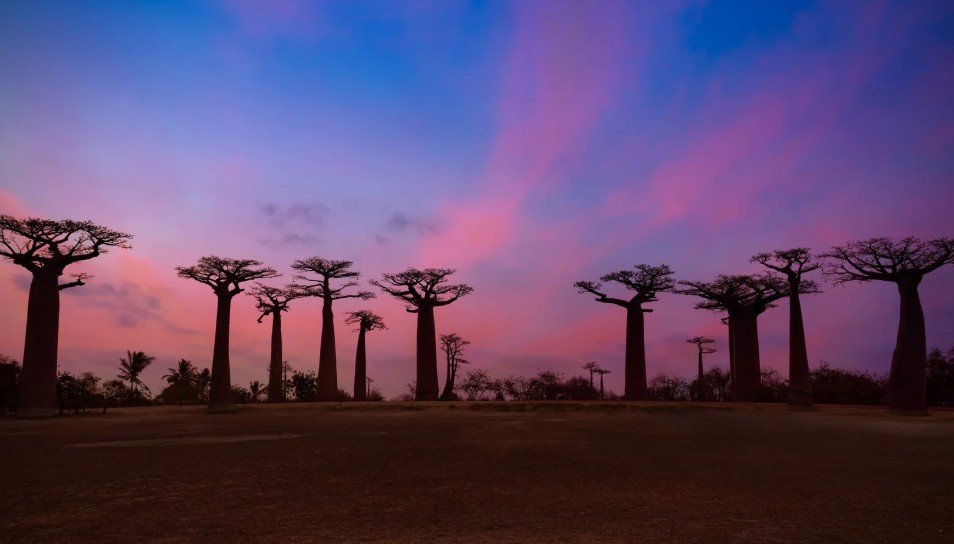
You’ll feel it before you see it – the road turns sandy, the horizon widens, and the light starts to soften as if someone quietly lowered the volume on the day. Then the first baobab appears like a monument dropped into the landscape, followed by another, and another, until you’re driving through a living corridor of giants.
That’s the heart of a baobab avenue sunset tour: not just “a sunset,” but a carefully timed moment in western Madagascar when the world-famous Avenue of the Baobabs looks almost unreal. It’s also one of those experiences that’s easy to under-plan. Get the timing or logistics wrong and you’ll still see baobabs – but you might miss the color, the calm, and the photographs you came for.
Why sunset on Baobab Avenue is the moment that matters
The Avenue of the Baobabs sits near Morondava on Madagascar’s west coast, where the land is flat and the sky is huge. Baobabs already have a sculptural presence in full daylight, but at sunset they turn into silhouettes with edge-lighting, their trunks and branches outlined in gold and copper.
The trade-off is simple: sunset is the most dramatic time and also the busiest. If you want a quieter experience, you can prioritize sunrise or a daytime visit and accept less cinematic light. If you want the iconic scene – the one you’ve seen in magazines and travel films – sunset is the strongest bet.
There’s another reason sunset works so well here: the setting is open, with very few obstacles to block the horizon. When conditions line up, you get long, clean rays across the dirt road, warm backlight on the trees, and reflections in seasonal puddles that can double the drama.
What a baobab avenue sunset tour usually looks like
Most travelers base themselves in Morondava and head out in the late afternoon. The drive is part of the experience. Depending on your exact start point and road conditions, you’ll spend roughly 30 to 60 minutes getting there.
A well-paced outing isn’t a quick stop-and-go. You want enough time to explore the main avenue on foot, try different angles, and let the light change. Sunset light shifts fast in the tropics – the scene can go from bright to fiery to pastel to twilight in less than an hour.
Many tours also include nearby baobab viewpoints, not because the Avenue itself needs “extras,” but because the surrounding area offers different compositions: clusters of trees, open fields, and sometimes a more peaceful spot to watch the sun drop if the central avenue is crowded.
Once the sun is down, most people stay through blue hour – that short window when the sky deepens and the silhouettes become even cleaner. Then it’s back to Morondava for dinner.
Timing: the difference between a good visit and the unforgettable one
For sunset, arriving early matters. Not “ten minutes early,” but early enough to walk, scout, and settle in.
Plan to be on site at least 60 to 90 minutes before sunset. That gives you time to:
- Walk the road slowly and choose your favorite groupings of trees
- Photograph in softer pre-sunset light (great for color and texture)
- Set up for silhouettes as the sun approaches the horizon
If you arrive right at sunset, you’ll be shooting in a rush, often from the most obvious roadside spots, surrounded by the same crowd with the same idea.
Season also changes the feel. In the drier months, dust can add atmosphere but can also haze the sun. In the wetter season, clouds can either ruin the last light or turn it into a full sky show. It depends – and that uncertainty is exactly why having flexibility in your schedule is valuable.
What you’ll actually see (and what surprises people)
The Avenue of the Baobabs is striking, but it’s not a fenced park with a visitor center and curated paths. It’s a working landscape. You may see locals walking home, zebu carts moving along the road, children playing, and everyday life unfolding beside one of Madagascar’s most photographed places.
For many visitors, that’s the surprise: it feels real, not staged. The best tours respect that reality. That means not treating people as props, not blocking the road, and not creating pressure around photos.
You’ll also notice the baobabs themselves are different. Some are thick and ancient-looking, others slimmer, some with dramatic branching shapes that look upside down. The variety is part of the magic – the avenue is a collection of personalities, not identical trees lined up for effect.
Photo tips that match the way the light behaves here
You don’t need pro gear to come away with great images, but you do need a plan for light and movement.
First, expect contrast. At sunset, the sky can be bright while the trees go dark fast. If you’re using a phone, tap to expose for the sky to hold color, then take a few variations. If you’re using a camera, consider underexposing slightly to protect highlights.
Second, move your feet. The classic shot is centered down the road, but some of the most memorable photos come from stepping off to the side (respectfully) and using a single baobab as a subject with open sky behind it.
Third, stay for the last ten minutes after the sun disappears. That’s when the sky often turns smooth and saturated, and the silhouettes become clean and graphic.
Finally, be realistic about tripods. They can be useful in low light, but the road can be busy and the ground uneven. If you bring one, keep it compact and be ready to pack it quickly if conditions change.
Comfort, safety, and the reality of the road
Western Madagascar is beautiful, but it’s not “plug-and-play.” Roads can be rough, dust is common, and travel times can vary.
Wear closed-toe shoes you don’t mind getting sandy. Bring water. If you’re sensitive to dust, a light scarf or buff helps on the drive. For bugs, a small amount of repellent is usually enough, especially after the sun goes down.
As for safety, the main thing is to travel with a plan and avoid improvising late-night transport. Sunset is, by definition, the time you’ll be returning in the dark. A private vehicle and an experienced driver remove a lot of stress from that equation.
How to choose the right tour style for you
A baobab avenue sunset tour can be done in different ways, and the “best” option depends on what you care about most.
If photography is your priority, you’ll want a departure time that’s built around light, not convenience. You’ll also want enough time on site to explore beyond the first viewpoint.
If you’re traveling as a couple or small group, a private outing gives you more control over pacing. You can linger when the sky lights up, or shift spots when you see a better angle.
If you’re trying to fit the Avenue into a bigger west coast itinerary (like continuing toward Kirindy Forest for nocturnal wildlife, or building a cross-island route), you’ll want someone to coordinate timing so you’re not choosing between sunset and a long, exhausting transfer.
This is where local ground handling becomes the difference between “we went” and “we experienced it.” On-the-ground operators can adjust for road conditions, seasonal changes, and the realities of Morondava’s rhythm.
If you want a sunset visit that fits smoothly into a wider Madagascar plan, we can build it into a private itinerary through Travelers of Madagascar – the same local team that coordinates drivers, guides, and hotels across the country.
Common add-ons (and when they’re worth it)
Many travelers pair the Avenue with Kirindy Forest Reserve. That combination makes sense because Kirindy is one of the best places to look for nocturnal wildlife, including Madagascar’s iconic predators and a range of lemurs and reptiles. The timing can be excellent: baobabs at golden hour, then wildlife after dark.
The trade-off is distance and energy. If you try to do too much in one evening, you may rush the Avenue or arrive late and tired for the forest walk. It can work beautifully with the right schedule, but it’s not the best choice for everyone.
Another option is adding time for the “love baobab” and nearby clusters outside the main avenue. These can be quieter and sometimes give you a stronger sense of space.
What to bring (without overpacking)
Think light and practical. You’ll want a small day bag with water, a light layer for the drive back, and your camera or phone fully charged. If you’re shooting a lot, bring a spare battery or a power bank. A headlamp can be helpful after sunset, but your driver’s vehicle lighting will typically cover the basics.
Skip anything that slows you down on foot. The best moments happen when you can move quickly to catch the last light.
A final word on expectations
The Avenue of the Baobabs is famous for a reason, but the sunset isn’t a guaranteed performance. Some nights the sky is clear and quiet. Other nights clouds catch fire. Sometimes dust softens everything into a dream. You’re not buying a postcard – you’re showing up for a real place at a real hour.
If you give yourself time, keep your schedule flexible, and let the light do what it wants, the avenue has a way of meeting you halfway – and sending you back to Morondava with that rare feeling that you didn’t just see Madagascar, you felt it.