
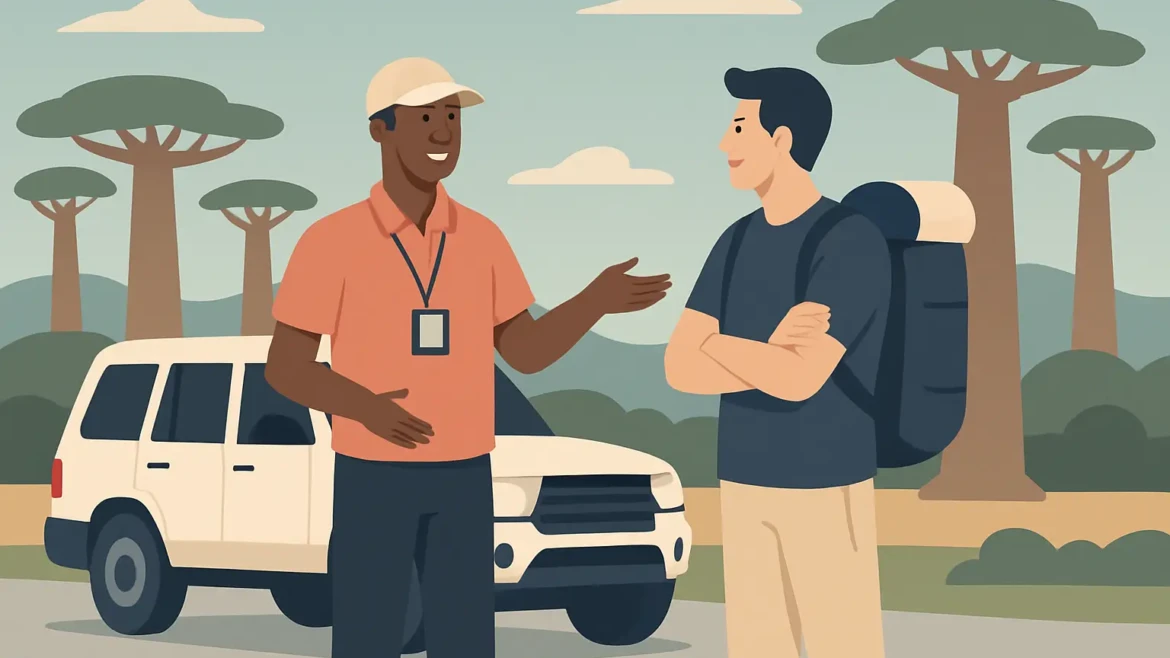
A paved highway can turn to rutted laterite without warning. A “two-hour” drive can stretch into half a day when the rains hit, a bridge is out, or a zebu cart decides it owns the road. That’s Madagascar in a nutshell: magnificent, unpredictable, and absolutely worth the effort – as long as your logistics are built for reality.
For most US travelers planning a multi-day route here, the single best decision you can make is choosing the right madagascar private driver and guide. Not because you can’t travel independently, but because distances, road conditions, local languages, park rules, and timing all stack the odds against a smooth DIY trip. When your goal is to see lemurs in rainforest canopies, walk through baobab country at golden hour, or reach a remote tsingy without losing a day to avoidable friction, the right team changes everything.
What a Madagascar private driver and guide actually do
In Madagascar, “driver” and “guide” can mean very different things depending on where you are. Sometimes one person does both. Often, you’ll have a dedicated driver for the road plus local guides inside national parks and reserves (which is frequently required). The best trips coordinate these roles so the handoffs are seamless and you don’t spend your vacation negotiating the basics.
A strong private driver is more than someone holding a steering wheel. They know which stretches crater after storms, where fuel can be scarce, when police checkpoints are routine, and how to time arrivals so you’re not hunting for a hotel room at dusk. They also know how to drive Madagascar’s roads defensively – trucks overtaking on blind curves, scooters without lights, livestock appearing out of nowhere.
A great guide adds a completely different layer. Madagascar’s wildlife is famously cryptic: geckos that look like bark, chameleons the size of your thumb, nocturnal lemurs you will not spot without practiced eyes and a good spotlight. Guides also translate culture as you move through highland villages, coastal towns, and market stops, helping you understand what you’re seeing instead of just passing through it.
When it’s worth it (and when it depends)
If your itinerary is more than a couple of days and involves cross-country drives, a private driver and guide is usually worth it. The trade-off is cost versus control, but Madagascar is a destination where “control” can become an illusion once you’re on the ground.
It’s especially worth it if you’re trying to connect regions like Antananarivo to Andasibe, then down toward Ranomafana, Isalo, and the southwest coast, or if you’re doing classic highlights such as the Avenue of the Baobabs and Tsingy de Bemaraha. These routes are stunning – and logistically demanding.
It depends if you’re staying in one place (like a beach base on Nosy Be or a single rainforest lodge near Andasibe) and only want a few structured day trips. In that case, you might be fine arranging transfers plus local guiding per excursion. It also depends on your comfort with uncertainty. Some travelers love improvisation. Others want their energy spent on hikes, wildlife, and sunsets, not on re-routing around a washed-out section of road.
What to expect day to day on a private trip
A well-run day starts early. That’s not a rigid “tour schedule” thing – it’s a Madagascar thing. Wildlife is more active in the morning, roads are calmer, and arriving before late afternoon gives you buffer for surprises.
Your driver handles the rhythm: when to stop for fuel, when to take the safer road variant, where bathrooms are realistic, and where you can actually eat without rolling the dice. Your guide (or your driver-guide if combined) keeps the experience human: translating conversations, arranging park tickets, coordinating local park guides, and setting expectations honestly when conditions change.
You’ll also notice something that’s hard to price: mental bandwidth. When you’re not the one navigating, negotiating, or troubleshooting, you start seeing Madagascar differently. You notice the rice terraces and the red-earth hills. You stop for a roadside fruit stand because it looks interesting, not because you’re lost.
Safety, comfort, and the “remote destination” factor
Madagascar is safe to travel with the right planning, but it is remote in the sense that services can be far apart and problems don’t always have quick fixes. A flat tire can be an inconvenience or a half-day derailment depending on who you’re with.
A vetted private driver usually travels with practical readiness: knowing tire repair basics, carrying essentials for long stretches, and understanding where mobile signal disappears. A good guide will also help you avoid the most common traveler mistakes, like arriving to a park too late for entry, underestimating driving times, or assuming ATMs will be available everywhere.
Comfort matters too. Long drives are part of Madagascar’s magic – you earn the landscapes – but comfort determines whether those drives feel like adventure or punishment. The condition of the vehicle, the spacing of stops, and the driver’s pacing make an outsized difference.
The hidden value: wildlife and culture you’d otherwise miss
Madagascar is not a place where you simply “walk into the forest and see lemurs.” Many species blend into foliage or move high in the canopy. Night walks reveal a second world entirely: mouse lemurs, sleeping chameleons, frogs that look unreal.
This is where guide quality is everything. A skilled naturalist guide doesn’t just point. They interpret – why a sifaka’s territory matters, how a baobab stores water, what the calls in the canopy mean, why a specific leaf shape signals a certain micro-habitat.
Culturally, a guide helps you engage respectfully and comfortably. Madagascar has deep traditions around family, community, and local customs (including regional taboos, or fady). You don’t need to memorize rules ahead of time, but you do want someone who can quietly steer you away from awkward missteps and toward genuine, welcome interactions.
Cost realities: what you’re paying for
Prices vary widely based on season, route, vehicle type, number of travelers, and whether guiding is included throughout or only in parks. It’s tempting to compare day rates as if they’re identical products. They’re not.
When you pay for a private driver and guide, you’re paying for time, local expertise, vehicle quality, planning, and risk management. Cheap options sometimes cut corners in the places you feel most on long routes: maintenance, comfort, and contingency planning.
The best way to think about value is trip outcome. If a strong team helps you keep a 12-day itinerary on track, gets you to the right trailheads at the right times, and turns “we’re stuck” moments into “we adjusted” moments, you feel it in the overall experience.
How to choose the right team (without overthinking it)
Start by matching the team to your route. A simple Antananarivo-Andasibe loop is different from a cross-island itinerary that mixes rainforests, highlands, desert-like formations, and beaches. Ask who has done your exact arc recently, not just “worked in tourism.”
Then ask about the vehicle in plain terms: what model, what condition, what luggage capacity, and what happens if there’s a breakdown. You’re not being difficult – you’re being realistic.
Finally, test communication. If you’re getting vague answers before you arrive, that doesn’t usually improve once you’re on the ground. Madagascar rewards clear planning. The good news is that a professional operator can make the process feel calm even when the destination is wild.
Red flags to watch for
If you hear guaranteed drive times that sound too good to be true, treat that as a warning. Madagascar is not a place for rigid promises about road speed.
Another red flag is a lack of clarity around guiding. Some sellers imply you’ll have a naturalist with you everywhere, then you discover on arrival that you only have a driver and must hire separate park guides each time. That can be fine if it’s transparent, but it shouldn’t be a surprise.
Also be cautious if the vehicle details are brushed off or if the plan relies on long night drives. Night driving increases risk and reduces the joy – you miss the landscapes and arrive tired.
What a well-designed itinerary feels like
The best private trips in Madagascar have a certain texture. The days are full, but not frantic. Drives are long, but spaced with meaningful stops. You arrive with enough daylight to take a short walk, watch sunset, or simply breathe. Parks are chosen for variety: a rainforest for indri calls, a dry forest for different lemurs and birds, a canyon or massif for landscapes, then water and sand to reset.
That balance is hard to achieve if you’re building from scratch without local feedback. It’s not about packing in the most places. It’s about sequencing regions so the road effort pays off in experiences.
If you want that kind of custom pacing with vetted drivers and strong local coordination, Travelers of Madagascar plans private routes built around wildlife, landscapes, culture, and beach time, with on-the-ground execution handled by a team that lives here: https://travelersofmadagascar.com.
Closing thought
Madagascar doesn’t ask for perfection from travelers – it asks for preparedness and curiosity. Choose a private driver and guide who respect both, and you’ll spend less time managing the map and more time meeting a living world found nowhere else on Earth.