
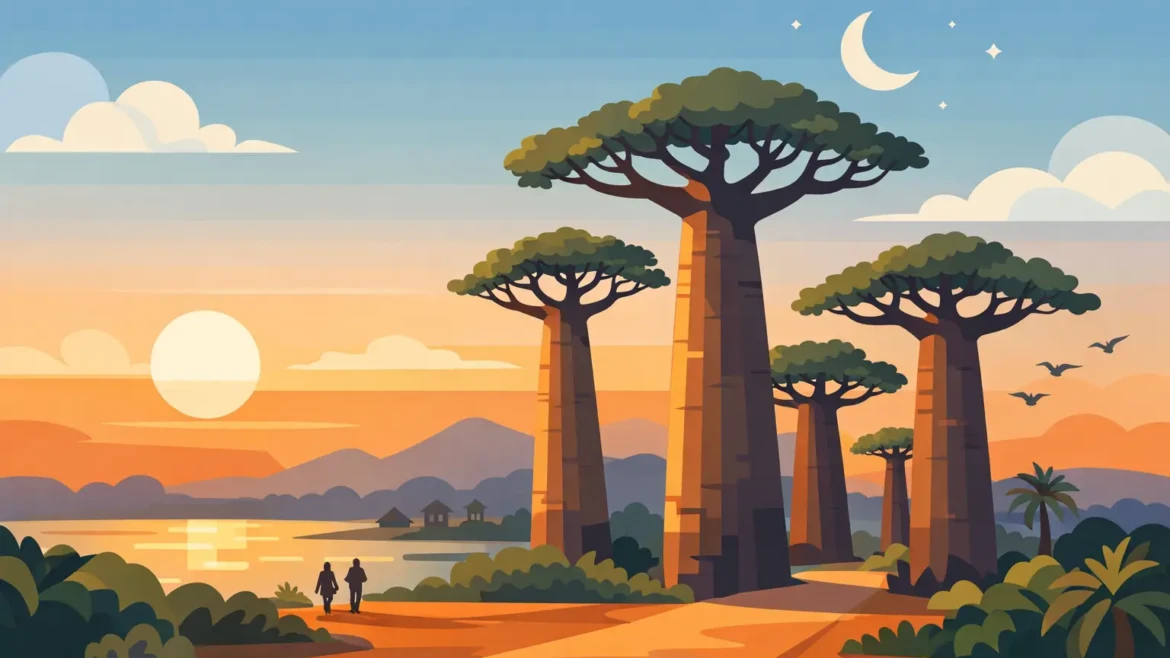
The first time you see the avenue at the right hour, the scale feels almost unreal. Trunks rise like pillars from the red earth, the light turns gold, and for a few minutes the landscape gives you exactly what people travel across the world to find in Madagascar – something found nowhere else in quite the same way. If the ruta de baobabs madagascar is on your list, timing and logistics matter more than most travelers expect.
This is not a stop you want to squeeze in casually between long road transfers. The Baobab Avenue near Morondava is one of Madagascar’s most iconic landscapes, but it sits within a part of the country where distances are long, roads can be slow, and weather changes the experience. Done well, it becomes a genuine highlight of a western Madagascar itinerary. Done poorly, it can feel rushed, dusty, and overcomplicated.
What the ruta de baobabs Madagascar really is
Despite the name many travelers use, the “route” is less a long scenic drive and more a specific, memorable stretch of road lined with towering Grandidier’s baobabs. It lies northeast of Morondava, in western Madagascar, and is best known for late-afternoon light when the silhouettes become dramatic against the sky.
What makes it special is not only the trees themselves, but the setting. This is not a manicured park or a fenced viewpoint. It is a living landscape shaped by local villages, agriculture, and the remnants of a much wider dry forest ecosystem. The famous photographs are real, but they show only one side of the place. On the ground, the avenue feels both monumental and fragile.
That matters for travelers because expectations should be accurate. You are going for a short but powerful experience, not a full-day attraction with lots of infrastructure. The value comes from seeing it in the context of a broader route through western Madagascar.
Best time to visit the ruta de baobabs Madagascar
For most travelers, the dry season offers the best conditions. Roughly from May to October, roads are generally easier, skies are clearer, and travel planning is more reliable. This is the period when many private itineraries to western Madagascar run most smoothly.
June through August often brings crisp light and comfortable travel conditions, though evenings can feel cooler than some visitors expect. September and October are also strong months, especially if you want dry landscapes and dramatic sunsets. The trade-off is that the heat can build later in the year.
The rainy season, usually from November into April, can still be beautiful, but it adds uncertainty. Road conditions around western Madagascar can deteriorate quickly, overland journeys may take much longer, and some combinations with other remote parks become less practical. If your trip depends on tight timing, domestic flights, and multiple road sectors, that extra uncertainty is worth taking seriously.
Sunset is the classic hour for a reason. The late light brings out the shape of the trunks and gives the avenue its most striking color. Sunrise can be rewarding too, with fewer people and softer light, but for first-time visitors we usually find sunset leaves the strongest impression.
How to get there without making the trip feel hard
Most travelers reach the Baobab Avenue from Morondava. That town is the natural gateway and the place where you typically overnight before or after your visit. From there, the drive is manageable, but “manageable” in Madagascar does not mean effortless. Travel times are often dictated less by mileage than by road surface, traffic through town, and the general rhythm of travel in a remote destination.
For US travelers used to building trips with rental cars and apps, western Madagascar is a place where local execution makes a real difference. A reliable vehicle, a driver who knows the route, and a schedule built around the light can turn a basic visit into a smooth and enjoyable one. This is especially true if you are connecting Morondava with Kirindy Forest, Belo-sur-Tsiribihina, Bekopaka, or the Tsingy region.
That is where a curated itinerary has clear value. The avenue itself is simple. The journey around it is not always simple.
How long you need at Baobab Avenue
You do not need a full day at the site itself. In most cases, one well-timed visit is enough, especially if it is scheduled for sunset. Photographers may want more flexibility, and some travelers enjoy returning at sunrise the following morning for a different mood and fewer vehicles on the road.
What you do need is breathing room around the visit. If you arrive after a punishing transfer and leave immediately for another long leg, the experience can lose some of its magic. We usually recommend treating Morondava and the avenue as part of at least a one- or two-night western segment, not as a rushed same-day detour.
This also allows time for nearby contrasts. Kirindy adds wildlife and nocturnal forest experiences, while a longer western route can connect the baobabs with river crossings, dry deciduous forest, and the limestone landscapes of Tsingy de Bemaraha. That mix is part of what makes this region so compelling.
What to expect on the ground
The setting is open, dusty, and exposed to the elements. There is beauty in that simplicity, but travelers should not expect polished visitor infrastructure. Conditions can be hot, and if you visit in the dry season, dust is part of the experience.
The atmosphere changes with the hour. In the middle of the day, the avenue can feel stark and quiet. Near sunset, it becomes more animated, with travelers arriving for photos and local life continuing around the road. Neither version is wrong. They are simply different.
The best visits are unhurried. Walk a little, look beyond the most photographed angle, and notice how the trees stand apart from the farmland and open terrain around them. Madagascar often delivers its strongest moments when you slow down enough to let the landscape speak for itself.
Pairing the ruta de baobabs Madagascar with other highlights
For many travelers, the avenue works best as one section of a larger west or cross-island itinerary. If your priority is iconic scenery, pairing Morondava with Tsingy creates a strong contrast – baobabs, dry forest, river crossings, and dramatic limestone formations in one route.
If wildlife matters just as much as landscapes, adding Kirindy is a smart choice. It is known for endemic species and gives the west a different dimension beyond postcard views. If your dream trip includes rainforests and lemurs as well, the baobabs can be combined with eastern or southern regions, but that requires more careful pacing.
This is where customization matters. Some travelers want a classic Madagascar journey with variety – rainforest, baobabs, tsingy, and beach. Others prefer a shorter private trip focused on one region done properly. Both approaches work. The right answer depends on your time, tolerance for long drives, and whether photography, wildlife, or scenic variety is the main goal.
Practical advice for first-time visitors
Bring water, sun protection, and patience with road travel. Wear shoes you do not mind getting dusty. Keep your camera ready, but do not spend the entire visit looking through a screen.
It is also worth setting expectations around comfort. Western Madagascar can be deeply rewarding, but it is not the most effortless part of the country. Hotel choice, vehicle quality, and good timing make a bigger difference here than travelers sometimes assume when planning from abroad.
That is one reason many guests choose a private, locally managed route rather than trying to improvise each transfer. Companies like Travelers of Madagascar can build the avenue into a wider itinerary that actually flows, instead of treating it like a pin on a map that is easy to check off.
Is it worth it?
Yes, if you approach it as a signature landscape rather than a standalone destination. The Baobab Avenue is one of Madagascar’s defining images because it earns that reputation in person. But its real value appears when it is woven into a thoughtful journey through the west.
Go at the right time of year, give yourself room for the light, and let the route around Morondava unfold at a realistic pace. Madagascar rewards travelers who plan for the country as it is – wild, beautiful, sometimes demanding, and absolutely unlike anywhere else. If you give the baobabs that respect, they will give you one of the strongest moments of the trip.