
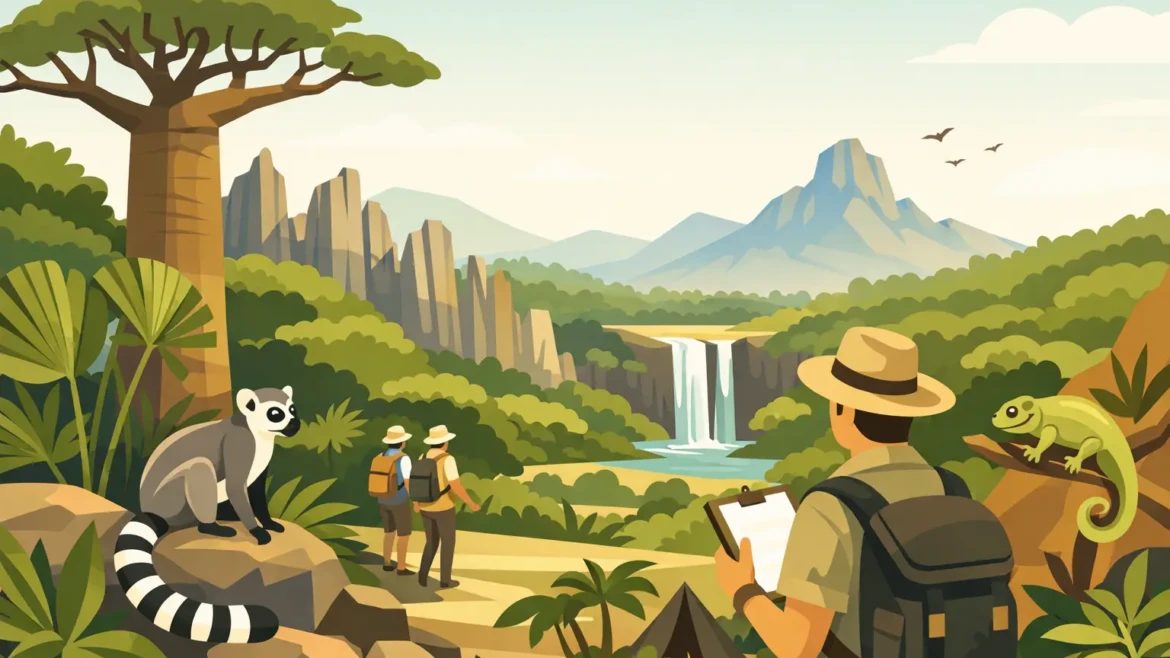
You do not want to reach a rainforest trailhead in Madagascar after a long drive, camera ready for lemurs and chameleons, only to learn you cannot enter alone. That surprise happens more often than it should. Understanding Madagascar national park guide requirements before you travel is one of the simplest ways to avoid delays, budget correctly, and make the most of your time in the island’s most remarkable landscapes.
For many US travelers, the confusion comes from assuming national park rules work the same way everywhere. In Madagascar, park access is often tightly tied to local guiding. In some parks, a certified local guide is effectively required for entry on standard circuits. In others, the rule may depend on the trail, the season, or whether you are doing a day walk, night walk, summit route, or technical excursion. The short version is simple: expect to need a guide in most major parks, and plan your itinerary around that reality rather than treating it as an optional extra.
Madagascar national park guide requirements: what travelers should expect
Across Madagascar’s protected areas, guides are not just there to point at wildlife. They are part of how the parks operate. In practice, many parks require visitors to take an official local guide, usually assigned or approved at the park office. This system supports conservation jobs, improves visitor safety, and helps protect fragile habitats where unaccompanied travel can easily lead to trail damage or missed rules.
That matters because Madagascar is not a destination where you simply show up and wander. Trail networks can be poorly marked, weather can change quickly, and the animals most people come to see are famously hard to spot without trained eyes. A good guide can find a leaf-tailed gecko that looks exactly like bark, identify lemur calls before you hear movement, and adjust your pace for the best wildlife activity windows.
So while travelers often ask whether guides are mandatory, the better question is whether your park visit will work well without one. In most cases, it will not.
Where guide requirements are usually strict
In well-known parks such as Andasibe-Mantadia, Ranomafana, Isalo, Amber Mountain, and Tsingy de Bemaraha, guided entry is commonly the norm. You typically pay a park entrance fee and a separate guide fee. Night walks may involve an additional guide arrangement or a dedicated local spotter, depending on the site.
The reason varies by destination. In rainforests like Andasibe and Ranomafana, guides are essential for wildlife detection and staying on designated routes. In rugged areas like Isalo or the Tsingy, safety becomes an equally serious factor. Trails can include canyon sections, exposed rock, ladders, suspension bridges, slippery descents, or route choices that are not obvious if you are unfamiliar with the terrain.
There can also be limits based on group size. A single guide may be assigned to a couple or a small private party, but larger groups often need multiple guides. That is not red tape for its own sake. It helps keep the group manageable on narrow trails and improves the quality of wildlife viewing.
Why the rules are not identical in every park
This is where travelers need a little flexibility. Madagascar national park guide requirements are not one fixed national rule applied in exactly the same way everywhere, every day. Park management, local associations, seasonal conditions, and specific circuits all shape what is required.
For example, a short interpretive walk near a park entrance may be straightforward, while a longer circuit into primary forest may only be possible with a guide assigned at a certain departure time. Night visits are often more controlled than daytime visits. Some parks are especially strict after heavy rains, when trail conditions create more risk.
That means the smart approach is not to memorize one blanket rule. It is to confirm the exact arrangement for each park on your itinerary.
What guides in Madagascar national parks actually do
Travelers sometimes hear “mandatory guide” and think of a formal escort who mostly enforces rules. In Madagascar, the role is much more valuable than that. A strong park guide is part naturalist, part tracker, part local interpreter, and part logistical fixer.
Wildlife viewing is the obvious benefit. Madagascar’s biodiversity is extraordinary, but much of it is cryptic, nocturnal, tiny, or high in the canopy. Without a guide, many visitors would walk past half the species they traveled across the world to see. This is especially true for reptiles, insects, and smaller nocturnal lemurs.
Guides also help with pacing and expectations. If you are visiting Ranomafana hoping for golden bamboo lemurs, or Andasibe dreaming of hearing the indri at dawn, a local guide can suggest the right start time, route, and recent sighting areas. That does not guarantee an encounter – this is wildlife, not a zoo – but it meaningfully improves your odds.
Then there is the cultural side. Many guides come from nearby communities and add context that turns a walk into a fuller Madagascar experience. You learn not just species names, but how local people relate to the forest, which plants are used traditionally, and why conservation matters in practical terms.
Costs, tipping, and what is usually separate from entry fees
One common point of confusion is pricing. Park entry fees and guide fees are usually not the same thing. You may also encounter separate charges for community guides, circuit upgrades, night walks, camera policies in certain locations, or equipment rentals where relevant.
Guide rates can vary by park, route length, and group size. A short walk is usually less expensive than a full-day trek. Technical areas or highly regulated routes can cost more. If you are building a self-planned trip, this matters because a route that looks affordable on paper can become much more expensive once you add guide fees across multiple parks.
Tipping is also worth planning for. While not always mandatory, it is widely appreciated for good service, especially when a guide works hard to find wildlife, adjust to your pace, or help in difficult weather. US travelers generally find that carrying small local cash for guides and drivers makes the trip smoother.
Can independent travelers visit parks without a guide?
Sometimes, but you should not build your Madagascar trip around that assumption. Even where independent access is technically possible in limited areas, it is often less rewarding and can still depend on local conditions or park staff decisions on the day.
There is also a difference between legal access and practical access. A trail may not be closed to solo visitors in theory, yet the signage may be minimal, recent wildlife sightings may be known only to local guides, and the best viewing windows may be easy to miss if you arrive at the wrong time. In a destination where distances are long and travel days are real, wasting a park visit is expensive.
For travelers who want freedom but not friction, the better balance is usually a structured itinerary with local handling. That gives you the private-trip feel without the guesswork at each gate.
How to plan around guide requirements without losing flexibility
The best Madagascar itineraries treat park guides as part of the trip design from the start. If you know you want rainforest wildlife, dry forest, tsingy, and a few beach days, your route should be timed around road conditions, opening hours, and the type of guided visit each park requires.
This is especially important on multi-stop trips. A delay on the road can affect your park check-in time. Heavy rain can change which trails are suitable. Some parks are best early in the morning for lemur activity, while others are excellent for sunset landscapes or night walks. A locally managed itinerary helps absorb those variables.
That is one reason many travelers prefer to work with a company that handles the on-the-ground details. With Travelers of Madagascar, for example, guide coordination can be built into a private route so you are not renegotiating logistics park by park.
Questions to ask before your park day
Before any national park visit, confirm whether a guide is mandatory for your chosen circuit, whether the guide is included in your package or paid separately, how long the walk lasts, and whether night walks need separate arrangements. Also ask about fitness level, footwear, weather exposure, and the latest road or trail conditions.
These are not small details in Madagascar. They shape whether your day feels effortless or improvised.
The real trade-off: cost versus experience
Yes, mandatory guiding adds cost. For budget-focused travelers, that can feel frustrating at first. But Madagascar is one of those places where guiding often improves the experience so much that the added expense is hard to argue against.
You are not paying only for access control. You are paying for species detection, local knowledge, safer movement through remote terrain, and a far better chance of seeing what makes Madagascar unforgettable in the first place. If your dream is to watch indri calling through misty forest, find brilliantly camouflaged reptiles in the undergrowth, or cross a dramatic limestone landscape with confidence, the guide is part of the experience, not a surcharge attached to it.
Madagascar rewards travelers who plan with the realities of the destination, not against them. If you treat guide requirements as a helpful part of the journey rather than a hurdle, your national park days tend to feel smoother, richer, and far more alive.