
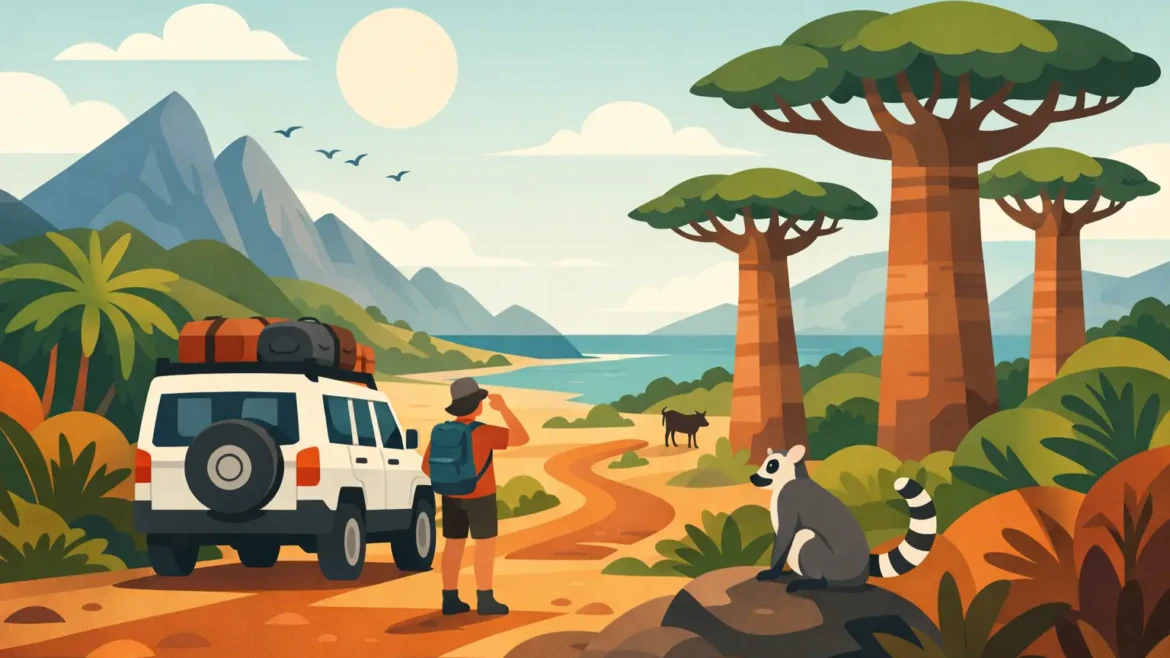
Landing in Madagascar can make even confident road trippers pause. The map looks manageable at first glance, but once you factor in road conditions, long travel times, shifting weather, and limited roadside support, the real question is not just can you drive in Madagascar – it is whether self-driving fits the kind of trip you want.
The short answer is yes, you can drive in Madagascar. Independent travelers do it every year, and for some routes it can be a rewarding way to experience the country at your own pace. But Madagascar is not a destination where driving is simply a matter of picking up a car and heading out as you might in Europe or the US. This is a place of huge landscapes, uneven infrastructure, and travel days that can be far longer than they look on a map.
For many visitors, especially first-time travelers to the island, the better question is whether driving yourself will improve the journey or quietly make it harder.
Can you drive in Madagascar as a visitor?
Yes, visitors can drive in Madagascar, provided they have the proper documents and a realistic understanding of conditions on the ground. Many foreign travelers use an international driving permit alongside their home license, and this is the safest assumption before arrival. It is also wise to confirm current rental requirements directly before your trip, since policies can vary by provider.
What surprises many travelers is that legality is only the easy part. The bigger challenge is the nature of driving itself. Madagascar rewards patience, flexibility, and local knowledge. A route that appears straightforward may involve broken pavement, long dirt sections, slow-moving trucks, river crossings in some regions, or towns where traffic patterns feel improvised rather than formal.
If your trip is centered on a short urban stay, self-driving rarely adds much. If you are planning a broader nature itinerary – rainforests in the east, baobabs in the west, highlands villages, national parks, and a beach extension – transportation becomes a much more serious part of the experience.
What driving in Madagascar is really like
Madagascar is one of those destinations where distance on paper means very little. A day with 160 miles of driving can be a full-day effort. Road quality changes constantly, and even major routes can have potholes, narrow stretches, livestock crossings, market traffic, or sections slowed by roadworks and weather damage.
In and around Antananarivo, traffic can be heavy and tiring, especially for travelers arriving after a long international flight. Outside the capital, the challenge shifts from congestion to endurance. You may spend hours on winding roads through the highlands, then transition to rougher surfaces as you approach remote parks or coastal areas.
There is also the issue of daylight. Night driving is best avoided on many routes. Limited lighting, unpredictable obstacles, and fewer support options make late arrivals a poor plan. In Madagascar, a smart road day usually starts early and ends well before dark.
That is why self-driving can feel liberating in theory but demanding in practice. You are not only navigating. You are constantly managing timing, fuel, road quality, local directions, and the possibility that a simple transfer may take much longer than expected.
Where self-driving makes the most sense
If you are comfortable driving internationally, have previous experience on rough roads, and prefer flexible travel, self-driving can work on selected itineraries. It tends to suit travelers who are intentionally building a slower route, with fewer stops and room for delays.
The best candidates are usually those focusing on one region rather than trying to cross the island too quickly. A simpler route in the highlands or a focused circuit with manageable distances can be very enjoyable. The same goes for travelers who are renting a 4×4 specifically because they understand the trade-off: more independence, but more effort.
Self-driving is less suitable for travelers trying to fit a lot into 10 to 12 days. Madagascar is not forgiving when an itinerary is overpacked. If you want to combine multiple parks, internal flights, and long overland sections, a professional driver often turns a complicated trip into a far more enjoyable one.
When it is better not to drive yourself
There are several cases where the answer to can you drive in Madagascar should technically be yes, but practically be no.
If this is your first visit, if you are traveling as a couple and want the trip to feel immersive rather than logistical, or if your route includes remote areas with rough access roads, having a driver is often the better call. The same is true if wildlife viewing and scenery are your priorities. Madagascar is a country you want to look at, not just concentrate on surviving behind the wheel.
A local driver also changes the rhythm of the trip. They know where to stop, how long routes actually take, which roads are currently difficult, and how to adapt if weather or roadworks interfere. That knowledge matters more here than in destinations with stronger infrastructure.
For many of our guests, this is the turning point. They arrive thinking of transportation as a basic practical detail, then realize it shapes the whole journey. The right driver is not just a driver. They are part of what makes a long Madagascar route feel smooth, safe, and enjoyable.
Road conditions, safety, and the 4×4 question
A standard vehicle may be enough on some paved sections, but many classic Madagascar routes are simply better with a 4×4. This is especially true in the rainy season, on secondary roads, and on approaches to more remote natural areas. Even when a route is technically passable in a regular car, comfort and reliability may be very different things.
Fuel planning matters too. Service stations are not always frequent once you leave major corridors, and roadside assistance is not something you should assume will be fast or easy. Mobile signal can also be patchy in remote zones.
Then there is weather. Madagascar’s climate varies by region and season, and heavy rain can quickly change road conditions. A route that was manageable last week may become much slower after storms. This does not mean independent driving is impossible. It means it works best for travelers who accept uncertainty as part of the experience.
Renting a car vs. hiring a driver
This is where your travel style matters most. Renting a car without a driver can offer privacy, spontaneity, and a sense of adventure. It can also add fatigue, navigation stress, and avoidable risk, especially on a first trip.
Hiring a car with a driver usually costs more than bare rental, but in Madagascar the value is often clear. You gain local knowledge, reduce stress, and free yourself to actually experience the country. On long scenic drives, that difference is huge. Instead of watching for potholes every minute, you can look out at rice terraces, village markets, baobab country, and shifting landscapes that make this island feel unlike anywhere else.
For travelers who want independence but also trusted local support, there is a middle ground. Some companies, including Travelers of Madagascar, can help arrange vehicle options for different travel styles while keeping the planning grounded in what really works here.
A realistic way to decide
Ask yourself what kind of Madagascar trip you want to remember. If your ideal journey includes freedom, fewer fixed plans, and the satisfaction of handling the road yourself, self-driving may suit you well – provided you keep your route conservative and your expectations flexible.
If your dream trip is about seeing lemurs at dawn, reaching exceptional landscapes without second-guessing every junction, and ending long travel days with energy still left for the experience, then a driver is usually the smarter choice.
The island is extraordinary, but it is not a place where logistics disappear into the background on their own. They need to be managed well. The more ambitious your itinerary, the more that matters.
So, can you drive in Madagascar?
Yes, you can drive in Madagascar, and some travelers genuinely enjoy doing so. But the better answer is that you should only drive yourself if you are comfortable with long distances, uneven roads, route changes, and the demands of a destination where travel takes time.
Madagascar gives back enormously to travelers who approach it with respect for scale and conditions. Sometimes that means taking the wheel yourself. Often, it means letting someone who knows the island handle the road while you stay focused on why you came: the forests, the wildlife, the rare landscapes, and the feeling of being somewhere truly different.
If you plan with that in mind, the road becomes part of the adventure rather than the obstacle.