
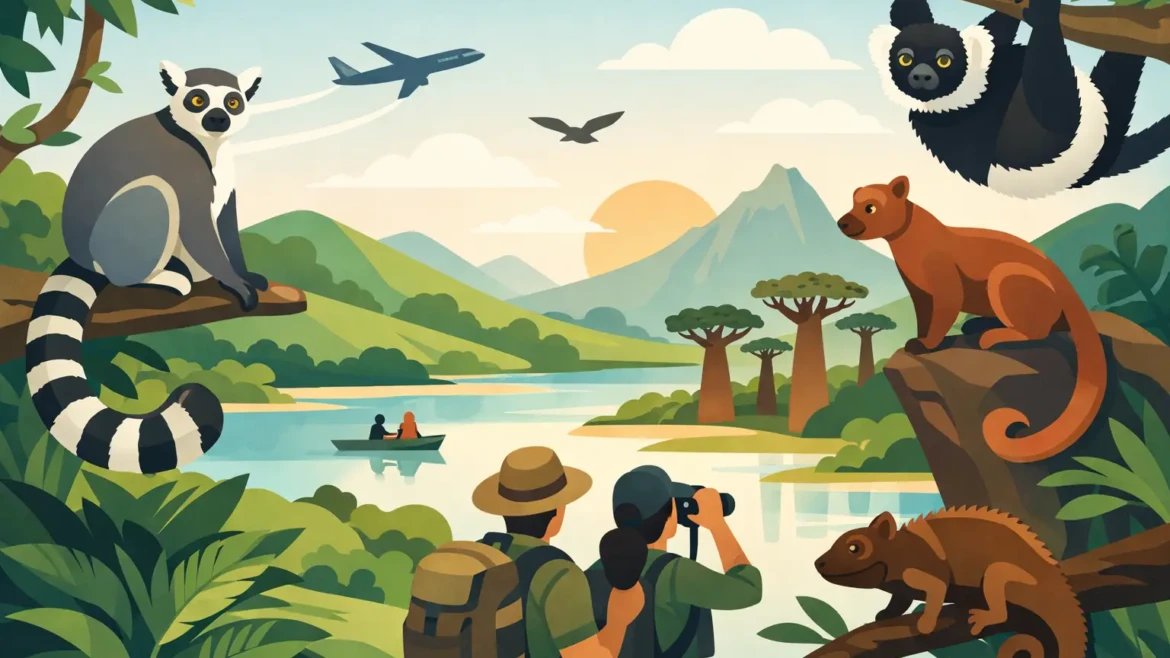
If you are trying to picture what a real Madagascar wildlife trip example looks like, start with this: sunrise in the eastern rainforest listening for indri calls, an afternoon spotting sifakas in dry forest, and a final stretch on the coast where the pace softens without losing the sense of discovery. That contrast is what makes Madagascar so compelling. The challenge is not finding places worth seeing. It is choosing a route that gives you iconic wildlife, manageable travel days, and enough comfort to enjoy the journey.
For most first-time visitors from the US, the best approach is not to chase every famous region in one trip. Madagascar is huge, road conditions vary, and distances that look simple on a map can take much longer on the ground. A strong itinerary focuses on a clear geographic arc and builds around the species and landscapes you came for. The example below does exactly that.
A Madagascar wildlife trip example for first-time visitors
This 12-day route is one of the most balanced ways to experience Madagascar. It combines rainforest wildlife in Andasibe with the dry forests and baobab country of the west, then finishes with time by the sea. It works especially well for couples, small private groups, and travelers who want major highlights without turning the trip into a constant transit exercise.
The route runs like this: Antananarivo, Andasibe, back to Antananarivo, flight to Morondava, Kirindy, Bekopaka and the Tsingy area, return to Morondava, then a beach extension or a flight onward depending on your schedule. It is a classic example because it shows Madagascar’s greatest strength – dramatic biodiversity shifts over a relatively short trip.
Days 1-2: Arrive in Antananarivo and head to Andasibe
Most international travelers arrive in Antananarivo, usually after a long journey. Rather than overloading the first day, the smart move is to rest briefly and transfer east to Andasibe either the same day if timing allows or the following morning. The drive is one of the gentler introductions to Madagascar’s road travel, and the scenery starts changing quickly as you leave the capital highlands.
Andasibe is often the first wildlife stop for a reason. It is accessible, rewarding, and home to the indri, the largest living lemur. Hearing their haunting calls move through the forest in the morning is one of those moments that stays with people long after the trip ends. You are also likely to see diademed sifakas, common brown lemurs, chameleons, tree frogs, and remarkable birdlife depending on the season.
A night walk is worth building in here. Madagascar’s forests transform after dark, and this is often when travelers get their first close look at mouse lemurs, leaf-tailed geckos, and sleeping chameleons. It is a different rhythm from daytime tracking and gives the trip an immediate sense of depth.
Days 3-4: Full wildlife immersion in the rainforest
A full day in Andasibe gives your guide time to work with the forest rather than rush through it. That matters. Wildlife viewing in Madagascar is rarely about huge herds or guaranteed sightings on a fixed schedule. It is about knowing where troops were heard at dawn, which trail is active, and how weather changes movement patterns.
This is one reason many travelers prefer a well-managed private trip. The difference between a good park visit and a memorable one often comes down to the driver who gets you there smoothly, the guide who understands your pace, and the hotel chosen for location and comfort. Madagascar can absolutely be done independently, but on a wildlife-focused itinerary, professional local coordination saves time where it matters most.
After two nights or three in Andasibe, return to Antananarivo. Some travelers prefer to continue quickly into the next region, while others add a night near the airport before an internal flight. That depends on energy levels, flight schedules, and how much buffer you want in a destination where flexibility is part of smart planning.
Why this Madagascar wildlife trip example works so well
The strength of this route is contrast. The east gives you lush rainforest and close-up lemur encounters. The west shifts into dry forest, giant baobabs, and stone formations unlike anywhere else. You do not leave Madagascar feeling like you saw only one version of the island.
It also balances iconic moments with practical reality. If you try to combine the far south, the east, the tsingy, and beach islands in under two weeks, the trip can become a string of transfers. This example keeps ambition high but avoids making every day feel like logistics.
Days 5-6: Fly west to Morondava and visit Kirindy
From Antananarivo, fly to Morondava on the west coast. This is where the mood changes. The air feels warmer, the landscape opens up, and the roads carry you toward one of Madagascar’s most photogenic regions.
Kirindy Forest is the key wildlife stop here. It is known for dry forest species and for offering the chance to see animals that you will not encounter in Andasibe. Verreaux’s sifaka is a highlight, with its unmistakable upright movement across the ground. Depending on timing and luck, Kirindy is also one of the better places to search for the fossa, Madagascar’s top predator.
The experience in Kirindy is more exposed and dusty than the rainforest. That is part of the appeal. You feel the ecological shift immediately. For photographers and wildlife lovers, this change in habitat adds texture to the trip rather than repeating what you have already seen.
Many itineraries include sunset at the Avenue of the Baobabs around this point. It is deservedly famous, but timing matters. If you hit it in harsh midday light, it can feel like a quick roadside stop. If you build the schedule carefully and arrive late in the day, it becomes one of the great visual moments of the journey.
Days 7-9: Bekopaka and the Tsingy
From Morondava, continue north toward Bekopaka, the gateway to the Tsingy de Bemaraha. This is the most demanding transport section of the route, and that is exactly why ground handling matters. Road conditions can be rough, river crossings are part of the journey, and travel times are affected by season and infrastructure.
But the reward is extraordinary. The tsingy is a forest of limestone needles, walkways, suspension bridges, and sharp stone labyrinths that feel almost unreal. Wildlife here includes lemurs, birds, reptiles, and smaller forest species, but the draw is not just the animal list. It is the combination of adventure and geology. Few places in the world give you this kind of terrain with Madagascar’s endemic wildlife layered into it.
This section is best for travelers who are reasonably active and comfortable with some physical movement. It is not extreme expedition travel, but it is not a passive sightseeing stop either. If someone in your party wants a softer pace, a different west-coast itinerary might fit better than forcing the tsingy into the plan.
Days 10-12: Return to Morondava and finish by the coast
After Bekopaka, return to Morondava. At this point, many travelers are glad for a more relaxed finish. A final night near the beach gives the trip room to breathe and lets the harder road section fade into the background.
If you have extra days, this is where you can tailor the itinerary. Some people add a beach extension elsewhere, such as Nosy Be, for a smoother tropical ending. Others keep the trip wildlife-led and return to Antananarivo for departure. There is no single right choice. It depends on whether your priority is species and landscapes, or a more balanced blend of nature and downtime.
What this itinerary gets right – and where it has trade-offs
A good Madagascar wildlife trip example should be honest about trade-offs. This route is excellent for variety, flagship wildlife, and first-time impact. It is less ideal if your only goal is maximum lemur diversity or if you strongly prefer light travel days.
For hardcore naturalists, the east alone can justify a deeper, slower itinerary with more rainforest reserves. For travelers dreaming mainly of beaches and easy comfort, the west-and-tsingy section may feel too rugged. And if you are traveling in the wet season, some western routes become less predictable, which can shift what is sensible.
That is why custom planning matters in Madagascar more than in many destinations. A beautiful itinerary on paper is not enough. The sequence has to match flight patterns, road conditions, hotel standards, and your own tolerance for movement. When those pieces line up, the country feels thrilling rather than complicated.
Travelers of Madagascar often designs trips around that exact principle: keep the wonder high, keep the logistics under control, and make sure each region earns its place in the route.
Who should choose this Madagascar wildlife trip example
This itinerary suits first-time visitors who want Madagascar’s greatest hits without reducing the trip to a checklist. It is especially strong for travelers who care about lemurs, dramatic scenery, and seeing more than one ecosystem in a single journey.
It also works well for private travelers who value a reliable driver, a knowledgeable local guide, and hotel choices that support the route rather than fight against it. Madagascar is one of those destinations where smooth execution changes the whole experience. A missed connection or poorly judged transfer can have a ripple effect. The reverse is also true. When the trip is well built, the island feels exhilarating, surprising, and far more accessible than many people expect.
The best itineraries here do not try to prove how much distance you can cover. They give you the right moments in the right order – the indri calling through mist, the baobabs at sunset, the stone towers of the tsingy, and finally the feeling that you have seen a place unlike anywhere else, without spending the whole trip worrying about what comes next.