
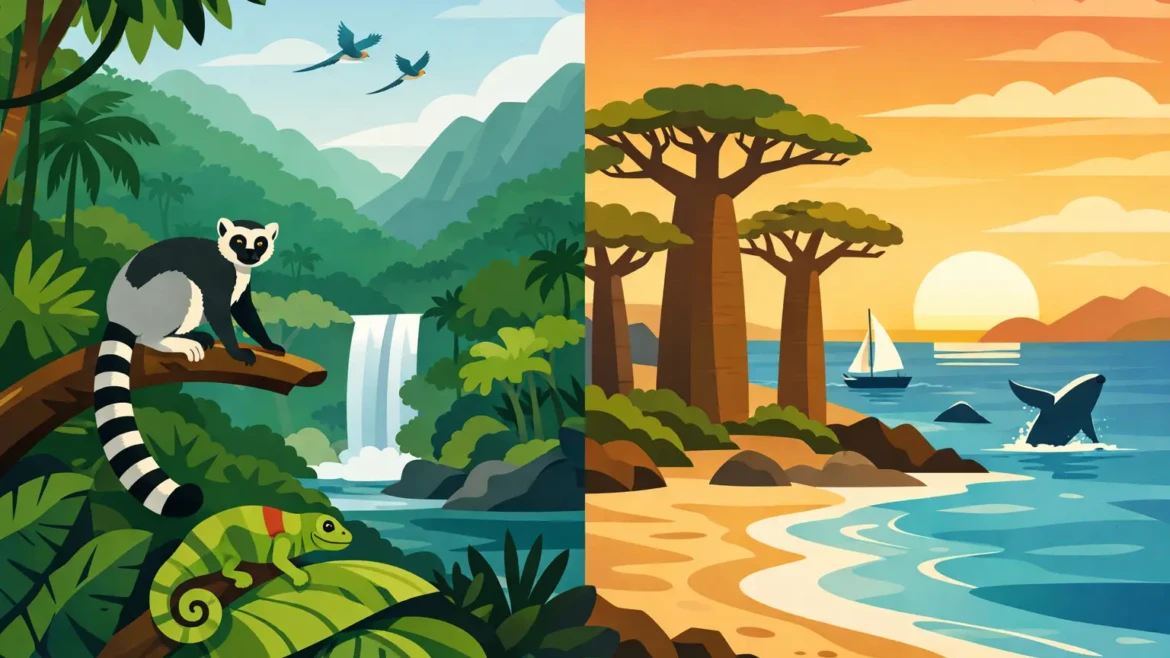
If you are weighing selva oriental o costa oeste for your Madagascar trip, you are already asking the right question. These two sides of the island feel dramatically different on the ground. One is dense, humid, green, and full of rainforest sounds. The other is wide-open, dry, cinematic, and shaped by baobabs, sandstone, and long distances. Neither is better in every case. The best choice depends on what you want to feel when you travel.
For many first-time visitors from the US, this is the moment when Madagascar stops being an abstract dream and becomes a real itinerary. Do you imagine walking under wet forest canopies while hearing indri calls at dawn? Or do you picture red dirt roads, giant baobabs at sunset, and a journey that feels raw, remote, and grand? Both routes deliver wildlife, culture, and unforgettable scenery. They simply do it in very different ways.
Selva oriental o costa oeste: the real difference
Madagascar’s eastern rainforest belt is the island at its most lush. This is where many travelers find the classic image of endemic wildlife in dense forest – lemurs leaping through the canopy, chameleons hidden in leaves, orchids, palms, tree ferns, and misty mornings. Travel here often centers on parks like Andasibe-Mantadia, with the option to continue farther south or combine rainforest with the Indian Ocean coast.
The west tells a different story. It is drier, more open, and often more visually dramatic in a big-sky way. This is where travelers come for the Avenue of the Baobabs, Kirindy’s nocturnal wildlife, the Tsingy de Bemaraha, river routes, and a sense of expedition. The distances can be long and the roads more demanding, but the reward is a side of Madagascar that feels elemental and unlike anywhere else.
If your priority is easy access to rainforest wildlife soon after arrival, the east usually wins. If your priority is iconic landscapes and a stronger overland adventure feel, the west has the edge.
Why the eastern rainforest draws so many first-time travelers
The eastern route is often the safest choice for travelers who want a shorter trip with strong wildlife returns. From Antananarivo, access to the rainforest is relatively straightforward compared with some western routes. That matters more than many people expect. In Madagascar, logistics shape the quality of your trip.
Andasibe is the best example. In a fairly short transfer from the capital, you can be in prime habitat for one of the island’s most famous species, the indri. Hearing their calls in the morning is one of those moments that stays with people long after the trip. The east is also excellent for reptiles, amphibians, insects, and smaller forest species that reward patient guiding.
This side of the island also suits travelers who like active days without feeling they are on a hard expedition. Forest walks, night walks, lodge stays surrounded by vegetation, and manageable driving days create a rhythm that works well for couples, photographers, and first-time visitors who want immersion without too much physical or logistical strain.
There are trade-offs. Rainforest travel means humidity, mud in some seasons, and less of the dramatic open-sky scenery many people associate with postcard travel. Wildlife viewing can also feel subtler than travelers expect. Forest animals do not always present themselves in a neat, cinematic way. Good guides matter enormously here.
What makes the west feel so special
The west is where Madagascar often feels biggest. Not just geographically, but emotionally. The landscapes open up. Villages feel farther apart. Sunsets get wider. The terrain changes from dry forest to stone cathedrals, river plains, and baobab country.
For many travelers, the west delivers the strongest sense of journey. Reaching places like Kirindy or the Tsingy is part of the experience, not just a transfer between highlights. The Avenue of the Baobabs is iconic for a reason, but the real power of the west is that it keeps changing. One day you are scanning dry forest for sifakas and fossa. Another day you are crossing by ferry, bumping along remote roads, or walking across razor-sharp limestone formations.
This route is ideal for travelers who do not mind longer travel days in exchange for stronger landscape drama. It also works well for repeat visitors who have already seen rainforest parks and want a deeper cross-section of the island.
The west has its own trade-offs. Road conditions can be challenging, timing matters, and some highlights are less forgiving if you are short on days. This is not usually the best side for a rushed schedule. If you only have a week or so, the west can feel compressed unless your route is carefully planned.
Wildlife: where will you see more?
This depends on what “more” means to you.
If you mean biodiversity in dense natural habitat, the eastern rainforest is hard to beat. The east offers an extraordinary concentration of endemic species, especially if your interest includes chameleons, frogs, insects, and rainforest lemurs. The feeling is immersive. You are not just spotting animals. You are entering their world.
If you mean larger contrasts and a broader variety of visual settings, the west can be more satisfying. Dry forest wildlife is different from rainforest wildlife, and species such as Verreaux’s sifaka create some of Madagascar’s most memorable encounters. Kirindy night walks can also be outstanding, particularly for travelers hoping to see nocturnal species.
Photography preferences matter here. The east can be more technically challenging because of low light and dense vegetation. The west often gives cleaner backgrounds, warmer late-day light, and more dramatic landscape frames.
Weather and seasonality matter more than travelers expect
When comparing selva oriental o costa oeste, weather is not a side note. It can completely change the experience.
The east is generally wetter. That is exactly why it is so green, but it also means muddy trails, rain interruptions, and a different packing strategy. If you love rainforest atmosphere, this is part of the appeal. If you dislike humidity or slippery conditions, it can wear on you.
The west is drier, but “drier” does not mean easy in every season. Heat, dust, and road conditions can become major factors. Some western routes and national parks are strongly seasonal in practical terms. Access to the Tsingy, for example, depends on timing and conditions. A route that looks perfect on a map may not be the best real-world choice for your travel month.
This is where local planning makes a huge difference. Madagascar is not a destination where you want to build an itinerary based only on distances. A route needs to work with weather patterns, road realities, and the pace you actually want.
Which side fits your trip style?
If you are planning your first Madagascar journey and want a strong chance of wildlife success without very demanding logistics, the east is usually the better fit. It pairs well with a comfortable itinerary and can combine beautifully with beach time if you want a balanced trip.
If you are drawn to remote scenery, don’t mind road adventure, and want that feeling of crossing a wild and varied landscape, choose the west. It asks more from travelers in time and flexibility, but it often gives back a bigger sense of scale.
For honeymooners or couples wanting a softer landing, the east often feels more forgiving. For adventurous friend groups or experienced travelers who value the route as much as the destination, the west can be more thrilling.
That said, the strongest Madagascar itineraries often avoid the either-or trap.
The best answer is often both
A lot of travelers arrive asking whether they should choose selva oriental o costa oeste, then leave with a route that combines both. That is often the smartest move if you have enough time.
Madagascar reveals itself through contrast. Rainforest and dry forest. Lemur calls and baobab silhouettes. Red highland villages and coastal downtime. Seeing only one side can absolutely be worthwhile, but combining regions gives you a much fuller understanding of why the island feels so singular.
A well-designed 10 to 15 day trip can connect these worlds without turning the journey into a checklist. The key is not trying to do everything. It is choosing a realistic arc, using strong local drivers and guides, and building in enough breathing room to enjoy each place properly. That is exactly where a locally managed operator like Travelers of Madagascar can make the difference between a trip that looks good on paper and one that feels smooth on the ground.
If you have under 10 days, choose one side and do it well. If you have more time, think in terms of contrast rather than quantity.
So, should you choose the east or the west?
Choose the east if you want lush rainforest, easier access from the capital, excellent guided wildlife walks, and a trip that feels immersive rather than rugged. Choose the west if you want spectacle, overland adventure, iconic baobabs, dry forest species, and landscapes that feel immense.
Both are deeply Madagascar. Both can be extraordinary. The right route is the one that matches your energy, your season, and the story you want to bring home.
The best trips here are not built around what sounds most famous. They are built around what will feel right once your boots hit the trail, the road stretches out ahead, and Madagascar starts showing you its many worlds.