
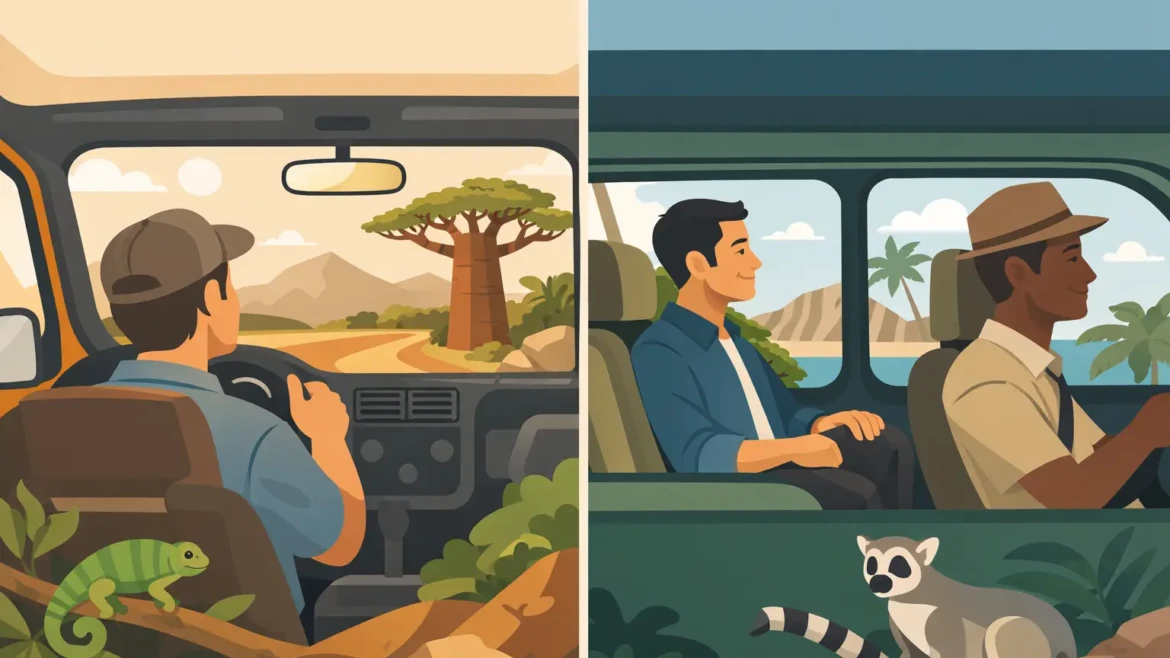
You can look at the same stretch of Madagascar road in two very different ways. For one traveler, it is freedom – pulling over for a sudden baobab view, lingering in a highland village, setting your own pace. For another, it is a full-day concentration test of potholes, washed-out sections, police checks, fuel planning, and slow progress after dark. That is the real question behind self drive Madagascar versus driver: not which option sounds more adventurous, but which one will give you the trip you actually want.
Madagascar is not a destination where transportation sits quietly in the background. It shapes the entire experience. Distances are long, road conditions can change fast, signage is limited in many areas, and timing affects whether you reach the rainforest in time for a night walk or arrive too late for anything except check-in and sleep. Choosing between self-drive and a driver is less about style and more about how you want to spend your energy.
Self drive Madagascar versus driver: what really changes?
On paper, both options get you from Antananarivo to the parks, coastlines, and landscapes that make this island unforgettable. In practice, they create very different journeys.
With self-drive, you take full control of the route, schedule, stops, and daily rhythm. That can be deeply appealing if you are an experienced independent traveler, comfortable driving in unfamiliar conditions and making decisions on the fly. You may enjoy the challenge, and you may not mind that a five-hour estimate can become eight.
With a driver, you still have flexibility, but the mental load changes. You are free to watch the scenery, spot zebu carts, notice rice terraces, or simply recover from a long-haul flight while someone who knows the roads handles the vehicle, the local driving culture, and the day-to-day transport logistics. In Madagascar, that difference is bigger than many first-time visitors expect.
Road conditions are the biggest dividing line
If you have driven in rural Africa, South America, or remote parts of Asia, you may already have the right frame of reference. If you are imagining a road trip where the main challenge is staying on the correct highway, Madagascar will feel very different.
Major routes can include broken pavement, deep potholes, narrow bridges, livestock, pedestrians, bikes, trucks moving slowly uphill, and occasional sections damaged by rain. Some roads are manageable with patience. Others are tiring even for skilled drivers. Travel times are rarely just about mileage.
This is where hiring a driver often changes the quality of the trip. A strong local driver does more than steer. He reads road conditions, judges safe speed, knows where overtaking is realistic, understands fuel and rest-stop patterns, and adapts when weather or traffic changes the day. For visitors planning a multi-day circuit through several regions, that local knowledge protects both your schedule and your energy.
Self-drive can still work, but it works best when you go in with realistic expectations. If you are the kind of traveler who enjoys difficult driving and treats route uncertainty as part of the adventure, you may find it rewarding. If your idea of adventure is the lemurs, the tsingy, the baobabs, and the beach, a driver is usually the better use of your time.
Safety means more than avoiding accidents
Most travelers think first about road safety, and that matters. But safety in Madagascar also includes avoiding night driving, managing fatigue, knowing when to stop, understanding local procedures at checkpoints, and reducing the risk of navigation mistakes in isolated areas.
A driver helps with all of that. He also gives you a second layer of local awareness. That matters on longer routes and in remote stretches where services are limited. The safest trip is often the one that feels least stressful hour by hour.
Cost is not as simple as it looks
At first glance, self-drive seems like the budget choice. You rent the car, buy the fuel, and skip the driver fee. For some travelers, especially those taking shorter routes or traveling very independently, that may be true.
But in Madagascar, transport costs cannot be separated from route efficiency and trip design. A self-drive traveler can lose money in less obvious ways – adding overnight stops because the day ran long, missing a planned activity due to late arrival, taking a slower route than expected, or choosing an unsuitable vehicle for the terrain. What looks cheaper upfront can become more expensive in time, comfort, and missed experiences.
A driver is an added cost, but it often brings better value on complex itineraries. You are paying for local road knowledge, reduced risk, less fatigue, and a smoother day-to-day flow. For couples, friends traveling together, or anyone booking a longer cross-island trip, that difference can be easier to justify than it first appears.
The hidden cost of exhaustion
This is the part many travelers overlook. Madagascar is a destination of early park entries, evening wildlife walks, long scenic drives, and shifting landscapes that reward attention. If you are driving all day on demanding roads, you arrive at your lodge tired. The next morning, you do it again.
With a driver, the journey itself becomes part of the experience instead of the task that drains you before the experience begins.
Who should seriously consider self-drive?
Self-drive is not the wrong choice. It is simply the right choice for a narrower type of traveler.
It makes the most sense if you have a high tolerance for uncertainty, real confidence driving in difficult road conditions, and a flexible itinerary that does not fall apart if a day takes longer than planned. It can also suit travelers who want to focus on a smaller region rather than trying to link many major highlights in one trip.
For example, if you are renting a vehicle for a relatively straightforward stretch and you are comfortable handling logistics independently, self-drive can offer a satisfying sense of freedom. It also appeals to repeat visitors who already understand how travel days work in Madagascar and are intentionally choosing more independence the second time around.
What matters is honesty. If you are asking whether self-drive might be stressful, that usually tells you something.
Who is better off with a driver?
For most first-time visitors, a driver is the better fit. That is especially true if you are planning a classic route with parks, reserves, and multiple hotel changes, or if your trip is limited to 10 to 15 days and every day counts.
A driver is also the stronger choice for honeymooners, wildlife-focused travelers, photographers, and anyone who wants to arrive fresh enough to enjoy guided walks, boat trips, village visits, or beach time. The same goes for families and small private groups. When someone else handles the road, the entire trip feels more spacious.
This is one reason many travelers choose a locally managed operator rather than piecing things together from abroad. Madagascar rewards good planning, but it rewards local execution even more. Travelers of Madagascar, for example, offers both guided transport and car hire without a driver, which is useful because the right answer depends on your route, confidence level, and travel style rather than one fixed formula.
Self drive Madagascar versus driver for different routes
Not every itinerary creates the same decision.
If you are staying close to Antananarivo for a shorter trip or limiting yourself to more established corridors, self-drive may feel manageable if you already have the right experience. But once you start building a longer journey – highlands to rainforest, then onward to dry forest, baobabs, tsingy, or coastal segments – the transport side becomes far more demanding.
Madagascar is famous for variety. In one trip, you can move from misty eastern forest to central plateau villages to stark western landscapes and island beaches. That variety is exactly what makes the destination extraordinary. It is also what makes transport planning so unforgiving. A driver helps those transitions feel connected instead of fragmented.
The quality question
This is the simplest test: do you want to manage the trip, or live the trip?
Some travelers genuinely enjoy managing every moving part. They like route planning, car handling, timing decisions, and fielding the unexpected. For them, self-drive can be part of the story.
Most travelers coming to Madagascar want something else. They want to hear the first indri call in the rainforest, watch sifakas leap through dry forest, drift past baobabs at sunset, and reach the coast feeling like the journey added to the trip rather than took from it. For that kind of experience, a driver is often the stronger choice.
The best Madagascar trips are not measured by how independently you handled the roads. They are measured by how fully you were able to experience a place unlike anywhere else on earth. Choose the option that leaves you more present for that.