Tsimanampetsotsa National Park: The Turquoise Oasis of the Deep South
In the arid, sun-scorched expanse of southwestern Madagascar, where the earth is painted in shades of rusty red and the vegetation bristles with thorns, lies an oasis of startling contrast. A sheet of milky-turquoise water stretches across the landscape, rimmed by blinding white salt flats and guarded by ancient baobabs. This is Tsimanampetsotsa National Park, a place of surreal beauty, extreme adaptation, and ecological importance.
While many visitors flock to the rainforests of Andasibe or the canyons of Isalo, Tsimanampetsotsa remains a destination for the true connoisseur of nature. It is Madagascar’s only Ramsar site in the south, a sanctuary for thousands of flamingos, and the guardian of the Spiny Forest—one of the most biologically unique ecosystems on Earth.
This guide explores the geology, wildlife, flora, and travel logistics of this extraordinary park, revealing why Tsimanampetsotsa deserves a top spot on your Malagasy itinerary.
1. Introduction: The Lake of Mystery
The park derives its name from the massive saline lake that dominates its geography. “Tsimanampetsotsa” roughly translates from Malagasy as “The Lake Without Dolphins” or, more accurately in the local context, “The lake where one cannot drink.”
Both interpretations hold truth. The lake is saturated with soda and salt, rendering the water toxic to most marine life (hence no dolphins or fish) and undrinkable for humans. Yet, what seems like a hostile environment is actually a thriving cradle of life.
Established as a National Park in 2002 (though protected since 1927), the reserve covers approximately 43,000 hectares. It serves as a biological bridge between the marine environment of the Mozambique Channel and the calcareous plateau of the Mahafaly region.
The Ramsar Status
In 1998, Tsimanampetsotsa was designated a Wetland of International Importance under the Ramsar Convention. This prestigious status highlights the park’s critical role in the migration and survival of waterbirds, particularly flamingos and plovers, making it a pivotal site for global ornithology.
2. A Landscape of Three Zones
To understand the biodiversity of Tsimanampetsotsa National Park, one must understand its geology. The park is neatly divided into three distinct geological zones, each offering a completely different visual and biological experience.
Zone 1: The Eocene Limestone Plateau
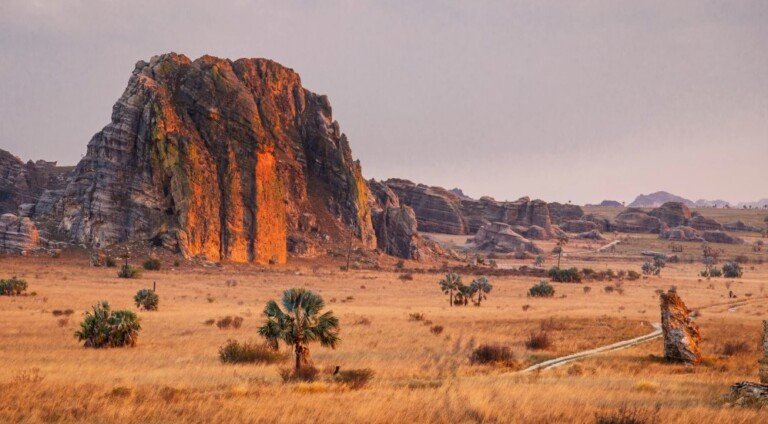
Rising abruptly from the coastal plain is the Mahafaly Plateau. Formed from fossilized coral and marine sediment dating back to the Eocene epoch (56 to 33 million years ago), this limestone cliff runs parallel to the sea. Over millennia, groundwater has carved a network of underground rivers, sinkholes, and caves beneath the rock.
- The Vibe: Rocky, rugged, and dry. This area provides the perfect lookout points for panoramic views of the Tsimanampetsotsa lake below.
Zone 2: The Spiny Forest Fringe
Sandwiched between the cliffs and the lake is a strip of reddish sand and soil. This is the domain of the famous “Spiny Thicket” or Spiny Forest. It is an alien landscape where plants have evolved bizarre shapes and armors to survive years of drought.
- The Vibe: Prehistoric and prickly. This is where you walk among the baobabs and the octopus trees.
Zone 3: The Soda Lake
The centerpiece of the park is the lake itself, measuring about 20 kilometers long and 2 kilometers wide. The water is shallow, rarely exceeding 2 meters in depth. The high concentration of calcium sulfate and sodium creates a chemical environment similar to the Dead Sea, but with a vibrant turquoise hue caused by fine mineral particles suspended in the water.
- The Vibe: Ethereal and blindingly bright. The contrast between the blue water, white salt crust, and red earth is a photographer’s dream.
3. The Pink Spectacle: Flamingos and Avifauna
For birdwatchers, Tsimanampetsotsa is arguably the most important site in southern Madagascar. The lake’s high salinity allows for the proliferation of microscopic algae and small crustaceans (specifically Artemia salina), which are the primary food source for flamingos.
The Dance of the Flamingos
The park is famous for hosting two distinct species of flamingo, often seen together in massive flocks that turn the horizon pink.
- Greater Flamingo (Phoenicopterus roseus): The larger of the two, with a pale plumage and bright pink wings. They tend to feed in slightly deeper water.
- Lesser Flamingo (Phoeniconaias minor): Smaller, with a deeper red beak and often more intense pink coloration. They filter-feed on the microscopic algae near the surface.
Best Time for Flamingos: While some flamingos are present year-round, the population swells dramatically between April and November, sometimes reaching over 30,000 individuals. The sight of thousands of these birds taking flight against the backdrop of the dry limestone cliffs is one of Madagascar’s signature wildlife spectacles.
Other Notable Birdlife
Beyond the flamingos, Tsimanampetsotsa boasts over 110 bird species.
- Madagascar Plover (Charadrius thoracicus): A vulnerable species endemic to the region.
- Madagascar Sandgrouse: Often seen near the water’s edge.
- Couas: Including the Verreaux’s Coua and the Running Coua, often spotted darting through the dry scrub.
- Vangas: Several species of this endemic family can be found in the wooded areas at the base of the cliffs.
4. The Spiny Forest: Flora of the Extreme
Tsimanampetsotsa protects a prime example of the Madagascar Spiny Thickets ecoregion. This is a land of xerophytes—plants adapted to environments with little liquid water. Approximately 90% of the flora here is endemic to Madagascar, and 48% is endemic to this specific southern region.
The Baobab Grandmother
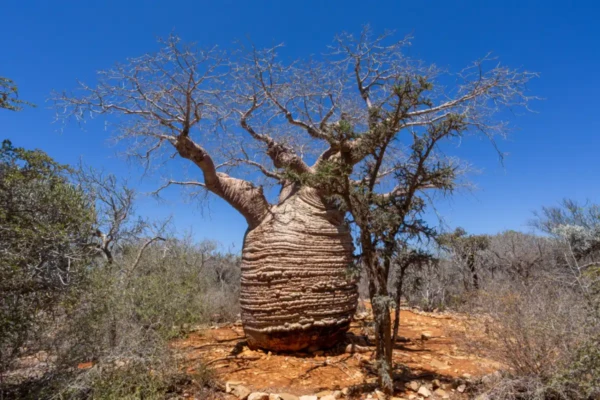
The undisputed queen of the park is a specific Adansonia rubrostipa (Fony Baobab) known locally as “Grand-Mère” (Grandmother).
- Age: Estimated to be over 3,000 years old.
- Appearance: Unlike the tall, smooth baobabs of Morondava, the Fony Baobab is shorter, squat, and gnarled, looking like a melted wax candle or a bottle with a distorted neck. Its bark is reddish and peels away in paper-like sheets. Standing before this ancient living organism is a humbling experience unique to Tsimanampetsotsa.
The Octopus Trees (Didiereaceae)
The landscape is dotted with Alluaudia, commonly known as octopus trees. These are not cacti, though they look like them. They are tall, spiny succulents that reach toward the sky with long, tentacle-like branches covered in small deciduous leaves that vanish during the dry season.
Pachypodiums
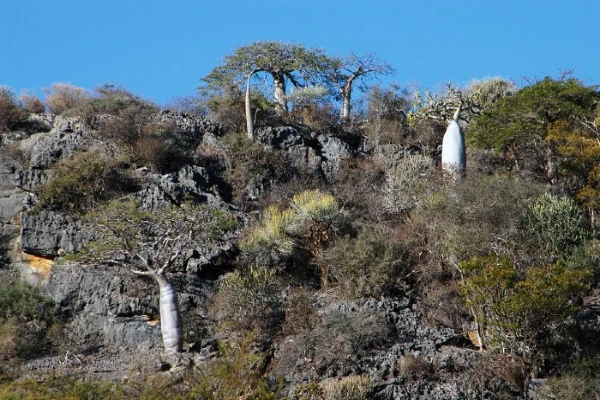
You will also encounter Pachypodium geayi (Bottle Palm), a succulent with a thick, water-storing trunk and a tuft of spiny branches at the top. When in bloom, they produce beautiful white or yellow flowers that stand out starkly against the arid backdrop.
5. Mammals: Lemurs and Mongooses
Despite the harsh conditions, mammals thrive here. Tsimanampetsotsa provides excellent opportunities to see some of Madagascar’s most iconic species in a relatively open environment.
Lemurs
There are four primary lemur species that visitors can encounter:
- Ring-tailed Lemur (Lemur catta): The most famous of all lemurs. They are cathemeral (active day and night) and highly terrestrial. In Tsimanampetsotsa, you will often see them walking on the salt flats or resting in the shade of the caves—a behavior unique to this region as they seek refuge from the heat.
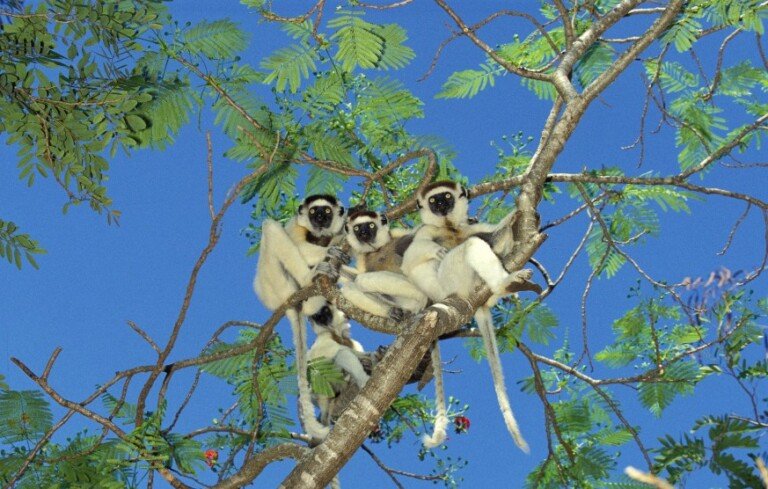
- Verreaux’s Sifaka (Propithecus verreauxi): Known as the “dancing lemur” for the way it hops sideways across the ground. With their white fur and brown caps, they are easy to spot in the trees.
- Gray-brown Mouse Lemur (Microcebus griseorufus): A tiny nocturnal primate, best seen during a night walk (if permitted/arranged with guides).
- White-footed Sportive Lemur (Lepilemur leucopus): Strictly nocturnal, often seen peering out of tree holes during the day.
The Predator: Grandidier’s Mongoose
Tsimanampetsotsa is the best place in the world to spot the Grandidier’s Vontsira (Mongoose). This is a rare, narrow-striped mongoose that lives only in the limestone karst regions of the southwest. They are distinct from the more common Ring-tailed Vontsira found elsewhere.
6. The Underground World: Caves and Blind Fish
The limestone plateau is honeycombed with caves and sinkholes (avens) filled with fresh groundwater. These freshwater pockets are vital for the survival of the terrestrial animals and hold deep spiritual significance for the local population.
The Blind Cave Fish
One of the park’s biological marvels lives in these dark, underground waters. The Typhleotris madagascariensis is a species of Gobi fish that has evolved in total isolation and darkness.
- Adaptation: It has no eyes (as it lives in perpetual dark) and no pigmentation (it is translucent white).
- Viewing: Visitors can peer into the sinkholes to see these tiny white ghosts swimming in the crystal-clear water. It is a striking example of evolutionary adaptation.
Mitoho Grotto
This is the most accessible cave in the park. It is a sacred site for the local Antambahaoka people. Legends say that an invisible tribe lives within the cave. Inside, you can see stalactites, stalagmites, and often, Ring-tailed lemurs cooling off near the entrance.
- Note: Swimming is generally strictly forbidden in these sinkholes due to their sacred nature (fady) and to protect the fragile ecosystem of the blind fish.
7. Reptiles: The Radiated Tortoise
The dry scrub of Tsimanampetsotsa is a stronghold for the Radiated Tortoise (Astrochelys radiata). Known locally as Sokake, this is considered one of the most beautiful tortoises in the world due to the brilliant yellow star-patterns on its high-domed shell.
Sadly, this species is Critically Endangered due to poaching for the pet trade and for food. However, in Tsimanampetsotsa, they are protected by both park rangers and local fady (taboos) of the Mahafaly people, who do not eat them. You can often see them plodding slowly across the red sand trails or grazing on fallen leaves.
8. Cultural Significance: The Mahafaly People
The region surrounding the park is inhabited by the Mahafaly people (“Those who make taboos” or “Those who make happy”). Their culture is deeply intertwined with the harsh environment.
Visitors to Tsimanampetsotsa will often see Mahafaly tombs scattered in the surrounding areas (though usually not inside the strict park boundaries). These tombs are famous for their Aloalo—intricately carved wooden funerary poles that tell the story of the deceased’s life—and the piles of zebu horns that indicate the wealth of the person buried there.
The park guides are often locals who can explain the complex system of fady that governs life here, such as days when it is forbidden to work the land or specific areas that are off-limits.
9. Practical Travel Guide
Visiting Tsimanampetsotsa requires planning. It is remote, hot, and lacks the infrastructure of northern parks.
How to Get There
The park is located about 90km south of Toliara (Tuléar).
- From Toliara: You can hire a 4×4. The drive takes about 4 to 6 hours depending on the condition of the sandy track.
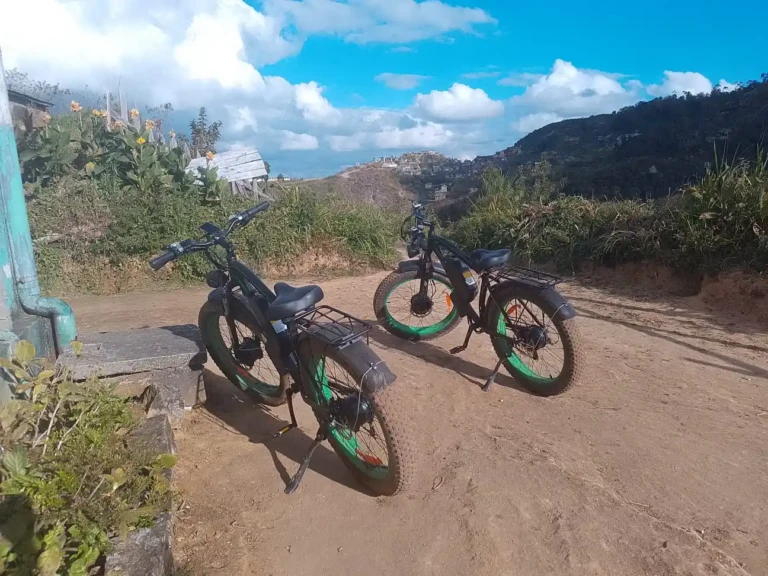
- From Anakao: Most visitors base themselves in the seaside village of Anakao. From Anakao, the park is a 2-hour drive by 4×4 or quad bike. Many hotels in Anakao organize day trips to the park.
- By Boat: It is possible to take a boat from Toliara to Anakao (approx. 1 hour) and then drive to the park.
Best Time to Visit
- Climatic: The park is accessible year-round, but it is extremely hot.
- April to November (Dry/Winter Season): This is the best time to visit Tsimanampetsotsa. Temperatures are bearable (25°C – 30°C), and this coincides with the peak flamingo population.
- December to March (Wet/Summer Season): It is incredibly hot (often exceeding 40°C). While it is the “rainy” season, this is an arid zone, so rain is erratic, but when it falls, the sandy tracks can become muddy.
What to Bring
- Water: Bring more than you think you need. There is no potable water in the park, and dehydration is a real risk.
- Sun Protection: High SPF sunscreen, a wide-brimmed hat, and sunglasses (the glare from the salt lake is intense).
- Footwear: Sturdy walking shoes or hiking boots. The limestone rock is sharp (tsingy-like in places) and the sand can be hot.
- Binoculars: Essential for viewing the flamingos and birds on the lake.
Accommodation
There is no lodging inside Tsimanampetsotsa Park itself (camping is sometimes permitted in designated zones with a guide, but facilities are non-existent).
- Anakao: Most tourists stay in Anakao, which offers a range of hotels from backpacker bungalows to comfortable lodges.
- Ambola: There is a small, basic lodge in the village of Ambola, closer to the park entrance, for those who want to be first at the gate in the morning.
10. Suggested Itinerary (Day Trip)
To make the most of a visit to Tsimanampetsotsa, an early start is crucial to beat the heat.
- 06:00 AM: Depart Anakao by 4×4.
- 08:00 AM: Arrive at the Tsimanampetsotsa park entrance. Briefing with the guide.
- 08:30 AM: Drive along the lake shore. Stop for photos of the flamingos. The morning light on the turquoise water is spectacular.
- 09:30 AM: Hike the “Circuit Andaka” or “Circuit Emigration.” Visit the Mitoho Grotto to see the blind fish and stalactites.
- 10:30 AM: Walk through the Spiny Forest. See the Grandmother Baobab and spot Verreaux’s Sifakas and Radiated Tortoises.
- 11:30 AM: Drive up to the limestone plateau viewpoint. Enjoy the panoramic view of the lake contrasting with the ocean in the distance.
- 12:30 PM: Picnic lunch in a shaded area (designated picnic spots usually have simple shelters).
- 02:00 PM: Begin the return drive to Anakao or Toliara before the afternoon heat peaks or the sun sets (night driving is not recommended).
11. Conservation Challenges
Like many places in Madagascar, Tsimanampetsotsa faces threats. Climate change is a major concern; a reduction in rainfall could dry out the freshwater aquifers that feed the sinkholes and sustain the forest.
Furthermore, while the limestone soil is poor for agriculture, the surrounding population relies on charcoal production. The park serves as a fortress against deforestation, preserving the spiny thicket which has largely disappeared outside protected areas.
By visiting the park, tourists pay entry fees that go towards Madagascar National Parks (MNP), funding patrols and community outreach programs that demonstrate the economic value of conservation to the local people.
Conclusion: An Alien Beauty
Tsimanampetsotsa National Park is not the lush, jungle paradise often associated with tropical islands. It is harsh, dry, and unforgiving. Yet, it is precisely this harshness that makes it so captivating.
It is a place where life has found a way to flourish against the odds. From the blind fish swimming in eternal darkness to the flamingos filtering toxic water, and the baobabs storing water in their swollen trunks, the park is a living laboratory of evolution.
For the traveler willing to venture into the deep south, Tsimanampetsotsa offers a silence and a stark, colorful beauty that is unmatched anywhere else in Madagascar. It is a reminder that nature is not just green; it is turquoise, red, white, and gloriously strange.