
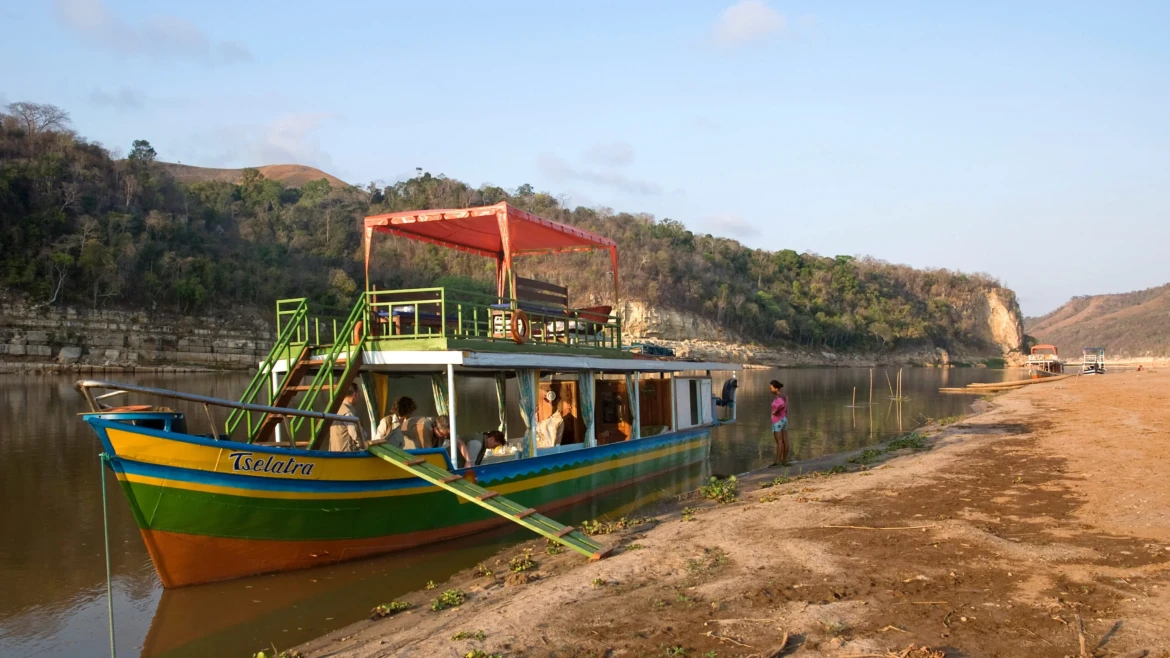
The first time you realize you’ve been listening to the river instead of your phone for hours, the Tsiribihina has already done its job. Days on this water don’t feel “busy” the way most travel days do. They feel wide – long bends, warm light on sandstone cliffs, a village canoe gliding past, and the kind of quiet that makes you notice everything.
A tsiribihina river descent tour is one of Madagascar’s classic adventures for a reason. It’s scenic, cultural, and surprisingly restful – but it’s still remote. Knowing what it’s really like (and what it isn’t) is the difference between a trip you tolerate and a trip you talk about for years.
Why the Tsiribihina descent is a Madagascar classic
If you’re building a Madagascar itinerary from the US, you’re usually trying to balance four big goals: endemic wildlife, iconic landscapes, cultural moments that feel real, and logistics that don’t spiral. The Tsiribihina descent hits all four.
The river runs through western Madagascar’s drier country, where the scenery shifts from open banks to tall cliffs and palms. You pass small riverside communities where life is tied to the water: fishing, washing, crossing by dugout canoe. It’s also one of the best ways to break up what can otherwise be a long overland push between the highlands and the west.
The experience is not a theme-park “river cruise.” It’s a working river and a slow journey. You travel at the river’s pace, and that’s the point.
What a tsiribihina river descent tour looks like day to day
Most descents run 2 to 3 days, depending on water levels, the craft used, and how much time you want for stops. Some travelers stretch it a bit longer for a more unhurried rhythm.
Mornings typically start early, when the air is cooler and the river is calm. You’ll have breakfast in camp, pack up, then drift off with your crew. The boat ride itself is the main event – not adrenaline, but immersion. You read the banks for movement, watch kingfishers flash by, and see how the light changes the cliffs as the sun climbs.
Stops are part of the flow. You might pull in for a short walk, a swim in a safer section, or to visit a village. Lunch is usually prepared by the crew and eaten on a sandy bank or under shade.
Evenings are when the Tsiribihina becomes unforgettable. Camps are set on the riverbank, often on sandbars. The sunset can be spectacular, and once it’s dark, you feel the distance from cities in the best way. Dinner is simple and satisfying. Then the river takes over the soundtrack again.
Comfort note: this is camping. It can be very well organized, but it’s still camping – you’ll have sand, humidity, and basic facilities. If you love a hot shower and crisp hotel sheets every night, this is where the trade-off is real.
Route options and how to choose the right one
Not every Tsiribihina descent is identical. The broad idea is the same, but details change based on the starting point, where you end, and whether you continue onward to other western highlights.
A common approach begins upstream (often reached via a drive from Antananarivo through the highlands) and ends closer to the Morondava area. Many travelers combine the river with the Avenue of the Baobabs and, if time allows, push farther to the Tsingy region.
How to choose:
If you want the descent as a scenic interlude on a longer route, a 2-day descent (but please note, that it will cost the same as a 3 days one) keeps momentum and fits neatly into a 10-15 day itinerary.
If you want the river to be a core experience, a 3-day descent gives you more time for stops, swims, and relaxed evenings in camp.
If your top priority is comfort and predictability, talk honestly about that before you book. Sometimes it makes sense to focus on lodge-based western highlights instead, or to do a shorter segment.
Wildlife and nature: what you can realistically expect
Madagascar is famous for dense rainforests and lemur parks, so some travelers assume the Tsiribihina will be nonstop wildlife. It’s different here. This is a drier ecosystem, and sightings are more about paying attention.
You’re likely to see plenty of birds, and you may spot lemurs in riverside forest pockets depending on where you stop. Reptiles and interesting riverbank life are part of the picture too.
The bigger “wildlife” moment is often the landscape itself: cliffs, baobabs in the distance, and that feeling of moving through a living corridor.
It depends on season, noise levels, and luck – so it’s best to treat wildlife as a bonus rather than the sole reason you go. If lemurs are your must-have, you’ll want to pair the Tsiribihina with a rainforest park elsewhere in your itinerary.
Best time of year for the Tsiribihina
Season matters here because water levels and weather shape the whole experience.
In the dry season (roughly May to October), conditions are generally the most comfortable for camping and travel. Days are warm, nights can be cooler, and rain is less likely to disrupt the river plan.
In the wet season (roughly November to April), you can get heavier rains and more unpredictable conditions. Higher water can change timing and safety considerations. In some periods, roads to and from the river can be more challenging.
There’s no single “perfect” month for everyone. If you’re sensitive to heat, shoulder months can feel better. If you want maximum reliability, dry season typically wins.
Camping, food, and facilities: set expectations early
A well-run Tsiribihina descent can feel surprisingly comfortable for camping because the crew does a lot: setting camp, preparing meals, organizing water, and managing the daily rhythm.
That said, you should expect basic conditions. Toilets may be simple setups. Showers, when available, are usually bucket-style. You’ll want to be comfortable being a little dusty and a little sandy.
Food is usually hearty and straightforward – think rice, vegetables, and whatever fresh protein is available. If you have dietary needs, say so early. In remote regions, flexibility is helpful, but planning makes a big difference.
Safety and logistics: what makes or breaks the experience
The Tsiribihina is not the place to “wing it” if you’re new to Madagascar. The river itself is only one piece. Getting to the start point, coordinating boats and crew, managing supplies, and timing onward travel all require local know-how.
Safety is mostly about smart decisions: wearing life jackets when advised, choosing swim spots carefully, and listening to the crew about river conditions. Sun exposure is also real on the water – shade comes and goes, and reflection adds up.
The make-or-break factor is operator quality. A strong team keeps camp clean, food consistent, pacing comfortable, and contingencies ready if weather or schedules shift.
How to fit it into a 10-15 day Madagascar itinerary
For many US travelers, the Tsiribihina is best as a centerpiece in a longer loop rather than a standalone. A classic structure is:
Start in Antananarivo, head west by road, descend the river, then continue to Morondava for baobabs and sunsets. From there, you can choose: continue north toward tsingy landscapes if you have the time and appetite for more rugged travel, or swing toward beaches later in the trip for recovery and ocean time.
The key is pacing. The river slows you down in the best way, but you don’t want to stack it immediately after multiple punishing road days without a plan for rest. Some travelers love the contrast. Others feel worn out if everything is “adventure” with no soft landing.
This is where customization matters. If you want a private itinerary that threads the Tsiribihina into a bigger nature-and-beach route with vetted drivers and guides, we do this kind of on-the-ground planning at Travelers of Madagascar – built around your dates, comfort level, and must-see regions.
Who this tour is perfect for (and who should think twice)
A Tsiribihina descent is perfect if you want Madagascar to feel big and real – not just a checklist of parks. It suits travelers who enjoy slow travel, don’t mind basic camping, and want cultural encounters that happen naturally.
You should think twice if you strongly prefer guaranteed comfort every night, if you’re uneasy around water, or if your schedule is so tight that one delay would cause major stress. Madagascar rewards patience, but it does ask for it.
If you’re on the fence, consider a shorter descent or build extra buffer days into your route. The river is most enjoyable when you’re not watching the clock.
The Tsiribihina doesn’t try to impress you with constant action. It wins by changing your sense of time. Give it a little space in your itinerary, and you’ll step off the boat feeling like you didn’t just see Madagascar – you felt it.