Introduction: Where the Road Ends and the Ocean Begins
If you travel south from Morondava, the paved roads dissolve into sandy tracks, the baobabs grow shorter and stouter, and the silence of the dry forest takes over. After four hours of bumping through the bush and skirting the edge of the Mozambique Channel, you arrive at a place that feels like the end of the world: Belo sur Mer.
Belo sur Mer is not a resort town. It is not a place of manicured lawns or infinity pools. It is a working village, a living museum, and perhaps one of the most authentically Malagasy destinations you can visit.
Here, the rhythm of life is dictated solely by the tides and the sun. It is a place of blinding white salt flats, turquoise lagoons, and the rhythmic sound of wooden mallets striking timber. This guide explores the soul of Belo sur Mer, a sanctuary for travelers seeking to disconnect from the modern world and reconnect with an older, simpler way of life.
1. The Soul of the Coast: The Vezo People
To understand Belo sur Mer, you must understand its people. This is the heartland of the Vezo.
Nomads of the Sea
The Vezo are unique in Madagascar. Unlike other tribes defined by their ancestry or land, the term “Vezo” essentially translates to “people who paddle.” Being Vezo is a lifestyle choice as much as an ethnicity. It means you live by the sea, for the sea, and from the sea.
- The Philosophy: In Belo sur Mer, the ocean is not a view; it is a provider, a road, and a home. The Vezo are semi-nomadic, often packing their families into outrigger canoes (pirogues) to set up temporary camps on distant sandbars during fishing seasons.
- Authenticity: Walking through the village, you witness a life uncluttered by modern distraction. Children play with toy boats made of driftwood in the shallows, women mend nets under the shade of neem trees, and men prepare the sails for the morning catch.
2. The Shipwrights of the Indian Ocean: The Botry Builders
The defining image of Belo sur Mer is the skeleton of a massive wooden ship rising from the sandy beach. This is the capital of dhow building in Madagascar.
A Legacy of the Spice Route
The ships built here, known locally as Botry, are direct descendants of the Arab dhows that sailed the Indian Ocean trade routes centuries ago.
- The Craft: Watching the shipwrights is a mesmerizing experience. There are no blueprints, no computers, and no heavy machinery. The master builder holds the design in his head, passed down from his father.
- Handmade: Everything is done by hand. The ribs of the ship are shaped from curved tree trunks found in the dry forest. The planks are sawn manually. The gaps are caulked with cotton and traditional sealants.
- The Launch: If you are lucky enough to be in Belo sur Mer when a boat is finished, you will witness a village-wide celebration. Launching a 50-ton wooden schooner without cranes requires the muscle power of the entire community, rolling the vessel on logs into the tide.
These boats are the 18-wheelers of the west coast. Once launched, they will spend decades transporting salt, dried fish, and supplies between Toliara, Morondava, and Majunga, powered only by the wind.
3. The White Gold: The Salt Flats (Les Salines)
Looking inland from the sea, the landscape shifts from blue to a blinding white. Belo sur Mer is famous for its salt production.
The Clay Pans
The geography here—flat clay earth and high tidal reach—is perfect for solar salt extraction.
- The Process: A network of canals brings seawater into shallow clay basins. Under the fierce sun of the Menabe region, the water evaporates, leaving behind pure sea salt.
- The Visuals: The contrast is a photographer’s dream. The geometric squares of the salt pans mirror the sky, bordered by the dark green of the mangroves.
- The History: This industry was formalized by French settlers (specifically a Breton family) in the early 20th century, but the locals have adapted it as a primary source of income alongside fishing.
- The Visit: You can walk through the salt pans (best done in the late afternoon when the glare is manageable). Watching the workers harvest the salt into pyramid-like piles is a scene of industrial beauty that has remained unchanged for a hundred years.
4. Kirindy Mitea National Park: Where Lemurs Meet the Ocean
Many travelers confuse this with the Kirindy Forest north of Morondava. However, Kirindy Mitea, located just south of Belo sur Mer, is a far more diverse and less visited gem.
The Transition Zone
The park is unique because it sits at the convergence of two ecosystems: the dry western tropical forest and the southern spiny desert.
- The Fauna: It is home to the Verreaux’s Sifaka (the dancing lemur), the Ring-tailed Lemur, and the elusive Fossa (Madagascar’s top predator).
- The Coast: What makes Kirindy Mitea special is that the forest runs right up to the beach. It is one of the few places in the world where you might see a lemur in a tree with the ocean in the background.
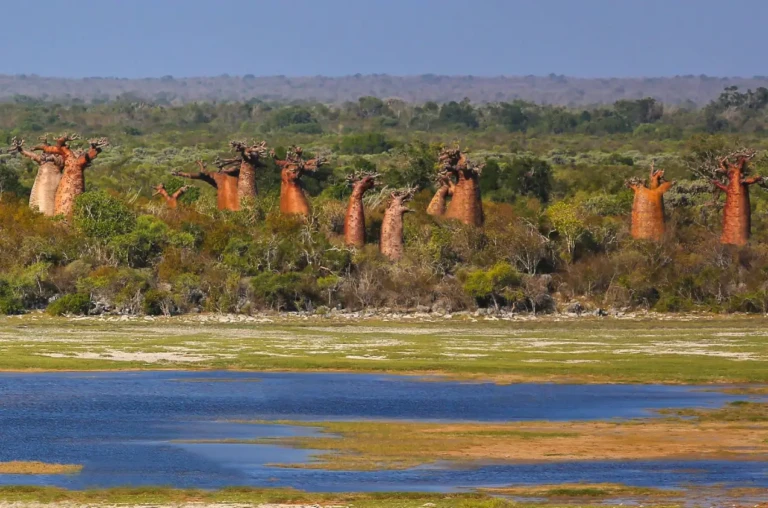
- The Baobabs: The park is filled with three species of Baobabs (Adansonia grandidieri, A. rubrostipa, A. za). Unlike the famous “Avenue” which is manicured, here the baobabs grow wild in the bush, often twisted into fantastical shapes.
5. The Islands: A Castaway’s Dream
A short pirogue or motorboat ride from the village takes you to a string of coral islands that rival the Maldives in beauty, but without the overwater bungalows.
Nosy Andravoho and Nosy Andriangory
These small islets are uninhabited, save for temporary Vezo fishing camps.
- The Water: The lagoon here is crystal clear, protected by reefs. It is arguably the best snorkeling on the central west coast.
- The Experience: A day trip here involves sailing out in the morning, snorkeling the reefs, and having a picnic of fresh grilled fish caught by your boatman.
- Authenticity: You will likely be the only tourist on the island. You might share the beach with a Vezo family drying their catch of sea cucumbers or octopus, offering a glimpse into their nomadic life.
6. The Journey: An Adventure in Itself
Part of the “authenticity” of Belo sur Mer is that it is not easy to reach. The journey filters out the casual tourists.
By 4×4
- The Route: The road from Morondava is roughly 80km, but it takes 3 to 5 hours. It is a sandy, rutted track that crosses salt flats and dry forests.
- The Crossing: The adventure peaks at the Kabatomena River crossing. There is no bridge. Your 4×4 must drive through the river (only possible at low tide). It is thrilling and requires a skilled driver.
By Sea (The Local Way)
- The Transfer: Many lodges offer boat transfers from Morondava (about 1.5 to 2 hours by speedboat).
- The Pirogue: For the hardcore adventurer, you can hire a local Vezo sailing pirogue. This can take 6 to 10 hours depending on the wind. It is uncomfortable, hot, and wet, but it is the ultimate way to understand the Vezo perspective.
7. Life in the Village: “Mora Mora”
Belo sur Mer operates on “Mora Mora” time (Slowly, Slowly).
Electricity and Water
This is a remote location.
- Power: There is no grid electricity. Hotels run on solar power or generators that usually shut off at 10 PM. This means the nights are pitch black and the stargazing is spectacular.
- Water: Fresh water is precious. Most of it comes from wells and is slightly brackish. Hot showers are often heated by solar power or wood fires.
Cuisine
Do not expect a menu with twenty options. You eat what the ocean provides.
- Seafood: You will eat the freshest seafood of your life. Crab, lobster, calamari, and fish (Captain, Grouper, Kingfish) are caught in the morning and served for lunch.
- Coconut: Many dishes are prepared with coconut milk, a staple of coastal Malagasy cooking.
The Atmosphere
The village is incredibly safe. The locals are curious but respectful.
- The Market: Visiting the small morning market is a great way to interact. You won’t find souvenirs, but you will find mangoes, tomatoes, and dried fish.
- Sunday Afternoons: On Sundays, the beach becomes a playground. The whole village comes out to swim, play soccer in the sand, and relax. Joining in a game of beach soccer is a universal language.
8. Practical Tips for the Authentic Traveler
- Cash is King: There are no ATMs in Belo sur Mer. You must bring enough Ariary from Morondava to cover your entire stay, plus extra for emergencies.
- Sun Protection: The sun here is relentless. The white salt and sand reflect the UV rays. Bring high SPF, a wide-brimmed hat, and polarized sunglasses.
- Tides Matter: Everything in Belo depends on the tide. You cannot leave or arrive by boat at low tide. You cannot cross the river by car at high tide. Trust your local guide’s timing; do not try to rush nature.
- Mosquitoes: While drier than the east coast, mosquitoes are present. Bring repellent and ensure your mosquito net is intact.
- Respect the Fady: Ask about local taboos. For example, pointing at certain tombs with your index finger is often forbidden (use your knuckle or open hand).
Conclusion: The Place That Time Forgot
Belo sur Mer is not for everyone. It is hot, dusty, and difficult to reach. But for the traveler willing to endure the bumpy road, the reward is profound.
It is a place where the 21st century feels like a distant rumor. Standing on the beach at sunset, watching the silhouette of a massive wooden dhow drift past a baobab tree, you realize you are witnessing a scene that has played out exactly the same way for hundreds of years.
In a world of curated travel experiences and filtered photos, Belo sur Mer offers something rare: the raw, unfiltered, and achingly beautiful reality of authentic Madagascar.