
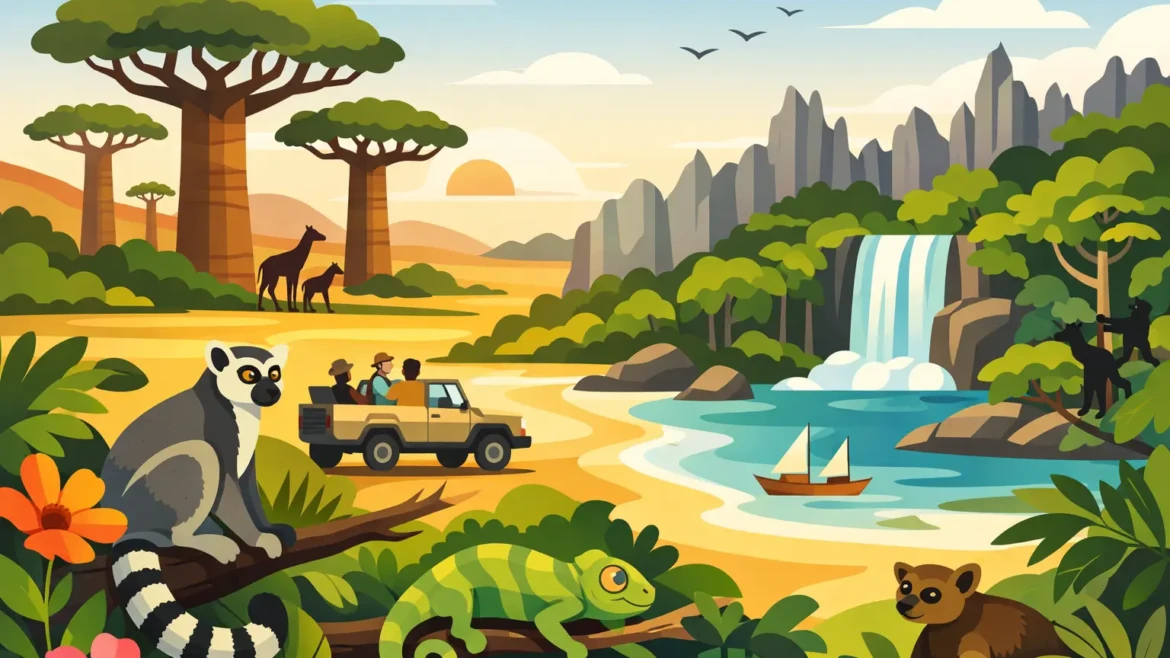
Madagascar rewards travelers who plan for contrast. One morning you are walking through misty rainforest listening for indri calls, and a few days later you are watching sunset through the baobabs or ending the trip beside warm coastal water. If you are searching for an ejemplo ruta biodiversidad Madagascar, the real question is not only where to go, but how to connect the island’s most iconic ecosystems without turning the journey into a constant series of rushed transfers.
For most first-time visitors from the US, the best biodiversity route is not the one that tries to cover everything. It is the one that balances rainforest, dry forest, endemic wildlife, and recovery time, with transport that feels realistic on Madagascar roads. Below is a 12-day example designed around exactly that principle – strong wildlife viewing, changing landscapes, and enough structure to feel smooth rather than exhausting.
A practical ejemplo ruta biodiversidad Madagascar
This route works especially well for travelers who want Madagascar’s signature natural highlights in a single trip: eastern rainforest, the central highlands, western dry forest, baobab scenery, and a beach finish. It is ambitious, but still manageable when the logistics are handled properly.
The broad arc is simple. You arrive in Antananarivo, continue east to Andasibe for rainforest wildlife, return through the highlands, fly west to Morondava for baobabs and dry habitats, then finish on the coast or an island extension depending on the season and flight schedule. That combination gives you biodiversity in the fullest sense of the word – not just more animals, but more habitats, different species behavior, and a better feel for why Madagascar is unlike anywhere else.
Days 1-2: Arrival in Antananarivo and transfer to Andasibe
After landing in Antananarivo, the smartest move is usually not to overcomplicate day one. Depending on your arrival time, you may rest in the capital or continue part of the way east. Madagascar can look compact on a map, but travel times often tell a different story.
By day two, you head to Andasibe, one of the island’s strongest introductions to endemic wildlife. This is where many travelers first understand the scale of Madagascar’s biological singularity. The forest is alive with sound, moisture, and movement. Chameleons, frogs, insects, and lemurs are not side notes here – they are the main event.
A night walk is worth building into the plan. Nocturnal species often become the memory people talk about longest after the trip. Mouse lemurs, sleeping chameleons, and tiny tree frogs can make a short evening outing feel unexpectedly rich.
Days 3-4: Andasibe National Park and nearby reserves
Two full days around Andasibe makes a real difference. Many itineraries cut this too short, and that usually means travelers leave feeling they only sampled the forest. With more time, guides can adapt to weather, animal movement, and your own pace.
This is the best place on many classic routes to look for the indri, the largest living lemur. Seeing one matters, but hearing one is what stays with you. Their haunting calls moving through the canopy are one of Madagascar’s defining wildlife experiences.
The other reason not to rush Andasibe is biodiversity density. Even beyond the headline species, the area delivers exceptional variety. Diademed sifakas may appear in nearby forest, and reptiles, orchids, and invertebrates reward slow observation. Travelers who enjoy photography often do particularly well here because the forest offers layered scenes rather than one single iconic viewpoint.
Why this Madagascar biodiversity route works
A good ejemplo ruta biodiversidad Madagascar should show how ecosystems change across the island. Madagascar is not one wildlife destination. It is a collection of biological worlds, separated by altitude, rainfall, and geology. That is why this route moves from humid east to drier west instead of staying in one region.
That shift is not only scenic. It changes what you see. The east is stronger for rainforest species, lush vegetation, and amphibians. The west introduces drier forests, baobabs, open light, and species adapted to tougher conditions. When travelers compare the two, Madagascar becomes easier to understand as an evolutionary story, not just a checklist of lemurs.
Day 5: Return to Antananarivo via the highlands
The drive back from Andasibe is a transition day, but it does not have to feel empty. The central highlands reveal another side of the country – terraced rice fields, roadside markets, red-earth hills, and a more cultural rhythm after the forest.
This contrast matters. A route built only around parks can miss the living context of the island. Even brief stops in the highlands help travelers connect biodiversity with village life, agriculture, and the realities of movement across Madagascar.
An overnight in Antananarivo usually makes the next flight easier and reduces the risk of tight connections causing stress.
Days 6-7: Fly to Morondava and visit the Avenue of the Baobabs
Morondava changes the mood immediately. The light is broader, the landscape opens up, and the journey becomes more cinematic. For many travelers, the Avenue of the Baobabs is the image that first drew them to Madagascar. It deserves its reputation, but it works best when treated as more than a quick photo stop.
Sunset here is the obvious choice, yet early morning can be just as rewarding for quieter conditions and softer light. Depending on timing, you can visit more than once. That flexibility matters because weather, haze, and crowd levels can shape the experience.
Morondava is also an excellent pivot point for western biodiversity. It does not offer the same dense rainforest feel as Andasibe, but it introduces Madagascar’s dry side in a way that broadens the whole trip.
Days 8-9: Kirindy or dry forest extension
If your priority is biodiversity rather than scenery alone, these are essential days. Kirindy Forest is one of the best dry forest experiences on a route like this, with a very different species mix from the east. This is where travelers may look for Verreaux’s sifaka, nocturnal lemurs, endemic birds, and the fossa if luck is on your side.
There is always a trade-off here. Dry forest can feel less immediately lush and dramatic than rainforest, especially to travelers who equate biodiversity with green density. But ecologically, this is part of what makes Madagascar so rewarding. The island’s uniqueness comes from variation. If you skip the west, you miss half the story.
Night walks in western forests can also be excellent, though expectations should stay realistic. Wildlife sightings depend on season, temperature, and timing. A strong guide makes a major difference.
Days 10-12: Coastal finish or island extension
After rainforest and road time, ending by the water is not a luxury add-on. It is smart trip design. Madagascar is large, distances are real, and a well-paced itinerary usually benefits from a softer finish.
From Morondava, some travelers prefer a relaxed coastal stay if the logistics line up cleanly. Others may connect onward for a beach ending that feels more distinct from the mainland journey. It depends on your budget, flight plan, and how much movement you still want at the end of the trip.
For wildlife-focused travelers, this final stretch can still carry natural interest. Coastal birdlife, mangroves, and marine settings add one more ecological layer. For honeymooners or couples, it also gives the route a better emotional rhythm – active days in the parks, then time to absorb the experience instead of flying home tired.
How to adapt this ejemplo ruta biodiversidad Madagascar
No single route is right for everyone. A photographer may want extra nights in Andasibe and Kirindy. A family might reduce internal transfers and keep the route tighter. Birders may build around seasonal targets, while travelers who care most about iconic landscapes could add more time in the west.
Season matters too. Rain can affect road conditions and wildlife visibility. Some months are better for lush scenery and amphibians, while others favor easier movement and drier trails. That does not mean there is one perfect season. It means your route should match what you most want to experience.
This is where local planning has real value. On paper, many Madagascar itineraries look similar. On the ground, the difference comes from pacing, road-day realism, airport coordination, hotel selection, and guide quality. Travelers of Madagascar builds routes around those operational details because they shape the trip as much as the parks themselves.
The strongest biodiversity itinerary is not the longest one. It is the one that respects distance, protects your energy, and gives each habitat enough time to reveal itself. Madagascar is a destination where good planning creates more wonder, not less. Start with a route that shows the island in layers, and you give yourself the best chance to feel what makes it unforgettable.