
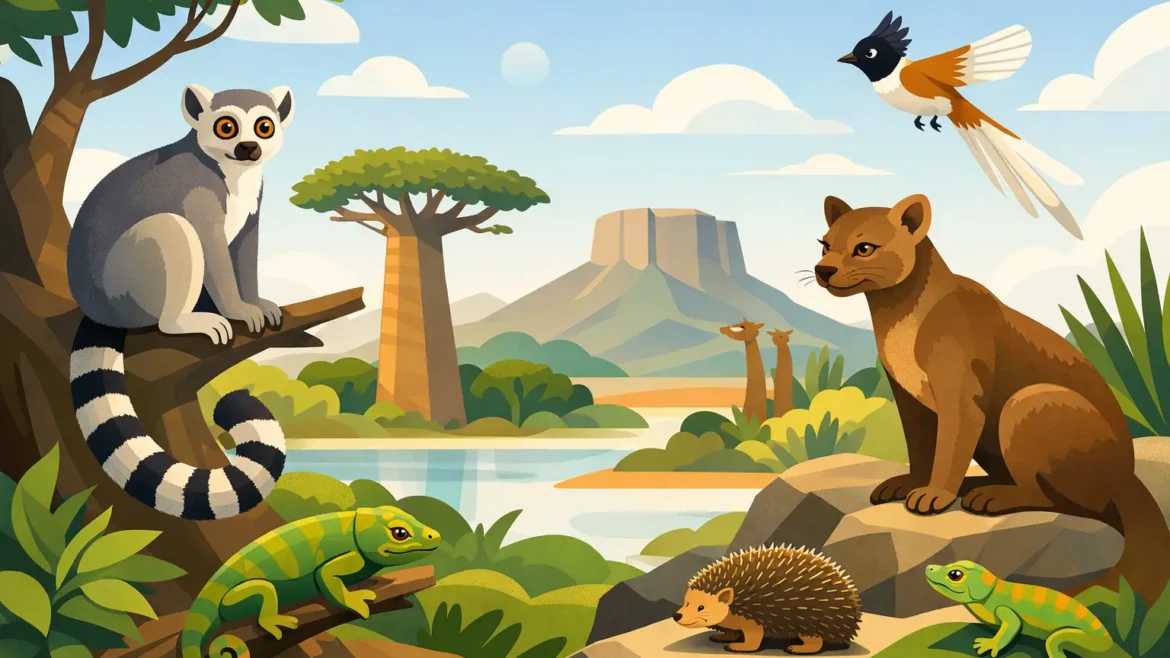
A sifaka crossing a forest clearing on its hind legs does not look real the first time you see it. Neither does a leaf-tailed gecko vanishing into bark a few feet from your guide, or a chameleon no longer than your thumb gripping a branch like a tiny acrobat. That is the point of any good guía fauna endémica Madagascar – helping you understand not just what you might see, but where, when, and why this island feels unlike anywhere else.
Madagascar is not a safari destination in the East African sense. You do not come here for vast herds on open plains. You come for evolution in isolation. Around 90 percent of Madagascar’s wildlife is endemic, meaning it exists nowhere else on Earth. For travelers from the US, that makes route planning especially important. The country is large, roads can be slow, and the animals you most want to see are spread across very different habitats.
Why Madagascar’s endemic fauna is so extraordinary
Madagascar broke away from other landmasses millions of years ago, and that long isolation shaped species found nowhere else. Lemurs are the headline act, but they are only part of the story. Chameleons, tenrecs, fossas, day geckos, baobab-dependent birdlife, and an astonishing range of frogs all evolved in ecosystems that can change dramatically from one region to the next.
This is why a short trip focused on one forest gives you a real experience, but not the full picture. Rainforest in the east produces a different wildlife encounter than dry forest in the west or spiny desert in the south. If your goal is to see Madagascar’s endemic fauna well, not just quickly, the itinerary matters as much as the species list.
Guía fauna endémica Madagascar by region
The simplest way to plan is by habitat. Madagascar rewards travelers who choose a route around wildlife priorities rather than trying to cover the whole island too fast.
Eastern rainforests – lemurs, frogs, and chameleons
For many first-time visitors, the east is the most immediate introduction to endemic wildlife. Parks such as Andasibe-Mantadia are among the best places to see indri, the island’s largest living lemur, famous for its haunting calls at dawn. Diademed sifakas, bamboo lemurs, colorful Mantella frogs, and a surprising number of reptiles also make this region a strong start.
The advantage here is accessibility relative to other major wildlife zones. If your time is limited, Andasibe often gives the highest wildlife return for the least logistical effort. It is especially good for travelers who want both daytime forest walks and night walks, when mouse lemurs, tree frogs, and sleeping chameleons become easier to spot.
Ranomafana, farther south, adds another layer. Its cloud forest setting is richer, wetter, and more physically demanding. In return, you get a deeper rainforest experience and the chance to look for rarities such as the golden bamboo lemur. If you enjoy hiking and want a more immersive wildlife rhythm, this is where Madagascar starts to feel truly wild.
Western dry forests – iconic species and dramatic landscapes
The west feels different immediately. The light is harsher, the forests are drier, and the landscapes open up around baobabs and sandy tracks. Kirindy Forest is one of the best-known wildlife stops here, especially for travelers hoping to see the fossa, Madagascar’s top predator. It is elusive, but this is one of the better places to try.
Kirindy is also strong for nocturnal lemurs and reptiles. The dry forest habitat makes some sightings easier than in dense rainforest. The trade-off is that the experience can feel more seasonal. Conditions, road access, and animal activity vary more noticeably depending on the time of year.
Further north, Ankarafantsika is a rewarding park for birders and travelers who want a less crowded wildlife stop. Coquerel’s sifaka, mongoose lemurs, and dry forest birdlife make it a smart addition for those who want more than the standard circuit.
Southern spiny forest – the strangest ecosystem of all
If you want the most visually unusual endemic habitat in Madagascar, head south. The spiny forest near Ifaty and Berenty introduces a surreal world of thorny plants, specialty birds, and lemur species adapted to dry conditions. Ring-tailed lemurs are a major draw here, particularly for travelers who want excellent viewing and photography.
This region is also where many visitors begin to appreciate how Madagascar blends wildlife with culture and landscape. The fauna is remarkable, but so is the atmosphere of the south – arid, open, and very different from the green east. It works especially well in longer cross-island itineraries that show the country’s contrast rather than just one side of it.
The endemic animals most travelers want to see
Lemurs usually come first, and for good reason. Indri, ring-tailed lemurs, sifakas, bamboo lemurs, and tiny mouse lemurs each create a different kind of encounter. Some are best appreciated for behavior, others for sound, and others for sheer charisma. If seeing multiple lemur species is your main priority, plan on visiting at least two habitats.
Chameleons are the second revelation for many travelers. Madagascar has species that range from miniature to spectacularly ornate. Parsons chameleon often gets the most attention because of its size, while leaf chameleons and stump-tailed species impress in the opposite way. A skilled local guide makes all the difference here. Without one, many reptiles simply remain invisible.
Then there are the animals people do not expect. The fossa feels like a creature invented from several others at once. Tenrecs can look vaguely hedgehog-like, but they are part of Madagascar’s own evolutionary story. Day geckos bring impossible color. Birds such as the ground rollers and vangas reward travelers who thought they were not especially interested in birding.
How to choose the right wildlife route
A practical guía fauna endémica Madagascar should be honest about trade-offs. If you have 7 to 9 days, it is usually better to choose one strong region and one complementary extension than to spend your trip in transit. Andasibe with a beach finish works well. So does a southern route that combines rainforest, highlands, and dry forest.
If you have 10 to 15 days, Madagascar opens up properly. You can build a route that includes eastern rainforest for indri, central highlands for cultural transition, and southern or western habitats for very different species and scenery. This is where private planning becomes valuable. Distances on the map often look manageable, but actual travel times say otherwise.
If your priority is photography, ask for early starts, multiple nights in key parks, and a pace that allows repeats rather than one quick walk per site. If your priority is comfort, that can absolutely be done, but you may need to accept a more selective route. Madagascar rewards ambition, but it punishes overpacked itineraries.
When to travel for endemic wildlife
There is no single perfect month for every species. That is the truth. The dry season generally brings easier road conditions and simpler logistics, which matters a lot in Madagascar. Wildlife viewing is often very good during this period, particularly for general circuits.
The wetter months can be excellent for lush scenery, frogs, and active reptiles, but they also bring more uncertainty. Some routes become harder, and certain parks can be less straightforward to access. Birders and repeat visitors sometimes benefit from traveling in shoulder periods, when the mix of conditions can be especially rewarding.
For most first-time travelers from the US who want a balanced wildlife trip with manageable logistics, the safest choice is to build around the drier months and then fine-tune by region and species interest.
Why guided logistics matter more here than in easier destinations
Madagascar is one of those places where local execution changes the entire trip. Wildlife sightings depend on park timing, guide quality, and knowing which routes are realistic. Hotel choice matters because some locations are best experienced with dawn starts or night walks, and a bad transfer plan can cost you a full wildlife day.
That is why many travelers choose a structured private itinerary rather than trying to piece everything together themselves. A well-designed route gives you the right forests in the right order, reduces tiring backtracking, and protects the quality of the experience. For a destination this special, that is not a luxury. It is often the difference between seeing Madagascar and truly feeling it.
Madagascar does not offer generic wildlife moments. It gives you strange calls in morning mist, eyeshine in the dark, and animals that exist nowhere else because this island has always followed its own rules. Plan for that uniqueness, leave space for it, and the trip will stay with you long after the forest sounds are gone.