
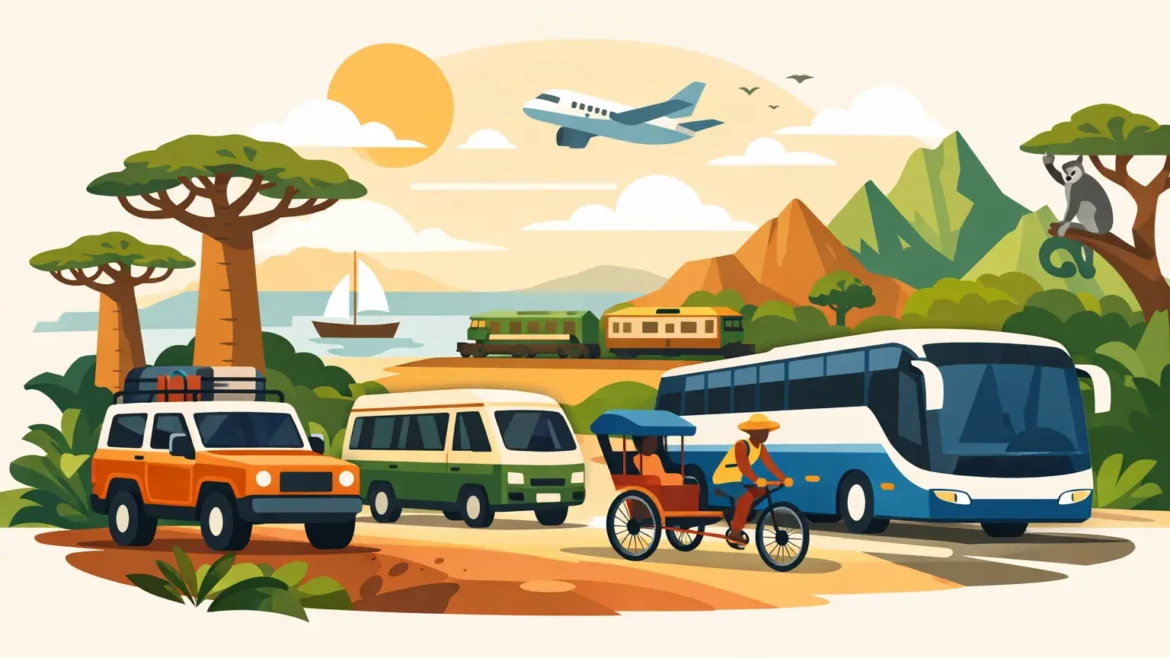
Landing in Madagascar can feel deceptively simple. On a map, a route from Antananarivo to Andasibe or Morondava may look manageable. On the ground, that same journey is shaped by road conditions, weather, mountain curves, traffic through towns, and long distances that demand more patience than many first-time visitors expect. That is exactly why a guía transporte terrestre Madagascar matters – not as a formality, but as the difference between a trip that flows and one that spends too much energy on logistics.
Madagascar is not a destination where overland travel is just a transfer between highlights. The road itself is part of the experience. Rice terraces unfold outside the window, highland villages rise from red earth, zebu carts share the route, and the landscape shifts dramatically from rainforest to dry forest to coastal plains. But this beauty comes with a practical truth: terrestrial travel here requires planning, realistic timing, and local judgment.
Why this guía transporte terrestre Madagascar matters
For US travelers used to predictable drive times and standardized road networks, Madagascar often resets expectations on day one. Distances that appear short can take most of a day. Some national roads are scenic and serviceable, while others are rough, slow, and tiring. A route can be perfectly feasible in the dry season and significantly harder after heavy rain.
That does not mean road travel is a bad idea. Quite the opposite. For most classic itineraries, it is the only way to connect Madagascar’s most rewarding wildlife and landscape experiences. If you want to combine lemurs in Andasibe, the highlands around Antsirabe, the sandstone canyons and ring-tailed lemurs of Isalo, and the baobabs near Morondava, overland logistics are central to the trip.
The key is to match your route to your travel style. If you want to cover major ground without stress, a private vehicle with an experienced local driver is usually the smartest choice. If you are highly independent and comfortable with uncertainty, self-drive can work on selected routes, but it is not the right fit for every region.
The reality of road travel in Madagascar
Madagascar is a large island, and its transport rhythm is slower than many visitors anticipate. Road quality varies widely, even within a single journey. A paved section can give way to potholes, broken edges, or urban bottlenecks. Some stretches demand steady caution rather than speed.
This is why planning by mileage alone does not work well here. It is more useful to think in full travel days. Antananarivo to Andasibe is a relatively accessible road transfer. Antananarivo to Morondava is much longer and can feel like a full expedition. Southbound routes through Antsirabe, Ranomafana, Fianarantsoa, and Isalo are among the island’s classic travel corridors, but they still require stamina and careful pacing.
There is also a comfort factor. Long drives in Madagascar are rarely about luxury for its own sake. Comfort affects how much energy you still have when you arrive at a forest night walk, an early lemur trek, or a sunset at the Avenue of the Baobabs. Good transport planning protects the experience you came for.
Private car and driver: the best fit for most travelers
For first-time visitors, couples, friend groups, and anyone building a 10- to 15-day route, a private car with driver is usually the strongest option. It gives you control over your schedule, flexibility for photo stops, and a much safer margin when road conditions change.
Just as important, a good driver in Madagascar does much more than drive. He reads the road, adapts to local conditions, manages timing between hotels and parks, and helps smooth the small operational details that can otherwise consume a day. That local experience matters most on long routes and in remote areas where quick decisions make a real difference.
The quality gap between vehicles and drivers can be significant. A well-maintained 4×4 is not always necessary on every itinerary, but on rougher roads it makes a noticeable difference in comfort and reliability. On easier paved routes, a standard vehicle may be enough. The right choice depends on your route, season, baggage, and tolerance for long days.
This is one area where working with an on-the-ground specialist pays off. Travelers of Madagascar, for example, builds itineraries around vetted drivers and route realities rather than optimistic estimates. That kind of local control is not glamorous, but it is often what makes a complex Madagascar journey feel calm instead of chaotic.
Self-drive in Madagascar: possible, but not for everyone
Some travelers are drawn to the freedom of driving themselves. In theory, that can be a rewarding way to move at your own pace. In practice, self-drive in Madagascar works best for experienced international drivers who are comfortable with variable road conditions, signage that may be limited, and long stretches without the kind of roadside support they may expect elsewhere.
The main trade-off is attention. If you are driving, you are not fully taking in the scenery, resting between activities, or relying on local road knowledge in real time. In a destination where transfers can already be long, that trade-off is bigger than it might seem.
There is also the question of route suitability. Some areas are more realistic for independent driving than others. A relatively straightforward highland route is one thing. Remote tracks, seasonal roads, or sections where delays can ripple through the rest of the itinerary are another. If you do consider self-drive, choose a conservative route and build in extra time.
Taxi-brousse and shared transport
Budget-minded travelers often ask about taxi-brousse, Madagascar’s shared minibus system. It is part of daily life for many locals and can connect major towns at low cost. But for most US travelers on a limited vacation window, it is not the most effective way to experience the island.
The issue is not just comfort. Departure times can be fluid, vehicles can be crowded, and travel days are often longer and less predictable than expected. If your priority is simply getting from one town to another as cheaply as possible, it may be workable. If your priority is wildlife timing, hotel coordination, and a smoother overall experience, private transport is usually worth the difference.
There are destinations where independent shared transport adds spontaneity. Madagascar can offer that too, but the cost is often time, energy, and reliability.
Best overland routes for first-time visitors
Antananarivo to Andasibe
This is one of the easiest and most rewarding road segments for a first trip. The transfer is manageable, and the payoff comes quickly: rainforest, indri calls, chameleons, and night walks. If you want a short itinerary with strong wildlife return and limited driving complexity, this route is a smart start.
The southern circuit
The classic route south from Antananarivo through Antsirabe, Ranomafana, Fianarantsoa, and Isalo is one of Madagascar’s great overland journeys. It works well because the travel arc feels coherent. You see changing landscapes, experience different ecosystems, and finish with a strong sense of the island’s range.
That said, it is not a quick loop. To enjoy it properly, you need enough days to break up the drives and avoid turning the trip into a blur of hotels and highways.
Antananarivo to Morondava
This route is famous because it leads to the baobabs, and the destination is absolutely worth seeing. But it is also one of the transfers travelers tend to underestimate. It is a long road journey, and depending on conditions, it can be tiring. If baobab landscapes are central to your dream trip, it belongs on the itinerary. Just plan it with realistic timing and not as a casual add-on.
Timing, weather, and seasonal trade-offs
In Madagascar, transport planning changes with the seasons. During the dry months, many overland routes are more reliable and easier to schedule. In wetter periods, especially where roads are already fragile, drive times can stretch and comfort drops.
This does not mean you should avoid travel outside peak conditions. It means you should build the itinerary around what the roads will realistically allow. A route that looks exciting on paper may become too ambitious if seasonal conditions add delay after delay.
This is also why same-day connections should be treated carefully. If a domestic flight, park entry, or boat departure is essential, you want buffer time. Madagascar rewards travelers who leave room for the road to be the road.
Safety and comfort on the road
Road travel in Madagascar is generally best handled during daylight hours. Night driving is usually avoided on longer intercity routes because visibility, road conditions, and roadside risks all become harder to manage. A well-planned itinerary respects that.
Comfort also matters more than many travelers think. Bring water, sun protection, and patience. Expect restroom stops to be practical rather than polished. Keep valuables secure and luggage sensible, especially if your route includes multiple hotels and regional transitions.
Most importantly, do not overpack your itinerary. Madagascar is not a place where adding one more stop always improves the trip. Often, the better choice is fewer regions, more time in each, and transport days that feel manageable enough to leave room for wonder.
How to choose the right ground transport plan
The best plan depends on what kind of traveler you are. If this is your first Madagascar journey and you want wildlife, landscapes, and cultural stops without second-guessing every transfer, private transport is the clearest answer. If you are experienced, flexible, and deliberately traveling slower, independent options can make sense in selected areas.
What matters is honesty about your priorities. Do you want the cheapest route, or the strongest trip? Do you want freedom, or do you want your energy saved for forests, canyons, beaches, and baobab sunsets? In Madagascar, those choices shape the entire experience more than most travelers expect.
The island gives back enormously to those who travel it well. Plan for real distances, trust local road knowledge, and treat transport as part of the journey rather than a detail to solve later. When the ground logistics are right, Madagascar opens up in the way it should – wild, varied, and unforgettable.