
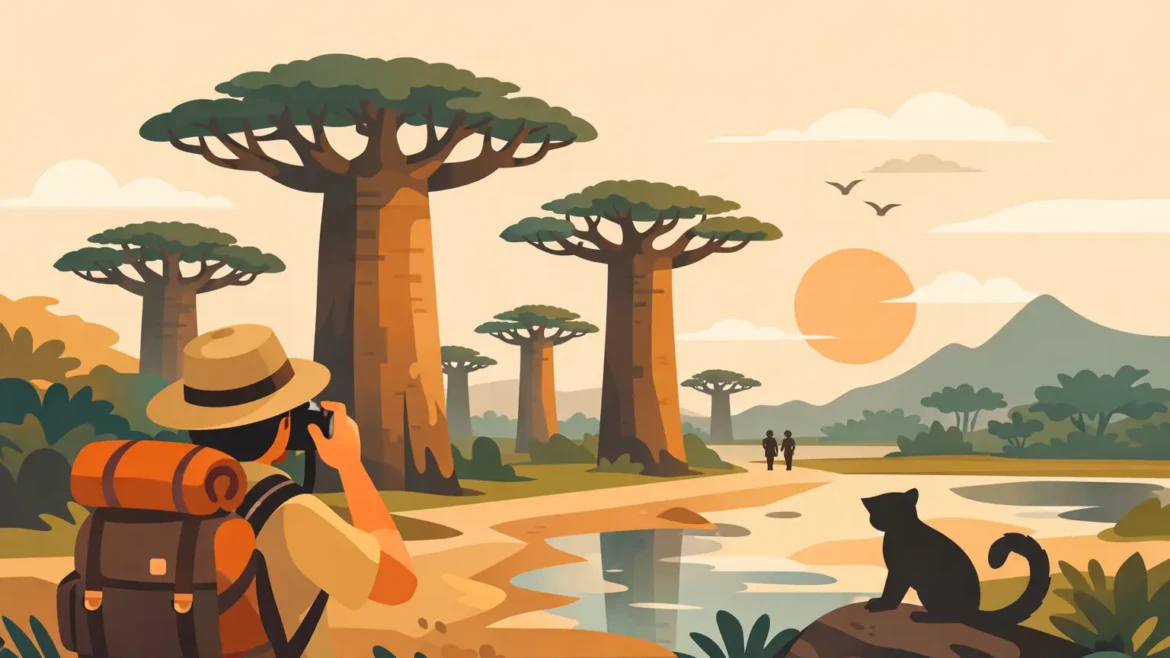
You do not travel to western Madagascar for a checklist moment. You go because there are landscapes that feel almost invented, and the baobabs around Morondava are among them. A Madagascar baobab tour is one of those trips that looks dramatic in photos, then somehow feels even more surreal when you are standing beneath those massive trunks at sunset, with red dust underfoot and the light turning gold across the plain.
For many travelers from the US, the baobabs are the image that first sparks interest in Madagascar. The mistake is thinking they are only a quick photo stop. Done well, this part of the island becomes a full journey through dry forests, wildlife-rich reserves, village life, and one of the most distinctive road routes in the country. The baobabs are the headline, but not the whole story.
Why a Madagascar baobab tour is worth the trip
The Avenue of the Baobabs is the best-known site, and for good reason. The trees rise straight from the earth with a scale that is hard to judge until you are beside them. Some are estimated to be centuries old. At sunrise, the landscape feels quiet and spacious. At sunset, it becomes theatrical without losing its sense of place.
But western Madagascar offers more than a single avenue of trees. Nearby reserves such as Kirindy add another dimension with dry deciduous forest, endemic wildlife, and a completely different mood from the island’s eastern rainforests. This is where travelers start to understand Madagascar’s contrast. In one itinerary, you can move from giant baobabs to lemur sightings, from dusty roads to coastal light, from big landscapes to very local encounters.
That range matters. If you are flying a long way to reach Madagascar, you want more than one iconic stop. You want a route that feels coherent, rewarding, and well-paced.
The classic route for a Madagascar baobab tour
Most baobab-focused itineraries center on Morondava, the gateway town on Madagascar’s west coast. From there, the standard arc includes the Avenue of the Baobabs and often Kirindy Forest Reserve. Some travelers continue farther north toward Bekopaka and the Tsingy de Bemaraha, creating a stronger overland adventure. Others keep the route shorter and pair the west with another region, such as Andasibe for rainforest wildlife or Nosy Be for beach time.
If your main goal is the baobabs, a short stay around Morondava can work. You can reach the avenue easily and time your visit for the best light. Still, a very short trip has trade-offs. You may see the famous trees, but miss the richer context of the region.
A better option for most travelers is to give the west at least two to four days. That leaves room for multiple visits to the baobabs, which matters because morning and evening feel completely different, and weather can change the mood of the landscape. It also gives you time to add Kirindy, where night walks can reveal nocturnal lemurs, fossas, and other wildlife that many first-time visitors do not expect to find in the same journey.
If you have more time, the west fits beautifully into a longer private itinerary. That is often the smartest way to travel in Madagascar. Distances are real, road conditions vary, and simple-looking transfers can take much longer than they would in the US. A trip that works on paper can feel rushed on the ground if it is not planned carefully.
What you will actually see beyond the Avenue of the Baobabs
The avenue gets the attention, but nearby baobab sites offer a more layered experience. You may visit the so-called Baobab in Love, where two trees have grown intertwined, or smaller clusters that feel less visited and more atmospheric. These stops are not always grander than the avenue, but they deepen the sense that western Madagascar is a true baobab landscape, not just one famous roadside scene.
Kirindy changes the rhythm of the trip. The forest is drier, flatter, and more understated at first glance than Madagascar’s lush eastern parks, but it rewards patience. This is one of the best places to appreciate how unusual the island’s ecosystems are. Giant jumping rats, sifakas, brown lemurs, reptiles, and birdlife all add texture to a route that many travelers initially imagine as purely scenic.
There is also a cultural side to the west that deserves space in the itinerary. Road journeys pass villages, working agricultural areas, and local markets that remind you this is a lived-in region, not an outdoor museum. The strongest trips make room for those moments without turning them into staged attractions.
Best time to plan a Madagascar baobab tour
Timing shapes this trip more than many travelers expect. The dry season, generally from May to October, is the most dependable period for road travel in western Madagascar. Skies are often clearer, conditions are easier, and the avenue tends to deliver those crisp sunrise and sunset views people hope for.
The shoulder months can be excellent too, especially if you want fewer visitors and slightly softer conditions. But there is always an “it depends” here. Early or late in the season, road quality, heat, and occasional weather shifts can affect comfort and timing.
The rainy season is more complicated. Landscapes can be greener, but logistics become less predictable, especially on routes that involve longer overland sections or extensions to remote areas like the tsingy. If your priority is smooth execution and reliable access, the drier months are usually the safer choice.
How long should your baobab trip be?
If baobabs are your single main focus, a compact three- to four-day segment around Morondava can work. It is enough for the avenue, a reserve visit, and a better-paced experience than a rushed overnight.
For most international travelers, though, a Madagascar baobab tour makes more sense as part of a broader 10- to 15-day itinerary. That is when the island starts to reveal its real variety. You can pair the west with lemur forests, highland scenery, or a few beach days at the end. The baobabs then become one powerful chapter in a much richer route.
This is especially valuable for first-time visitors. Madagascar is not a destination where you want to spend your entire vacation solving transport problems. A realistic itinerary, good vehicle support, and trusted local coordination make a noticeable difference to the quality of the trip.
What makes the experience better, not just longer
The best baobab tours are not built around quantity of stops. They are built around timing, pacing, and who is handling the ground logistics. A well-planned route gets you to the avenue when the light is right, allows for flexibility if weather shifts, and avoids turning every day into a long transfer followed by a late arrival.
Guide quality matters as much as the route. In Kirindy or similar reserves, a strong local guide will turn a forest walk into a wildlife experience rather than just a walk in dry woodland. Driver quality matters too. Western Madagascar is spectacular, but it is also a destination where road conditions and distances are part of the reality. Reliable transportation is not a luxury feature here. It is central to the trip.
Hotel choice also shapes the experience more than many travelers expect. In Madagascar, location, consistency, and service standards can vary a lot. The right property can help you recover well between drives and make early starts for sunrise visits much easier.
That is why many travelers prefer a private custom itinerary with local management on the ground. A specialist such as Travelers of Madagascar can design the route around your pace, wildlife interests, comfort level, and available days, instead of forcing the west coast into a generic schedule.
Is a Madagascar baobab tour right for you?
Yes, if you are drawn to unusual landscapes and you want one of Madagascar’s most iconic scenes without losing the deeper context of the island. It is an especially strong fit for couples, photographers, nature travelers, and anyone planning a first trip who wants a memorable visual highlight combined with wildlife and culture.
It may be less ideal if you want nonstop luxury with very short transfer times. Western Madagascar rewards travelers who are comfortable with some road time and with the fact that remoteness is part of the appeal. The experience is not difficult in an expedition sense, but it does ask for patience and good planning.
That trade-off is exactly what makes the region so special. The baobabs still feel earned. They are not presented behind barriers or polished into something artificial. You arrive, the light changes, the trees start to glow, and for a few minutes the whole landscape feels larger than the trip you thought you were taking.
If the image of Madagascar in your mind begins with giant ancient trees against a red sky, trust that instinct – then build the trip properly around it, so the road to the baobabs becomes part of the reason you remember it.