
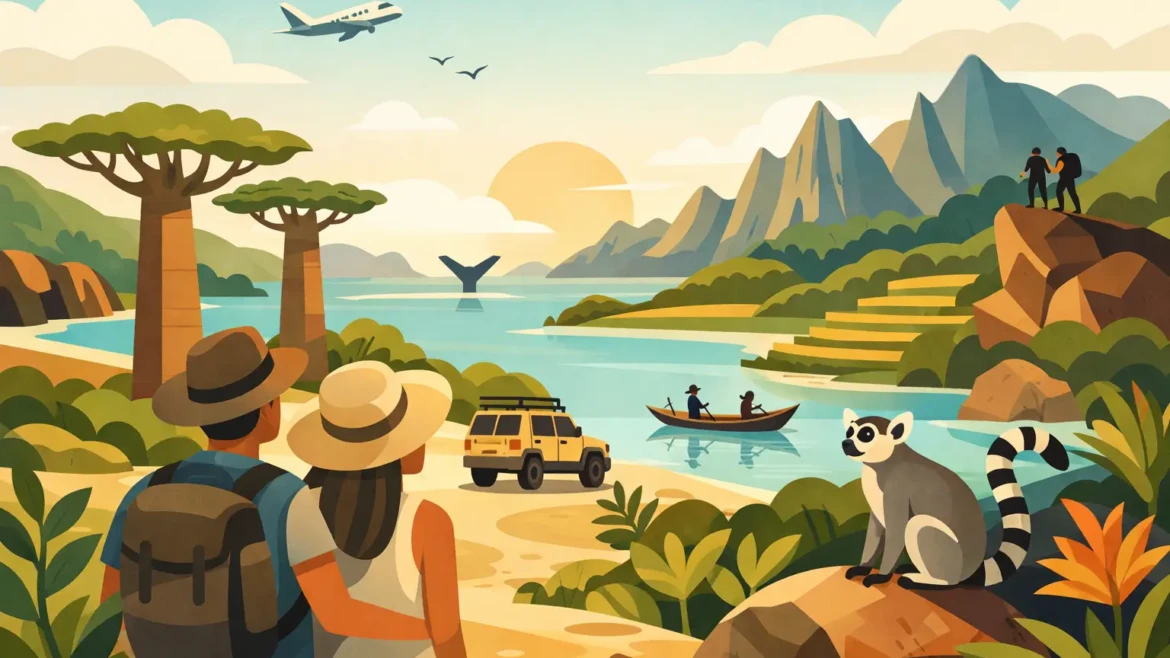
A Madagascar trip usually looks simple on a map right up until you start planning it. Distances are long, roads can be slow, flight schedules shift, and the best wildlife moments rarely happen on a tight, rushed timetable. That is exactly why Madagascar multi day excursions make so much sense. They give you enough time to move through very different landscapes, see wildlife when it is active, and experience the island as a complete journey rather than a string of disconnected stops.
Madagascar is not a destination you visit for one thing. You come for the lemurs, then find yourself standing under giant baobabs at sunset, walking through rainforest alive with birdsong, crossing stone forests of tsingy, and ending the trip on a warm coast with the Indian Ocean in front of you. The beauty of a well-designed multi-day route is that it turns those contrasts into one coherent experience.
Why Madagascar multi day excursions work so well
A day trip can show you a park or a beach. A multi-day itinerary shows you the island’s rhythm. Wildlife viewing is better when you are not racing in and out. Long drives become worthwhile when they connect habitats that feel completely different from each other. Even the practical side matters more here than in many destinations. Hotel standards vary, road conditions change, and some of the most rewarding areas require careful timing and local coordination.
For most US travelers, the biggest value is not simply transportation. It is having a route that is realistic. Madagascar rewards ambition, but it also punishes overpacking an itinerary. A good plan leaves space for early morning forest walks, sunset viewpoints, market stops, and the kind of moments you never remember to ask for in advance – watching sifakas leap through the trees, seeing village life along the road, or finding that one perfect stretch of beach at the end of a long overland route.
What a great multi-day route in Madagascar includes
The best itineraries are built around contrast. If every day feels the same, you are probably not seeing Madagascar at its best. Most travelers want a mix of wildlife, landscapes, culture, and a softer finish by the sea.
A classic first trip often pairs the eastern rainforests with the southern or western highlights. That might mean time in Andasibe for close lemur encounters and chameleon spotting, then heading south for highland scenery, ring-tailed lemurs, sandstone massifs, and the dry forest feel around Isalo. Another strong route focuses on the west – baobabs, Kirindy, and Tsingy de Bemaraha – then adds a coastal extension. These are very different journeys, and neither is automatically better. It depends on what you want to feel most strongly.
If wildlife is the priority, your itinerary should not just name parks. It should consider habitat variety. Rainforest species, dry forest species, nocturnal sightings, and birdlife all change by region. If landscapes matter just as much, you want a route that builds toward the dramatic – baobab avenues at golden hour, tsingy formations that feel almost unreal, canyons and open plateaus that show Madagascar’s scale.
The most popular trip styles
For first-time visitors, 10 to 15 days is often the sweet spot. It is long enough to experience the island without turning the trip into a nonstop transit schedule. Couples often prefer a balanced route with wildlife, scenic lodges, and a few nights on the coast. Friend groups may lean more into active routes with hiking, river descents, or tsingy crossings. Travelers returning to Madagascar usually go deeper into one region rather than trying to check every box.
That trade-off matters. If you try to combine the far north, deep south, and west in one trip, you will spend too much energy moving. A better itinerary chooses a logical arc and does it well.
Choosing the right Madagascar multi day excursions for your travel style
Start with one honest question: what would make this trip feel unforgettable for you? For some travelers, it is seeing as many lemur species as possible. For others, it is that cross-island feeling – forests, villages, baobabs, canyons, and then the beach. Some want romance and comfort with strong wildlife moments built in. Others are happy with early departures and long road days if the reward is reaching remote places.
This is where customization matters. Madagascar is not a plug-and-play destination. The right route for a honeymoon is rarely the same as the right route for photographers, birders, or travelers with a strong interest in culture. Even the same national park can feel completely different depending on your guide, your timing, and whether you stay nearby long enough to do both day and night walks.
A private itinerary also gives you room to adjust the pace. Maybe you want more nights in one park and fewer hotel changes. Maybe you want to add beach time in Nosy Be or another coastal area after a demanding overland route. Maybe you want to focus on high-quality wildlife guiding and skip anything that feels like filler. Those decisions shape the quality of the trip more than most people realize.
What to expect on the ground
Madagascar is rewarding because it is not polished into predictability. Roads can be rough. Drive times can be longer than they look. Internal travel requires experience to organize well. That should not scare you off, but it should influence how you book.
A strong local operator does more than reserve hotels and assign a vehicle. They know which driver can handle difficult routes without turning the day stressful. They know where guides consistently deliver excellent wildlife spotting. They know which hotels are worth the rate and which ones only look good in photos. They can also solve problems quickly when conditions change.
That local control is where trips become smoother, safer, and more enjoyable. In a destination with this much variability, details matter. A great driver can change the whole tone of a long overland journey. A great guide can turn a forest walk into the highlight of your trip.
Timing changes everything
The same route can feel very different depending on season. Rain can affect roads. Wildlife activity shifts. Some beach areas are more appealing in certain months, while some overland sections are easier and more comfortable outside the wettest periods.
That does not mean there is one perfect time to go. It means the itinerary should fit the season. If your dates are fixed, the route should adapt to those dates rather than forcing a plan that looks good on paper but works poorly in reality.
How long should your trip be?
If you are flying from the US, a very short Madagascar trip rarely gives enough return for the effort. Seven days can work for one focused region, especially if you want a compact wildlife escape. But for a broader first trip, 10 to 15 days is usually the better investment.
With 10 days, you can build a meaningful route with real depth. With 12 to 15 days, you can combine major wildlife areas with striking landscapes and a short beach finish. Once you go beyond that, Madagascar opens up even more comfortably, but only if the route is designed well. More days do not automatically mean a better trip. Poor pacing can still wear you out.
Why many travelers prefer a locally managed private tour
Madagascar is one of those places where local execution shows. When your itinerary is designed and managed by people who know the island firsthand, you feel it in the route logic, the quality control, and the confidence that someone is paying attention from arrival to departure.
That is especially valuable for travelers who want the wonder of Madagascar without having to personally manage every hotel, transfer, guide, permit, and timing question. Travelers of Madagascar approaches the island exactly this way – as a home terrain that deserves custom planning, carefully selected partners, and realistic routes that match each traveler’s priorities.
There is also a value question here. The cheapest-looking option is not always the best value once you factor in missed time, weak guiding, inconsistent hotels, or avoidable stress. A well-run private trip often pays for itself in quality and time saved.
The real goal of a multi-day journey here
The best trips in Madagascar do not feel like a checklist. They feel like a progression. You start by adjusting to the island, then you settle into its pace, and suddenly each region adds another layer – more species, more textures, different villages, different light, different moods. That is why multi-day travel works so well here. It gives Madagascar time to reveal itself.
If you plan well, you will come home with more than wildlife photos and dramatic landscapes. You will remember the changing roads, the local faces, the silence before dawn in the forest, and the strange, beautiful sense that nowhere else looks quite like this. Give the island enough days, and it gives you a trip with real depth.