
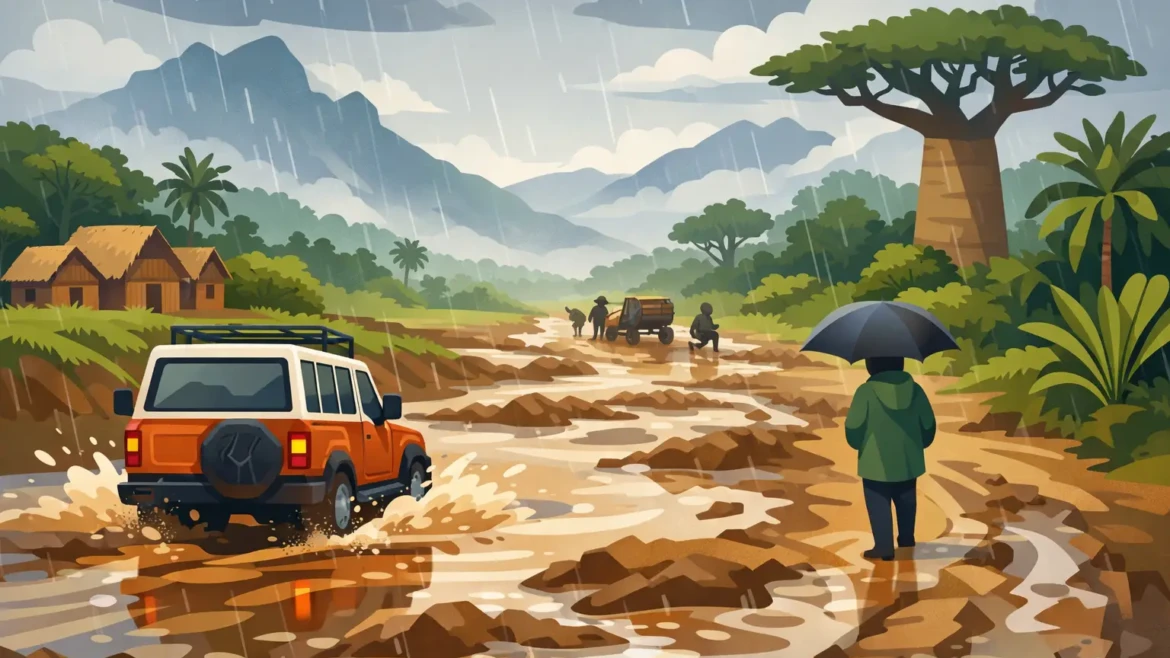
A four-hour drive can turn into ten in Madagascar after a night of hard rain. A smooth red-dirt track becomes deep mud, a shallow river crossing rises, and a route that looked simple on a map suddenly demands patience, timing, and the right vehicle. That is the reality of madagascar road conditions rainy season travelers need to understand before locking in dates and routes.
This does not mean you should avoid Madagascar during the wet months. It means you should plan differently. Rainy season travel can be lush, dramatic, and deeply rewarding, with greener landscapes, powerful waterfalls, fewer crowds in some areas, and remarkable wildlife activity. But road travel is where expectations matter most. In Madagascar, distance is only part of the equation. Surface quality, recent weather, local road works, bridge conditions, and the experience of your driver can matter even more.
What Madagascar road conditions in rainy season really mean
In much of Madagascar, roads are already variable in the dry season. Add sustained rain, and that variability becomes the central fact of the journey. Main paved highways can remain passable but develop potholes, standing water, soft shoulders, and traffic slowdowns around damaged sections. Secondary roads often deteriorate much faster. Dirt roads can become slick and deeply rutted, and some stretches become inaccessible without a true 4×4 and a driver who knows the terrain.
Rainy season usually runs from around November through April, with the heaviest impacts often seen from December to March. Cyclones and regional storms can make conditions change overnight. That is why broad statements such as “the road is open” are only partly useful. The better question is whether that road is realistically comfortable, safe, and time-efficient for your specific trip.
For visitors coming from the US, it helps to reset your frame of reference. In Madagascar, a road that appears on a major route may still feel remote and slow by American standards. During the rainy season, flexibility is not a bonus. It is part of good trip design.
Which roads are most affected during Madagascar road conditions rainy season
The biggest differences usually show up between paved national roads and unpaved access roads to parks, reserves, villages, and coastal areas. If your itinerary focuses on classic circuits with stronger infrastructure, travel is often still possible with careful pacing. If your plans depend on remote tracks, river crossings, or long overland links between regions, the rainy season raises the stakes.
The route east toward Andasibe is one of the more manageable options because it relies on a major road corridor from Antananarivo, though delays and rough patches can still happen. This is one reason the eastern rainforest zone remains attractive in wetter months. By contrast, routes in western and southern regions that depend on long dirt sections can become far more complicated. Access to places that feel wonderfully wild in the dry season may become unreliable or uncomfortable after repeated rain.
Even when a road remains technically open, the travel experience can change a lot. Sections may require very slow driving. A bridge bottleneck can create long waits. A vehicle may need to stop for local assessment before crossing a muddy stretch. For travelers trying to combine wildlife, scenery, and beach time across multiple regions, this is where a realistic itinerary becomes more valuable than an ambitious one.
The regions where timing matters most
Madagascar is not a one-condition destination. Rain patterns and road impacts vary by region, and that matters when building a trip.
The east coast and rainforest areas are humid for much of the year, so roads can stay challenging even outside peak rainy months. The upside is that these regions are built into many nature-focused itineraries, and access planning is relatively well understood. The west often involves long approaches on harder roads, especially once you leave the main highway network. These roads can become a serious obstacle in wet conditions, especially if your goal is a place like the Tsingy, remote baobab routes, or less-visited protected areas.
The south and southwest may see different seasonal patterns, but when rain does hit vulnerable sections, overland travel can still be disrupted. Deep sand mixed with rain, damaged tracks, and washouts are all possible. Northern routes vary widely. Areas with stronger tourism infrastructure may remain feasible, while remote links can shift quickly depending on local weather.
This is why “best time to visit” and “best time to drive” are not always the same thing. You may still have excellent wildlife viewing in one region while road access to another becomes the weak point of the itinerary.
Why vehicle choice and driver quality matter so much
During the rainy season, the difference between a workable journey and a miserable one often comes down to logistics. A proper 4×4 is not just a comfort upgrade on many routes. It is the tool that makes the route possible. Ground clearance, tire condition, and mechanical reliability matter much more when roads are muddy, uneven, and slow.
Just as important is the driver. In Madagascar, rainy-season driving is not about speed. It is about judgment. A skilled local driver knows when to push on, when to wait, how to read a flooded section, and when an alternate route will save hours. They also understand a truth many first-time visitors miss: forcing the schedule is usually the fastest way to lose control of the trip.
That is one reason many travelers prefer a locally managed private itinerary rather than trying to piece together long road segments on their own. At Travelers of Madagascar, for example, route planning is built around current on-the-ground conditions, not just map distances. That local read can save far more than time. It protects the quality of the journey.
Should you avoid overland travel in the rainy season?
Not necessarily. It depends on your priorities.
If your dream trip is a cross-island adventure linking multiple remote parks by road, the rainy season may not be the best match. You could spend too much of your vacation dealing with delays, fatigue, and route uncertainty. But if your goal is to experience Madagascar’s rainforests, lemurs, culture, and a few well-chosen landscapes without trying to conquer the whole island, wet-season travel can work very well.
The smartest rainy-season itineraries are usually tighter and more selective. They avoid unnecessary backtracking, reduce dependence on difficult secondary roads, and build in breathing room. Sometimes the better choice is to pair one overland region with a domestic flight or with beach time in an area that is easier to access. Sometimes it means choosing one exceptional rainforest experience over three scattered destinations connected by punishing road days.
There is a trade-off here. The more ambitious the route, the more weather can dominate the trip. The more focused the itinerary, the more space you keep for what you actually came to see.
How to plan around Madagascar road conditions rainy season
The first step is to decide whether your trip is experience-first or route-first. Most visitors are happier when they choose experiences first. Start with what matters most – lemurs, baobabs, rainforest walks, cultural encounters, beaches, or dramatic landscapes – and then build the most weather-resilient route around those priorities.
Next, be conservative with driving times. If a route looks long on paper, assume it may take longer than expected in the rainy season. Avoid stacking major transfers back to back. Give yourself room for a late arrival, a road slowdown, or a changed departure time without losing key activities.
It also helps to think in layers of reliability. Main roads to established destinations are one layer. Remote access tracks are another. Boat crossings, ferries, or weather-sensitive add-ons create a third layer. The more layers your trip depends on, the more vulnerable it becomes. Good planning reduces those weak points instead of hoping conditions will stay perfect.
Finally, ask current questions, not general ones. Instead of asking whether January is rainy, ask how a specific route has been performing recently, whether a park access road is currently realistic, and what backup plan makes sense if weather shifts. Madagascar rewards travelers who plan with real conditions, not assumptions.
The upside of traveling in the wet season
Rain changes the island in beautiful ways. Forests feel alive, rice fields glow green, and many landscapes look fuller and more dramatic than they do later in the year. In some regions, wildlife activity can be excellent, and the atmosphere feels intensely tropical in the best sense of the word.
There is also something deeply memorable about seeing Madagascar in a more elemental mood. Mist hanging over the hills, red earth roads cutting through bright green countryside, villages moving with the rhythm of the weather – this is part of the island too. The key is making sure the romance of the season is matched by realistic transport planning.
If you approach the rainy season with the right mindset, it is not simply a risk to manage. It is a version of Madagascar that asks for more flexibility and rewards it with a different kind of beauty. Plan for slower roads, trust local judgment, and let the route serve the experience, not the other way around.