
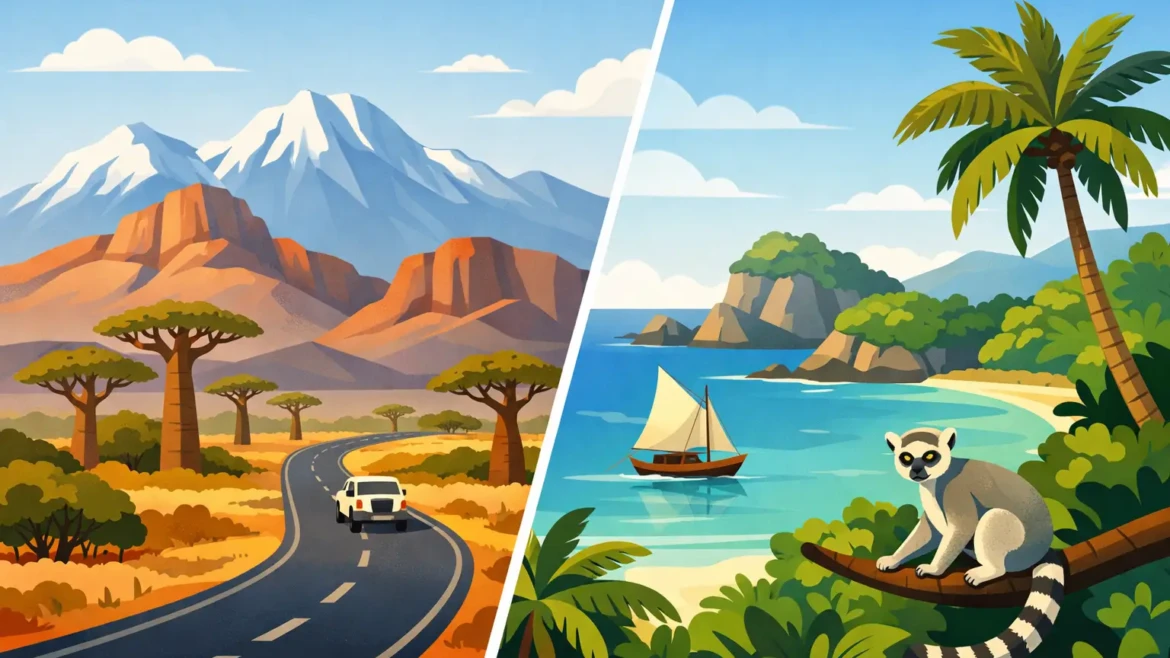
You can feel the choice almost immediately when planning Madagascar: do you follow the classic RN7 route south from Antananarivo, or head north for rainforest, islands, and a wilder coastal rhythm? If you are weighing RN7 route versus northern Madagascar, you are really deciding what kind of trip you want to remember most – long overland variety, or a more tropical mix of forest and sea.
Both routes deliver the Madagascar most travelers dream about. Both can include lemurs, dramatic scenery, and unforgettable local encounters. But they do not feel the same on the ground, and that difference matters more than many first-time visitors expect.
RN7 route versus northern Madagascar: what changes most
The biggest difference is not simply geography. It is travel style.
The RN7 is Madagascar’s great overland journey. It links the highlands to the deep south through a chain of landscapes that keeps changing – rice terraces, granite massifs, dry forests, canyons, sandstone formations, and spiny desert. It is the route for travelers who want contrast, movement, and the sense of crossing a large and complex island.
Northern Madagascar feels more concentrated and more tropical. The north is where many travelers go for lush forest, striking volcanic scenery, tsingy, crater lakes, and easier beach extensions around Nosy Be and nearby islands. It can feel softer, greener, and more relaxed, though parts of the north are still very adventurous.
If the south is a road story, the north is often a region story. That distinction shapes everything from hotel choice to daily driving times.
Why travelers choose the RN7
For a first big Madagascar trip, the RN7 has a powerful advantage: it gives you a broad reading of the island. One route can combine Antsirabe, Ranomafana, Andringitra, Isalo, and the dry southwest near Tulear or Ifaty. You move through different climates, ethnic regions, architecture, and ecosystems without needing multiple domestic flights.
That variety is hard to match. Ranomafana offers humid rainforest and excellent chances for lemurs and reptiles. Ambalavao and Andringitra bring highland culture and mountain scenery. Isalo changes the mood completely with canyons, rock formations, natural pools, and huge open skies. By the time you reach the southwest, the vegetation looks almost alien.
The RN7 also works well for travelers who like a clear itinerary arc. Each stop builds naturally into the next. For many people, this creates a satisfying sense of progression rather than a series of disconnected highlights.
Still, there is a trade-off. The RN7 is road-heavy. Even on a well-planned private trip, some days are long. That is not necessarily a problem if you enjoy watching the country unfold through the window and stopping in villages, markets, and viewpoints. But if your ideal vacation prioritizes slow mornings and several nights in one place, the southbound route can feel more demanding.
What northern Madagascar does better
Northern Madagascar usually wins on tropical atmosphere and beach pairing.
If your dream trip includes rainforest walks in the morning and a breezy island stay afterward, the north is a very natural fit. Areas around Diego Suarez, Amber Mountain, Ankarana, and the Nosy Be region create a strong combination of wildlife, scenery, and downtime. You can move from national parks to coast without the same long, linear overland push that defines the RN7.
The wildlife experience is also different in tone. Amber Mountain feels lush and cool, with waterfalls, chameleons, and a dense volcanic forest environment. Ankarana adds caves, tsingy, and dry deciduous forest. Lokobe near Nosy Be offers another forest setting with endemic species in a more compact format. It is not better than the south – it is simply a different ecological mood.
The north can also be more appealing for couples or mixed-interest travelers where one person wants wildlife and the other wants a proper beach finish. Nosy Be and its surrounding islands make that combination easy and attractive.
The trade-off here is that the north may give you less of that classic cross-island feeling. Depending on the itinerary, it can feel more like a regional circuit with a strong coastal finish rather than a grand overland expedition.
Landscapes: dramatic south or tropical north?
If landscape variety is your main priority, the RN7 usually has the edge.
Southern and central Madagascar change fast. Highland towns give way to rainforest escarpments, then mountain plateaus, then the sculpted rock world of Isalo, then dry southwest vegetation. For photographers and travelers who want to feel they have crossed several countries in one journey, this route is exceptionally rewarding.
Northern Madagascar is stunning in a different way. It is greener, more volcanic, and more marine-oriented. The bays around Diego Suarez, the red tsingy formations, crater lakes, and island views create a vivid visual identity. It is especially strong for travelers who want lush forest and ocean in the same trip.
So this is one of those it-depends decisions. If you want the broadest spectrum of inland scenery, choose the RN7. If you want a tropical profile with a stronger sea-and-forest balance, the north often feels more aligned.
Wildlife and parks
Madagascar never reduces neatly to one wildlife route, but some patterns help.
The RN7 is excellent for travelers who want several major park experiences stitched together. Ranomafana is one of the country’s most rewarding rainforest parks. Anja Community Reserve near Ambalavao gives easy ring-tailed lemur viewing. Zombitse and Isalo add dry habitats and different species. The route creates a strong sense of ecological transition.
Northern Madagascar tends to feel more specialized. Amber Mountain is particularly enjoyable for reptiles, amphibians, and lush forest species. Ankarana stands out for caves, tsingy landscapes, and lemurs in a dramatic karst setting. Beach add-ons in the north bring marine activities into the picture in a way the RN7 usually does not.
For pure wildlife density, your guide quality and time in each park matter as much as the route itself. A well-designed private itinerary with strong local guides often makes a bigger difference than choosing north or south on reputation alone.
Road time, comfort, and pace
This is where trip planning becomes very practical.
The RN7 is one of Madagascar’s best-known overland routes for a reason. It is established, logical, and highly suited to private touring. But it still involves real driving days. Travelers who are comfortable with road travel and want to experience village life, changing scenery, and classic national parks usually do very well here.
Northern Madagascar can be easier to shape around shorter stays, flights, or beach time, but it is not automatically simpler. Some northern sections can be logistically tricky depending on season and road conditions. Distances that look manageable on a map do not always travel quickly in Madagascar.
This is why local planning matters. A route is not just a line between attractions. It is a question of where to break the journey, which lodges actually work, what road conditions are currently like, and whether the pace feels exciting or exhausting.
Which route suits your travel style?
Choose the RN7 if you want a classic first journey through Madagascar, if you enjoy overland travel, and if your idea of a great trip means seeing the island transform day by day. It is especially strong for active travelers, photographers, and anyone drawn to varied inland landscapes and major southern parks.
Choose northern Madagascar if you want a greener, more tropical trip with a smoother beach extension, or if your group wants a balance of wildlife, scenery, and recovery time by the sea. It often works beautifully for honeymooners, couples, and travelers who want strong nature experiences without making the whole trip feel like one long road expedition.
There is also a middle ground. Some travelers do not need to force the choice. If you have enough time, combining a southern overland section with a northern or northwestern beach finish can create an exceptional trip. That takes careful coordination, but it is often the best answer for people who want both contrast and comfort.
The better question than RN7 route versus northern Madagascar
The real question is not which region is better. It is which region fits the way you travel.
Madagascar rewards travelers who match the route to their energy, interests, and available time. A rushed RN7 can feel too ambitious. A northern trip chosen only for convenience can miss the island’s huge interior drama. The right itinerary is the one that gives you enough movement to feel discovery and enough breathing room to enjoy it.
At Travelers of Madagascar, that is where local planning changes the experience. The road, the guide, the stop sequence, and the hotel choices all shape how these routes feel in real life.
If you are torn between the two, that is usually a good sign. It means you are looking at two genuinely remarkable parts of the island – and with the right route, Madagascar does not just meet expectations, it changes the scale of what a nature journey can feel like.