
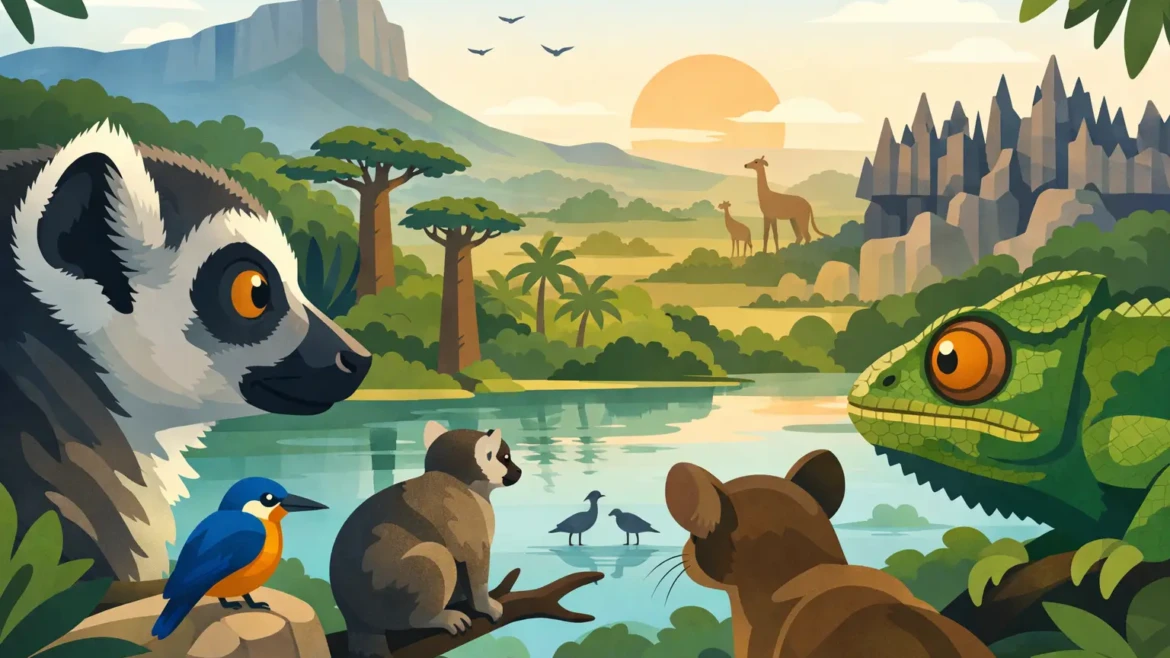
A night walk in Andasibe can change the way you think about wildlife travel. Your flashlight catches two orange eyes in the trees, a leaf-tailed gecko appears where there was only bark a second ago, and somewhere above you a lemur moves through the canopy with the kind of ease that makes the forest feel older than time. If you are wondering what animals see in Madagascar, the real answer is this: you are stepping into one of the most concentrated wildlife spectacles on Earth.
Madagascar is not a safari destination in the East African sense. You do not come here for huge herds on open plains. You come for endemism, for forests that hold species found nowhere else, for landscapes that shift from rainforest to dry spiny desert to limestone tsingy, often within a single well-planned route. That is exactly why animal sightings here feel so personal. They are not only abundant in the right places. They are deeply tied to habitat.
What animals see in Madagascar by region
One of the biggest trip-planning mistakes is treating Madagascar as if wildlife is spread evenly across the island. It is not. The animals you see depend almost entirely on where you go, what time of year you travel, and whether your itinerary is built around specific habitats.
In the eastern rainforests, travelers usually hope for lemurs first, and with good reason. This is where many classic sightings happen. Andasibe-Mantadia is known for the indri, the island’s largest living lemur, whose haunting call carries through the forest at dawn. Diademed sifakas, bamboo lemurs, and a long list of frogs, reptiles, and insects also make this part of the country incredibly rewarding. If your idea of Madagascar starts with misty forest and expressive primates, the east is often the strongest beginning.
Head west and the experience changes completely. Kirindy Forest is better known for dry deciduous habitat, nocturnal wildlife, and one of the best chances to see the fossa, Madagascar’s top predator. This region also pairs naturally with the Avenue of the Baobabs, where the scenery becomes part of the wildlife experience. Animals are still the focus, but the scale of the landscape gives the trip a different rhythm.
In the south, spiny forest creates one of the most distinctive ecosystems anywhere in the world. Near Ifaty or Berenty, you may see ring-tailed lemurs, Verreaux’s sifakas, radiated tortoises, and birdlife adapted to a harsher, drier environment. This part of Madagascar feels more exposed, more sculptural, and in some ways even more surreal than the rainforest.
Then there are the marine encounters. Between July and September, humpback whales migrate along parts of Madagascar’s coast, especially around Sainte Marie. Sea turtles, reef fish, and seasonal marine life make the island more than a forest-and-lemur destination. For travelers who want wildlife plus beach time, this matters.
The animals most travelers hope to see
Lemurs are the headline, but they are not a single experience. Seeing an indri in humid eastern forest feels entirely different from watching a ring-tailed lemur move across sunlit southern scrub. Madagascar has more than 100 lemur species and subspecies, and while no itinerary can cover all of them, the variety is one of the island’s strongest draws.
Chameleons are another major reason people come. Madagascar is home to some of the world’s most remarkable species, from tiny leaf chameleons to Parsons chameleons with their heavy, prehistoric look. Even travelers who arrive focused on mammals often end up fascinated by reptiles once they start noticing the detail – the textures, the color shifts, the camouflage that only makes sense when a guide points directly at it.
Geckos deserve the same attention. The satanic leaf-tailed gecko is one of the island’s most famous examples of natural disguise, but it is far from alone. Day geckos, often bright green with red markings, add a flash of color around lodges and forest edges. They are small sightings, but they stay with people.
Birders know Madagascar as a serious destination, and even non-birders often get pulled in. Ground rollers, vangas, couas, and fish eagles make the island unusually exciting because so many species are endemic. You are not just seeing birds. You are seeing a separate evolutionary story.
And yes, there are animals people do not expect. The fossa draws a lot of attention because it is elusive and unmistakably wild. Tenrecs, strange little mammals that resemble hedgehogs but are not closely related, surprise many visitors. So do the frogs. In the rainy season especially, the chorus at night can be every bit as memorable as the larger wildlife.
Why sightings in Madagascar feel different
What animals see in Madagascar is not just a checklist question. It is also about how you see them. Wildlife here often appears in layers. A forest walk is not about scanning a distant horizon. It is about slowing down and learning to read bark, leaves, branches, movement, and sound.
That can be an adjustment for first-time visitors. In some parks, the best sightings come from patient walking with an experienced local guide rather than from covering huge distances. A guide hears the indri before you do. A guide notices a gecko pressed flat against a trunk. A guide knows when fresh tracks in Kirindy might mean a chance at seeing a fossa near dusk.
This is one reason Madagascar rewards travelers who choose a structured route over trying to piece everything together on their own. Distances can be long, roads can be demanding, and timing matters more than many people expect. A park visited at the wrong hour, or squeezed too tightly between transfers, can mean a very different wildlife result.
Best places for wildlife based on your priorities
If your top priority is lemurs and classic rainforest biodiversity, Andasibe is often the most efficient first stop from Antananarivo. It is accessible enough for shorter trips and strong enough for first impressions.
If you want dramatic contrast, pairing the east with western dry forest gives you a much fuller picture of the island. That might mean Andasibe with Kirindy and the baobab region, or a longer cross-island route that adds more habitats.
If photography is your focus, it depends on your subject. Rainforest gives intimacy, texture, and moody light. The west and south often offer cleaner backgrounds, stronger sunrise and sunset conditions, and landscapes that add scale. Neither is better in every case.
If you are traveling as a couple or planning a more balanced itinerary, Madagascar works especially well when wildlife is mixed with scenery and downtime. A route that includes national parks plus a few nights by the coast often feels richer than trying to maximize species at every turn.
When to go for the best chance of seeing animals
Season matters, but there is no single perfect month for every traveler. The dry season, broadly from April to November, is generally easier for road travel and park access. That is often the safer choice for first-time visitors who want a broad itinerary with fewer logistical risks.
The rainy season can bring lush landscapes, active amphibians, and excellent reptile sightings, but some roads and parks become harder to manage. If your trip is heavily wildlife-focused and flexible, this can still be rewarding. If you want to combine several regions smoothly, dry-season planning is usually more straightforward.
Whale watching has its own window, mostly from July to September. Birding can peak differently depending on breeding activity and migration. Chameleons and frogs are often especially exciting when conditions are wetter. So the best answer is not just when wildlife is best, but which wildlife you care about most.
How to set expectations the right way
Madagascar delivers extraordinary wildlife, but not in a push-button way. You may not see every target species. Some animals are seasonal, some are nocturnal, and some simply require luck. That is part of the appeal. The experience feels real.
The upside is that even when a specific sighting does not happen, the setting almost always gives something back. A morning in the forest still brings calls, color, insects, orchids, and that constant sense that life here evolved on its own terms. For many travelers, that is what makes the island unforgettable.
At Travelers of Madagascar, we see this every season: the best trips are the ones built around realistic wildlife goals, smart pacing, and the right habitat mix. When those elements come together, Madagascar does not feel like a place where you chase animals. It feels like a place where the island slowly reveals them.
If you are planning your first route, think less about seeing everything and more about seeing the right things well. Madagascar rewards that approach, and usually far beyond what you expected.