
Andasibe‑Mantadia National Park – rainforest, indri, chameleons and accessible nature
Andasibe‑Mantadia National Park (often called Andasibe or Perinet) is one of the most accessible and iconic nature destinations in eastern Madagascar. Just a few hours from Antananarivo along the RN2, it protects a precious lowland and mid-altitude rainforest, famous for the powerful calls of the indri – the largest of the lemurs – and for its abundance of chameleons, frogs and endemic birds.
Made up of two sections – the more visited Analamazaotra (Perinet) and the larger, wilder Mantadia massif – Andasibe‑Mantadia National Park is the ideal place to discover Madagascar’s humid forest without straying far from the capital. Well-maintained trails, experienced guides and easily observable wildlife make it almost a mandatory stop.
Geography and landscapes of the park
Andasibe‑Mantadia National Park is located in the Alaotra‑Mangoro region, along the RN2 east of Antananarivo, near the villages of Andasibe and Morarano‑Gare.
- Total area of approximately 15,500 ha.
- Altitude ranges from about 900 to 1,250 m.
- Terrain of gentle hills, valleys and streams, with small lakes and wetlands.
- Climate hot and very humid, with frequent rain all year round; more marked rainy season from November to April.
Two main sections:
- Analamazaotra (Perinet): the most accessible and visited area, close to the lodges.
- Mantadia: larger, wilder and less frequented massif, about 20 km further north.
Together they create a typical eastern humid forest landscape, with wooded hills, waterways and small lakes surrounded by vegetation.
Trails and circuits
With a mandatory guide, Andasibe‑Mantadia offers many trails for all levels:
Short circuits in Analamazaotra (1–3 h)
Easy walks around lakes and clearings, ideal for seeing indri, brown lemurs and chameleons.
Other circuits in Analamazaotra (up to 5 h)
Longer loops that allow you to go deeper into the forest and away from the busier areas.
Circuits in Mantadia
Half‑day or full‑day hikes in a more primary forest, with fewer visitors and greater chances of observing shy birds and lemurs.
Night walks (on the edge of the park)
Guided night walks along the road or in dedicated areas to see chameleons, mouse lemurs, frogs and other nocturnal animals.
The trails are well marked but often muddy and slippery, especially in the rain.
Wildlife
Andasibe‑Mantadia National Park is best known for its indri, but it is home to a wide range of rainforest fauna.
Key species:
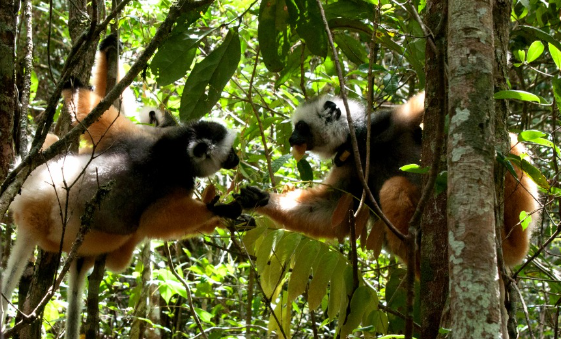
- Indri (Indri indri), the largest lemur, symbol of the park and relatively easy to spot
- Eastern bamboo lemur (Hapalemur griseus)
- Brown lemurs (e.g. Eulemur fulvus)
- In Mantadia: sifakas and other more elusive lemurs
- Large variety of humid forest birds, including vangas, drongos, couas and ground‑rollers
- Numerous chameleons (e.g. Calumma parsonii, Calumma gastrotaenia), geckos and non‑venomous snakes
- Rich community of rainforest frogs, with small brightly coloured endemic species
The calls of the indri at dawn are one of the most thrilling aspects of the visit.
Flora and vegetation
The flora of Andasibe‑Mantadia is a good representation of the low and mid‑altitude rainforests of the eastern coast:
- Dense evergreen forest: tall trees, closed canopy, lianas and thick undergrowth.
- Abundant epiphytes: mosses, ferns, orchids and bromeliads covering trunks and branches.
- Wetlands and stream banks: very humid vegetation, essential for water‑dependent frogs and birds.
- Forest edges and secondary areas: ferns, bamboos and pioneer species colonising old clearings.
This vegetation plays an essential role in regulating water, protecting soils and maintaining the cool, humid microclimate.
Ecological and cultural importance
Conservation
Andasibe‑Mantadia is a key site for the survival of the indri and many humid forest species; it is one of the best studied and most visited blocks of eastern forest.
Tourism and education
Thanks to its proximity to the RN2, it is an ideal place to raise awareness about deforestation, endemic fauna and conservation.
Local communities
The villages of Andasibe depend heavily on tourism (guides, lodges, crafts) and on regulated use of forest resources.
Conclusion
Close to the capital, rich in iconic wildlife and lush forest, Andasibe‑Mantadia National Park is the best introduction to Madagascar’s humid forest. Between the calls of the indri, the chameleons in the branches and the night frogs, it offers a complete and easily accessible experience of the island’s eastern biodiversity.