
Most travelers arrive on Nosy Be thinking mainly about the beaches. They exist, of course. Warm water, pirogues pulled directly onto the sand, and sunsets that slowly empty the bars and restaurants towards the shoreline every evening. But after a few days, the island starts to feel less like a perfect tropical postcard and more like a blend of fishing villages, old colonial buildings, fragrant plantations, and small scattered offshore islands.
There is movement everywhere. Cargo ships near Hell-Ville, now mostly called Andoany. Scooters weaving around pushcarts. The smell of grilled fish mixed with ylang-ylang as the humidity rises in the late afternoon.
The island remains alive beyond tourism – and that is probably why many end up staying longer than they planned.
Most travelers stay around Ambatoloaka, Madirokely, or further north towards Andilana. Ambatoloaka remains more lively in the evenings with beach bars and restaurants. Andilana feels quieter and probably has one of the most beautiful beaches on the main island.
But what truly makes Nosy Be special lies mostly offshore.
Brief History
Long before tourism, Nosy Be already held an important place on the northwest coast of Madagascar. The island was once called Nosy Manitra, the “Fragrant Island”, and was part of the Sakalava kingdoms that controlled trade routes across the Mozambique Channel.
Sakalava traditions remain very present today, especially around fady, the taboos linked to sacred sites. Several tromba ceremonies continue to be practised in various villages.
The French officially took possession of the island in 1841 and developed large plantations of sugar, coffee, cocoa, vanilla, and above all ylang-ylang, whose flowers became essential to the perfume industry. The nickname “Island of Perfumes” dates from this period, and some humid evenings still make it immediately clear why.
Old colonial houses remain inland, sometimes half-covered by tropical vegetation. Even Hell-Ville still retains visible traces of this period.
After Madagascar’s independence in 1960, tourism gradually replaced agriculture as the main activity. Despite this, Nosy Be still retains something quite raw. Power cuts, roads flooded after rains, and restaurants without fish because the boats didn’t come back.
Nobody seems particularly stressed about it, though.
When to Go
April to November generally remains the best time to visit Nosy Be. Drier weather, calmer seas, and better conditions for snorkeling and scuba diving.
Between June and September, humpback whales migrate through the Mozambique Channel.
Between September and December, the waters around Nosy Be become one of the best places in Madagascar to spot whale sharks.
Must-See & Must-Do
Nosy Komba remains the classic day trip from Nosy Be, with its black lemurs, villages and steep trails.
Nearby, Nosy Tanikely is famous for its coral reefs, clear water and excellent snorkeling with tropical fish and sea turtles.
Lokobe Reserve protects the last fragment of primary forest on Nosy Be. Humid heat, mud, and guides who can spot chameleons invisible to everyone else.
Further afield, Nosy Iranja is probably the most photographed spot in Madagascar, thanks to its huge white sandbank visible at low tide.
For travellers seeking more tranquillity, Nosy Sakatia and the Nosy Mitsio archipelago offer a quieter atmosphere and excellent scuba diving.
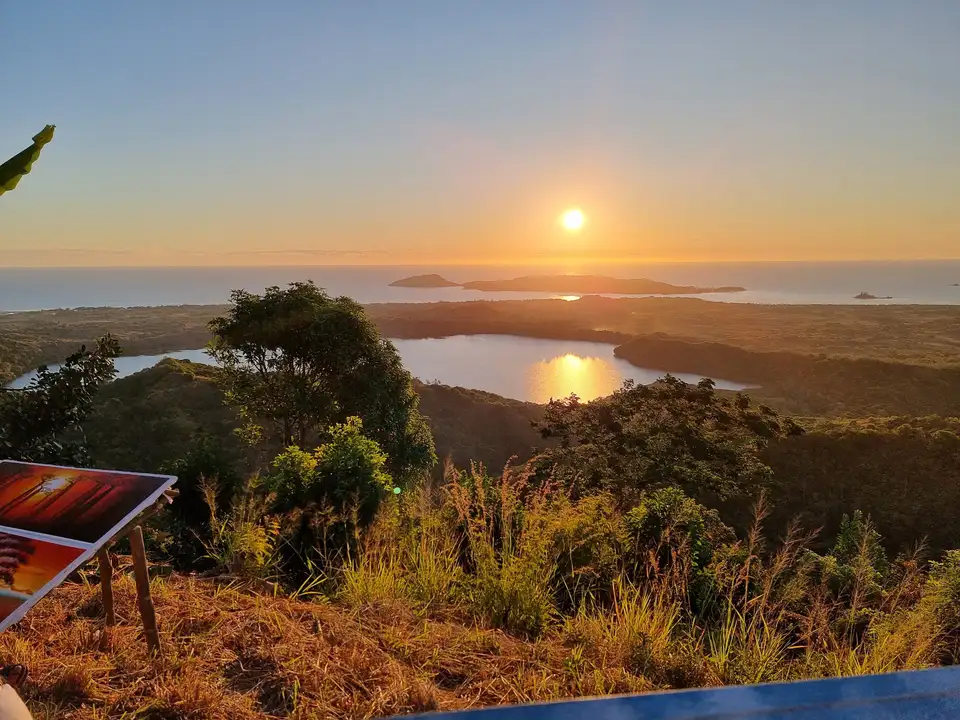
On the main island, sunset from Mont Passot remains a classic.