
Fianarantsoa: the intellectual, spiritual and wine capital of Madagascar’s Highlands
Perched on the edge of the central plateau, surrounded by terraced rice paddies and vineyards, Fianarantsoa is a city often glimpsed from afar: through the window of a bush taxi heading to Ranomafana, or through the windscreen of a 4×4 speeding south along the RN7. Yet for those who choose to stop, “Fianar” as the locals call it, reveals a world apart: a city designed as the second capital of the Merina kingdom, the cradle of Madagascar’s intellectual elite and the spiritual heart of the Highlands.
Founded in 1830 by Queen Ranavalona I, its name literally means “the place where one learns good”. Fianarantsoa was not born of a village that gradually grew; it was a political and urban project: a city built to strengthen Merina power over Betsileo territory and to serve as a southern mirror of Antananarivo.
From royal stronghold to capital of knowledge
In the 19th century the Merina kingdom was expanding southwards. To control the fertile, densely populated lands of the Betsileo, the court decided to establish a “twin capital” in the region. Fianarantsoa was thus born as a sort of Antananarivo of the South: a hilltop city, layered and endowed with strong symbolic value.
The choice of name was deliberate. Calling it “the place where one learns good” sends a clear message: from here would radiate laws, administration, language and the values of central power. It was simultaneously a military fortress, an administrative centre and a beacon of “civilisation” in the eyes of the Merina rulers.
Soon after its founding, another force deeply influenced the city’s destiny: Christian missions. While Antananarivo was the first major hub of the London Missionary Society, Fianarantsoa quickly became their main centre in the South. Protestant missionaries established schools and churches, soon joined – and even rivalled – by French Jesuits and other Catholic congregations.
This “holy rivalry” had a decisive consequence: Protestants and Catholics competed to build the best schools, seminaries and colleges. Over time, Fianarantsoa turned into Madagascar’s leading educational hub. For decades a large share of the country’s elite – priests, pastors, teachers, senior civil servants, intellectuals – was shaped in its classrooms. Even today the city boasts an exceptional concentration of high schools, religious boarding schools and faculties grouped within the University of Fianarantsoa.
Haute Ville: a time capsule at the top of the hill
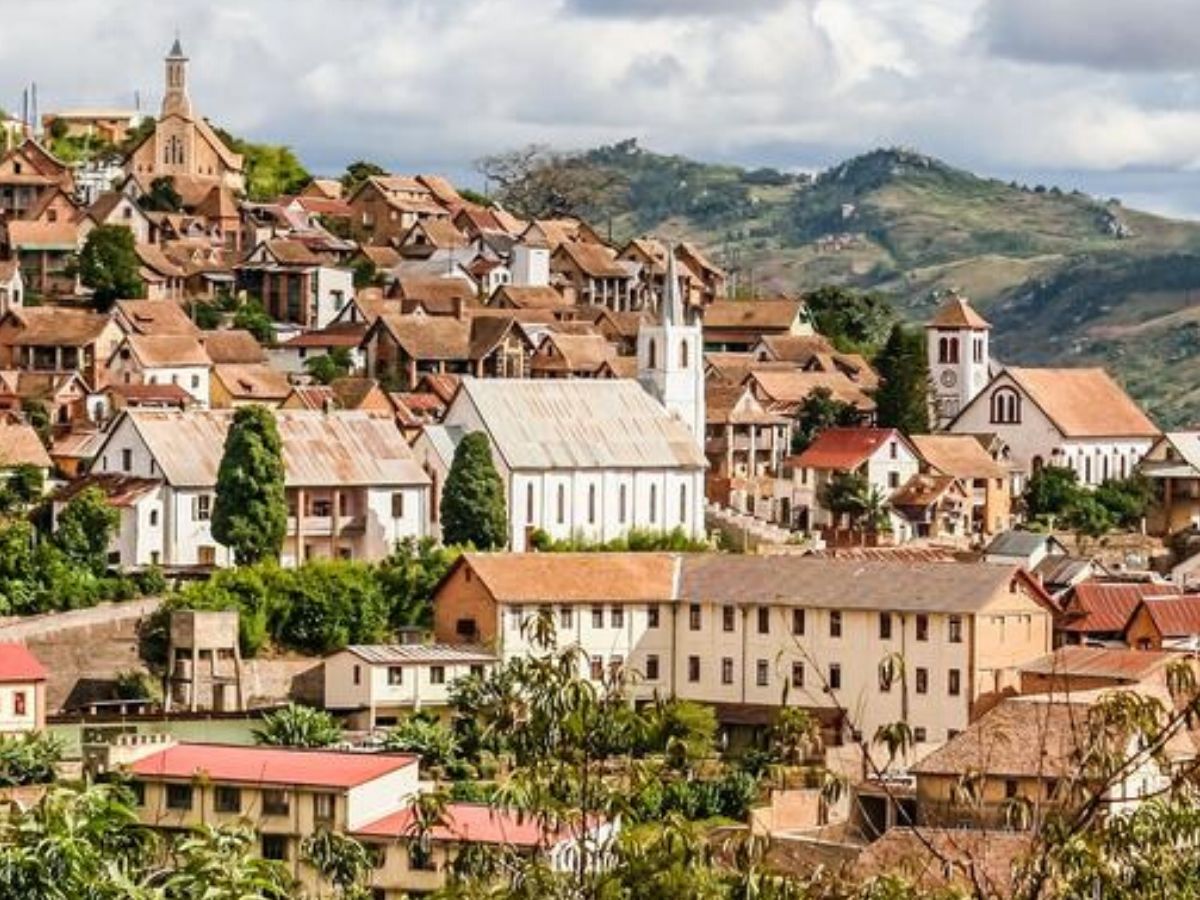
Fianarantsoa’s most visible treasure is its Haute Ville, the historic upper town. While Antananarivo’s old centre has undergone rapid modernisation, Fianar’s perched heart has surprisingly preserved its 19th‑century character. In 2008 it was even placed on the World Monuments Fund’s list of 100 Most Endangered Sites, triggering restoration projects and heritage awareness.
Reaching the Haute Ville means climbing on foot. Its streets are narrow, cobbled and often stepped, inaccessible to cars. Brick houses with tile or slate roofs, lined with wooden balconies and carved railings, crowd along winding lanes. Washing hangs from windows, smoke from hearths escapes from rooftops, voices echo between the walls: the feeling is of an ancient village poised above a modern city.
At the very top the massive Ambozontany Cathedral dominates the neighbourhood, an imposing red‑brick edifice that seems to watch over the whole region. A few steps away stands a substantial Protestant temple, reflecting the religious duality deeply embedded in Fianar’s history. This cohabitation – sometimes rivalry – between Catholics and Protestants has profoundly shaped daily life, local politics and education.
From the viewpoints of the Haute Ville the panorama is remarkable. To the west lie the newer quarters and the modern city; to the east the gaze slides over a succession of mist‑shrouded hills, behind which hide tea plantations and forests announcing Ranomafana. At sunset golden light sets the bricks ablaze and gilds the rice paddies. For photographers the combination of altitude + mist + old architecture gives Fianar a soft, almost medieval atmosphere.
Betsileo country: rice terraces, Savika and vineyards
Beyond its political and religious function, Fianarantsoa is above all the heart of Betsileo territory, one of Madagascar’s most numerous and most agricultural peoples. In the Betsileo worldview, land and farm work stand at the centre, as the landscape clearly shows.
Terraced rice paddies
Approaching Fianar by road, the traveller sees the valleys turn into true amphitheatres of terraced rice paddies. The Betsileo have sculpted the slopes into small steps held by stone walls, with canals and sluices meticulously distributing water. These hydraulic engineering works are not decorative: they allow rice cultivation on steep hillsides and make the most of every drop of rain.
Savika: wrestling the zebu
Another strong marker of Betsileo identity is Savika (or Tolon’omby), a form of wrestling or rodeo with zebu bulls. Unlike Spanish bullfighting, the aim is not to wound or kill the animal. During a Savika, young men face a powerful zebu in a dirt arena. The challenge is to grab the animal’s back or hump and hold on as long as possible while the zebu jumps, bucks and tries to throw them off. There are no weapons or banderillas: everything rests on strength, reflexes and courage.
Savika events usually take place at weekends or during festivals in villages around Fianar. They are not staged for tourists, so it is best to ask a local guide about upcoming events and attend with a companion, for both practical and cultural reasons.
The Betsileo “wine route”
Although Madagascar is not instinctively associated with wine, the Fianarantsoa region is the country’s main viticultural centre. Labels such as Lazan’ny Betsileo or wines produced by the Maromby monastery bear witness to the vine’s adaptation to these high‑altitude terroirs. Malagasy wines can surprise: often sweeter, more rustic or irregular than European vintages, they nonetheless reflect over a century of agricultural experience. Visiting vineyards and monasteries, discovering family cellars and tasting reds, whites or “grey” wines in the middle of the Indian Ocean is an experience as curious as it is endearing.
The FCE train: a lifeline to the east coast
From the lower town departs the Fianarantsoa–Côte Est (FCE) railway, one of Africa’s most astonishing rail lines. Built in colonial times, it descends the steep slopes of the plateau to link Fianarantsoa to the small coastal town of Manakara, crossing 48 tunnels and 67 bridges over 163 km.
Travelling on the FCE changes your relationship with time. The train is slow, old and breakdown‑prone. The journey can last from 8 to 18 hours, and punctuality is more a hope than a reality. But when it runs, the experience is unforgettable.
The FCE is not a luxury tourist train; it is a vital artery for dozens of forest‑locked villages with no usable road. Along the route the train skirts waterfalls, precipices, ravines and tiny stations lost in the jungle. At every stop, villagers rush to the windows to sell bananas, lychees, crayfish, peanuts, skewers, sambos (samosas) and spices. The train becomes a rolling market and a moving balcony over rural life.
Before planning an FCE trip it is essential to check the current state of the line with local operators or hotels, as interruptions due to breakdowns or landslides are frequent. If you are lucky enough to find it running during your stay, it is one of the finest slow‑travel adventures in Madagascar.
Surroundings: tea, forest and distant horizons
Sahambavy Tea Plantation
About twenty kilometres from town lies the country’s only large tea plantation: Sahambavy. The landscape suddenly changes: hills become covered with neat rows of carefully trimmed tea bushes, reminiscent of Sri Lanka or the Cameron Highlands. You can visit the tea factory, watch the withering, rolling and drying of the leaves, and inhale the green, slightly sweet scent of tea in the making. A lakeside hotel offers a peaceful setting for lunch or an overnight stay.
Ranomafana National Park
About an hour and a half’s drive east lies Ranomafana National Park, one of Madagascar’s most famous and a World Heritage site. Its humid forests, deep valleys and thermal rivers harbour iconic lemurs such as the golden bamboo lemur, along with a multitude of chameleons, frogs and endemic birds. A day trip from Fianar is possible, but spending at least one night near the park is strongly recommended to take part in the night walks essential for observing nocturnal wildlife.
Conclusion: the soul of the Highlands
Fianarantsoa is often presented as the intellectual capital of Madagascar, but it is also one of its main spiritual landmarks. It is a city where church bells ring out above misty valleys, where red earth produces both rice and grapes, and where the memory of the Merina kingdom, the Christian missions and French colonisation is inscribed in bricks, bell towers and rusted rails.
Access and best time to visit
The best time to visit Fianarantsoa runs from May to October, during the cool, dry highland season. At this time rains are less frequent, roads are generally in better condition and walks in the Haute Ville, vineyards, tea plantations and surroundings are more pleasant.