
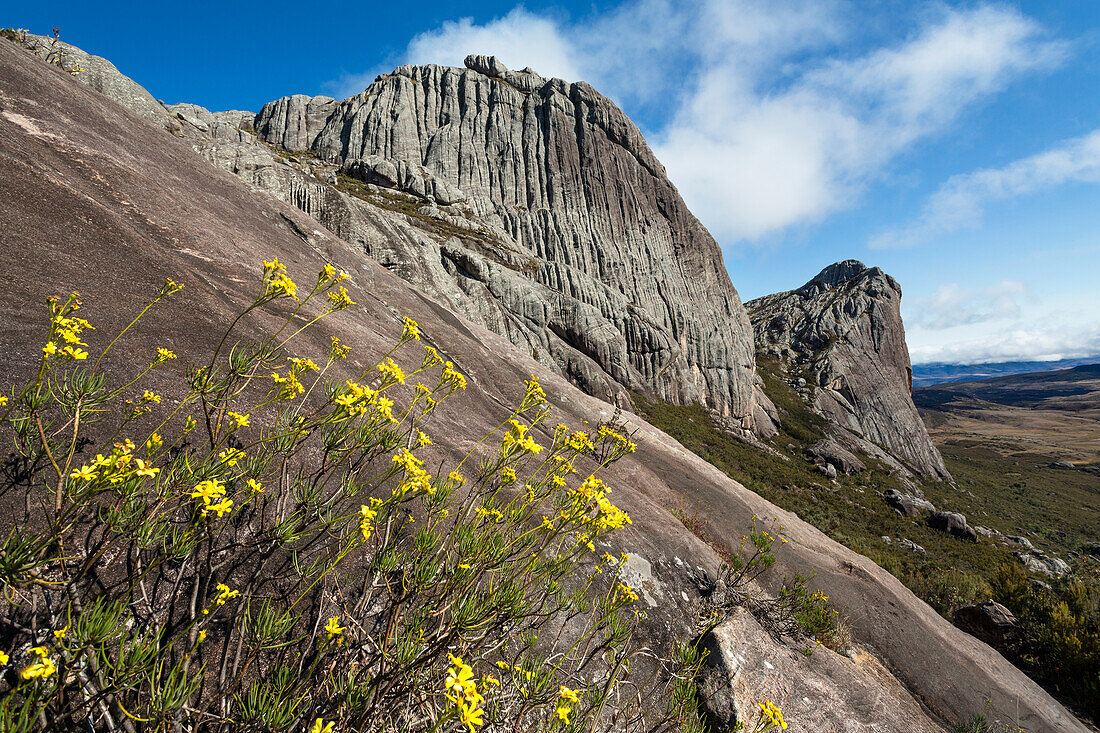
In the heart of the granite mountains of southern Madagascar lies Pic Boby, also known as Imarivolanitra, the most famous and highest accessible trekking peak in the country at 2,658 meters. The route crosses the Andringitra National Park, one of the most spectacular and wild areas of Madagascar, renowned for its granite cliffs, highlands, remote valleys and breathtaking mountain landscapes.
This is not a luxury experience. It is a real mountain trek. You sleep in tents or very basic camps, walk for hours through isolated landscapes, and wake up to cold temperatures even when it is warm in the lowlands below.
The scenery changes continuously: highland grasslands, enormous granite boulders, streams, deep valleys and rock formations shaped by wind and erosion.
Most treks start from the Namoly area, after leaving the RN7 near Ambalavao. A local guide is mandatory and highly recommended, especially because some trails can become difficult to follow in fog or bad weather.
Day 1 — Entry into the Massif
The trek generally starts early in the morning after meeting the guide and porters at the park entrance. The first hours cross open mountain landscapes between granite rocks and small streams. The ascent is gradual at first, but the altitude slowly begins to be felt.
As you enter the massif, the landscape becomes increasingly mineral and remote. It is not uncommon to meet zebu herders crossing the mountains with their herds.
After about 5 or 6 hours of walking, you reach the camp. Nights here can be very cold, especially between June and August. When the sun disappears behind the mountains, the temperature drops rapidly and the silence of the massif becomes absolute.
Day 2 — Ascent to Pic Boby
This is the most important day of the trek.
Departure is usually before dawn or very early in the morning to reach the summit in the best conditions. The trail becomes progressively steeper and rockier. Some sections cross large granite slabs and more exposed passages, although technical climbing experience is normally not required.
Reaching Pic Boby gives a real feeling of isolation. No infrastructure, no buildings. Just wind, granite and vast panoramas over the mountains of southern Madagascar.
At 2,658 meters, it is the second highest mountain in the country and the most iconic trekking peak in Madagascar. On clear days, the view extends over much of the Andringitra massif and the surrounding highlands.
After spending some time at the summit, you begin the descent to the second camp located lower down in the massif. During the dry season, the late afternoon light over the granite valleys is often spectacular.
Day 3 — Descent to the Tsaranoro Valley
The final day descends to the famous Tsaranoro Valley, one of the most impressive trekking and climbing areas in Madagascar. The landscape gradually changes as you leave the highlands and enter greener valleys dominated by huge granite walls.
The descent can be long and steep in some sections, but the scenery changes continuously. The great rock walls dominate the valley as forests, rice paddies and small rural villages reappear.
Tsaranoro is especially famous for its immense vertical walls, considered among the best big wall climbing destinations in Africa. Even for non-climbers, the valley is spectacular for its wild atmosphere and impressive views.
Arrival in the valley generally occurs in the afternoon, concluding three days of walking through some of the most remote landscapes in Madagascar.
When to Go
The best period for trekking Pic Boby is generally from April to November, during the drier season. Between June and August, the sky is often clear and daytime temperatures are pleasant, but nights at altitude can become extremely cold, sometimes near freezing. September, October and November often offer milder temperatures and greener landscapes while remaining relatively dry.
From December to March, heavy rains can make trails very slippery and significantly reduce visibility near the summit. Bring warm clothes: nights in the Andringitra are cold due to altitude and wind.
Good trekking shoes are essential. Some sections are rocky, uneven and slippery after rain. Trekking poles are very helpful during the long descents towards Tsaranoro.
Do not underestimate this trek. It is accessible to those with a good level of fitness, but includes long days and significant elevation changes. Even during the dry season, it is advisable to have waterproof protection because mountain weather can change rapidly.
Finally, do not expect comfort or constant phone signal. It is precisely this isolation that makes the experience special.